




 |
| Tuner Photo: Black Bear Pictures |
American director, Daniel Roher's narrative feature debut Tuner, is anchored by a compelling performance from Leo Woodall, who plays Niki White, a piano tuner suffering from hyperacusis, a condition that increases his sensitivity to sound and lowers his tolerance for environmental noise. Managing his condition with the constant use of earplugs, he works alongside his mentor, Harry Horowitz (Dustin Hoffman). Between them, they've built a reputation for being the best tuners in New York.
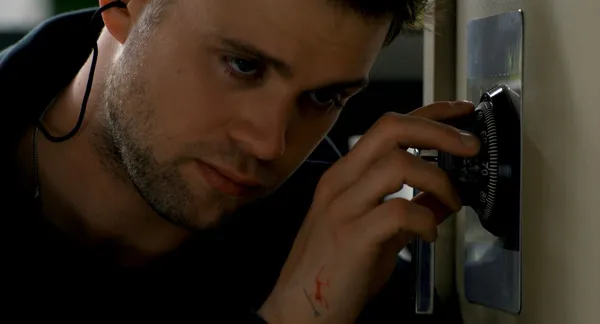
When Harry falls ill, Niki's desire to do right by him sees him lend his safe-cracking services to a heist crew. It's a decision that places him in peril and threatens to derail a burgeoning relationship with pianist and composition student, Ruthie (Havana Rose Liu).
Tuner’s score is composed by Will Bates, whose previous credits include the convent-set horror, Immaculate, the black comedy Dumb Money, which is based on the real-life 2021 GameStop stock incident, and The Sound Of Silence, in which Peter Sarsgaard plays a house tuner, who comes across a client whose home he can’t calibrate. Bates, whose work shifts between genres, has also composed for the episodic series Anne Rice’s Mayfair Witches, the Benjamin Netanyahu documentary The Bibi Files, and the HBO documentary The Inventor: Out For Blood In Silicon Valley, about Theranos’ founder Elizabeth Holmes.
In conversation with Eye For Film, Bates discussed his own roundabout journey, composing a score that shouldn’t sound like a heist film, and paying tribute to New York City. He also reflected on the joy of chasing the dragon, discovering freedom from the film’s visuals, and rubbing shoulder to shoulder with musical greats.
The following has been edited for clarity.
Paul Risker: Can you remember discovering the creative spark for music and composition?
Will Bates: I’ve been fascinated by film scores ever since I was a kid. I sang the whole score of Star Wars to my parents when I was 6 years old, and then they went out and bought me a violin that I was terrible at. The first record I bought was The Good, The Bad And The Ugly by Ennio Morricone. And when I started to understand that this guy, John Williams, had written all these melodies that I'd been humming as a kid, I knew I wanted to do that.
I've been in lots of bands, and I discovered the saxophone when I was 11 years old. I became good at that very quickly, and I played a lot of jazz in cafés and bars around London — I promptly closed most of them down. But really, film scores were always the first love. That has always been the thing that I've wanted to do, and I've taken a funny path to get here, but that's where I've ended up.
PR: Discovering one’s creative voice is a journey, and so, taking a roundabout way, experimenting with different types of music must have infused your repertoire with a unique sound.
WB: That’s very true, and that's partly why I've ended up doing what I do. For a long time, I thought I was going to be Cannonball Adderly when I grew up and then, at the age of 19, I discovered techno. I started writing a bunch of electronic dance music in London, putting out some records, then I was the lead singer of a band in New York for a while.
The only way I've known how to support myself is scoring to picture. I was scoring commercials and then eventually scoring some independent films in New York and finding movies that went to Sundance. But being able to have all of those experiences has definitely informed the way I compose. And it's funny, I was thinking about Tuner, which in a way has all of those things in it. There’s the saxophone and there's a cue towards the end that's very much me dipping into my old electronic dance stints past. Then, of course, there’s the piano aspect of everything. Sometimes you can't help but bring your experiences to a project — it’s sort of inevitable.
PR: There’s a jazz-like vibe to Tuner’s soundtrack that reminds me of Jean-Pierre Melville. Either that or early French and American crime films, with these super-cool, larger-than-life characters. To me, your score taps into this spirit.
AB: There's definitely a film noir aspect to it, and it is a heist film, but Daniel really didn't want it to have heist music. It needed that heartbeat, but I couldn't reach for the regular tropes. So, I had to find unusual ways of doing things. I guess the other part of it for me is that it's also a love letter to New York City.
I lived in New York for 15 years, and nothing says New York more than Wayne Shorter and the tenor saxophone. I was 18 when I first went to New York, and a hopeless romantic, I was driving over the Queensborough Bridge in the back of a cab, and I handed the driver a cassette of Speak No Evil. I said, “Could you play this while I smoke a cigarette out the window? I want this to be the way that I first come to this town.” Ridiculous.
That's why I ended up writing a lot of the melodies [for Tuner] on the saxophone, which is something I don't normally do. Even though I'm a sax player, I tend not to reach for that instrument too often. There's a bit of a joke in my house that the sax is the first thing that the director will kick out. "Yeah, it's really great, but just get rid of the popping sound, please.”
The night before Daniel and his editor Greg [O’Bryant] came over to my studio, I played the cues for my wife, Sarah. She said, “It's really great. These are lovely, but they're a bit saxy. He’s gonna kill it.” So, I replaced all the saxes with synths, and I played them to Daniel the following morning. He was like, "These are great, but I just wish they were a bit more human.” And so, I played him the original sax version, and he said, “It’s that. Why didn't you play that to me first?” I thought, ‘It’s complicated, man.’
I'm glad that we ended up with the horn, and it does have that noir thing you associate with it — it’s just inevitable. Everybody has a thing about that instrument, and I honestly think that's partly why so many directors have had me remove it, because you bring your own memories to it.
PR: Picking up on your point about the music being a love letter to New York, music can exist between the layers of the story, characters, and themes, communicating what is not necessarily seen.
WB: There's counterpoint with score and sometimes our job is to tell the story of something that isn't necessarily on screen. In the case of Tuner, we're trying to express Niki’s isolation and loneliness. That first melody, which we started calling Lonely Boy, was a very important thing to unlock. It gives us this sense of yearning for someone that has disconnected himself from society because of the condition he has and him having to give up on his dream. Music has the power to reinforce something that isn't necessarily there, and that's alchemy.
PR: The banter in the film’s opening scene between Leo Woodall and Dustin Hoffman is playful. It motivates the feeling that you wouldn’t want to be in the company of anyone but these two characters. I also noticed how the music cues in the early scenes play an important part in fine-tuning our expectations for what is to come.
WB: Those opening scenes are about to take you on a ride and that's what Daniel is trying to offer his audience. He said to me very early on that after making Navalny, he wanted to make something that he would be entertained by. He kept calling it a “movie-movie.” When the movie starts and there's that Herbie Hancock piece of music and then later on, there's that lovely Dave Brubeck track, you just know that you're being invited on a fun ride. And I don't think it disappoints.
PR: Watching Tuner, with the prospect of potentially interviewing you, I realised towards the end of the film that I’d failed to home in on the soundtrack as intended. Instead, I found myself pulled into Niki’s world and taken along for that ride.
WB: Sometimes the music needs to make a statement, but also, some of the best film scores are the ones that you don't notice. And the other thing about the way that this movie works is the sound design and the score are intertwined, especially during some of the heist scenes, and the safe-cracking sequences.
An important part of the process was going back and forth with Johnnie Burn, the wonderful sound designer, to really envelop you in Niki’s world. Everything needed to feel very much from his point of view, and that's partly why the score sometimes disappears. So, whenever I was doing something that felt like it wasn't entirely from Niki’s point of view, Daniel would just say, “Nope, his POV, man. Let's go back.” It's a really important aspect of the storytelling.
PR: Thinking about the music and sound design being in conversation, the score is also interacting with pre-existing music. And in some cases, notable pieces of music.
WB: There was a lot of jazz in the script when I first read it, and obviously, in the opening. When I first started talking to Daniel, I think I got the gig because I suggested what it would sound like if Bill Evans had access to all of my modular synths and toys. Daniel said, “Yeah, do that.”
The score is definitely informed by a lot of those choices. I remember the first cut because sometimes they use a temp score while they're editing — stuff that they're not necessarily going to clear or they're going to replace. I watched the first cut and thought, ‘Man, you're never gonna get Herbie Hancock, that’s crazy.’ And then, 30 minutes into the movie, he's on camera.
So, yes, the music is a narrative, and some of those pieces I've known almost my whole life, and it's a real joy to be able to run up against them.
PR: Is the way in which the images, dialogue, music and sound design interact, a metaphor for the broader creative process?
WB: All of it is working in concert together. And finding that piece of music, even a melody or chord sequence, which I call a 'eureka moment' is a direct response to something that I've just seen or read. The one thing couldn't exist without the other, and the joy of discovering that thing is chasing the dragon that we composers are always doing.
PR: Is that moment of finishing a film, when you’re done, and you can no longer tweak it a surreal experience? And are you still processing the work for a period of time afterwards?
WB: It never really leaves you. Every project leaves you feeling differently, and I tend to just jump straight into the next. Once the movie's finished and some time has gone by with the movie selling, going to festivals, the release schedule being announced, then talk about the album begins. And it's lovely to go back and revisit the music and make the record.
You're talking about the visual and the music being such an intertwined thing. Well, it’s an interesting exercise to remove it from the visual and just have the album exist on its own. So, that's a fun like sorbet at the end of a project, where you go back to the music and you don’ have to be beholden to the image quite as much. This is something that I'm doing with Tuner right now — we’re about to put the album out.
Tuner is out now in UK and US cinemas.