




 |
| Holy Days Photo: Blue Fox Entertainment |
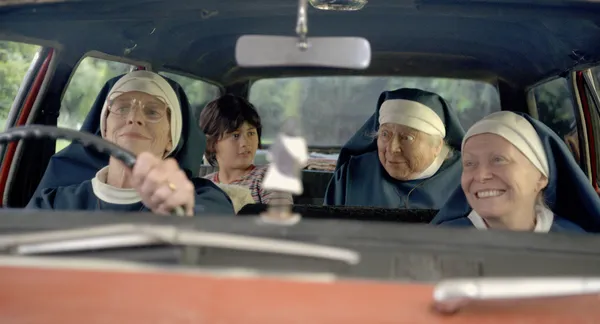
New Zealand director Nat Boltt’s Holy Days is an adaptation of Dame Joy Cowley’s 2000 novel of the same name. It follows three nuns, played by Miriam Margolyes, Jacki Weaver and Judy Davis, who take an impromptu road trip from north to south New Zealand. Along for the journey is their most devout parishioner, a young boy named Brian (Elijah Tamati). They’re on a mission to find their lawyer and recover the deeds to the convent because the priest and bishop are both eyeing up selling the land to a local developer.
Speaking with Eye for Film, Margolyes, Weaver and Boltt discussed creating a comedy with emotional and thematic depth, and nurturing an insightful perspective on death.
Paul Risker: How would you choose to describe Holy Days?
Nat Boltt: Holy Days is a feelgood film that is designed to bring people together. It's a community building road trip down into 1970s New Zealand that has been likened to Hunt For The Wilderpeople meets Little Miss Sunshine.
Miriam Margolyes: So much of life today is ghastly — war, misery, lying and people dying. And this is a film that gives you a little bit of hope and lets you know that there are people in the world that can make things better, that we can achieve something heartwarming and decent together. So, it’s a very wholesome film about decent and good people. And it's very clear who is evil in it, you don’t have to work it out, and I like that.
Jacki Weaver: Well, I always say I like films that echo real life and in real life we're crying one minute and laughing the next. I love a film that can make you cry and make you laugh. I think they're the most truthful, and they touch your soul more than just an action film or others will. I love all sorts of films, but my favourites are the ones that show real life — be it sad or happy, interesting or dangerous. And this film's got all of that.
PR: In a time when we’re losing our grip on nuance, is Holy Days trying to protect and nurture that?
MM: It is a nuanced film; it’s not a simple film. It shows the challenges and the cruelties of life, and the warmth of life, too. I think that's why it's going to reach a lot of people and give them joy.
JW: Most people have experienced emotional pain, and so they can identify with that pain in this film, and also the optimism and the spiritual nuance. Even if you're not religious, there's a wonderful spiritual component, especially from the New Zealand Māori people. Even though it's being sold as a comedy, it's quite a deep film in parts. I think it covers the waterfront.
NB: I can tell you a little anecdote of how I came to want to write the film. My son was three, and he was just grappling with the realisation that people die. There is that moment in a child's life when they are told this. So, he was horrified, and then he thought about it a little bit, and he said to me, “Can we die together?" And that's even worse. I thought, what is it we can say to kids that might comfort them? And this book is about that, and it’s what ties me to Joy, because there's a line in the film that says, “There’s no such thing as gone”, and that's all we can really offer. People do die; we are all going to die. No one gets out of here alive. But there is a part of us that stays connected, and I hope that this film can bring some comfort to all those who are grieving and are facing their own mortality.
PR: Death is often spoken of in a literal sense, but it’s present in our lives beyond the literal, especially the metaphorical death as we transform time and again on our own personal journeys.
JW: When you get to mine and Miriam's age (we're very similar in age), you know more dead than living people, and they never really get out of your head. I'm not saying we see ghosts, but they've been a part of your life, and they still are, even though they're deceased.
NB: I think that's such a good point — they have affected you in some way. Whatever your belief is, you have been touched and affected by all the people that you've known and loved or spoken to. What I wanted to write into the script and why I loved it being compared to Little Miss Sunshine, is that at the end of the journey, the older characters have learned as much about death as the young character. In fact, maybe the little boy teaches the nuns more than they teach him, because he's got a different take, and he's closer to it in another way. That sort of layering and nuance is what I like to play with.
MM: It's a moving film. I suppose we're all on different journeys and this was a journey that we as actresses took together. And it's a journey that the characters obviously took together, and good things came of it. I feel comforted by this film.
Many of the films that I've done have been rather grisly, and this is absolutely not that. All of human life is there, like they used to say about the News of the World, that rather shocking newspaper [laughs]. It's about human beings being very human.
Holy Days releases in US cinemas nationwide on 27 March.