





Eye For Film >> Movies >> Cruel Tale Of Bushido (1963) Film Review



Cruel Tale Of Bushido starts somewhat unusually for a jidaigeki film. No swords, no samurai, no period costumes; an ambulance, sirens blaring, speeds through a city, its headlights cutting through the night.
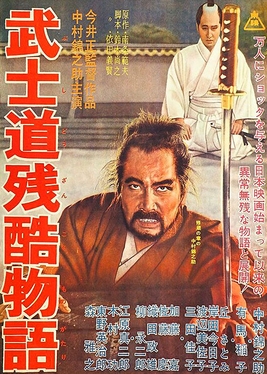
The salaryman Iikura (Kinnosuke Nakamura) finds his fiancée Hitomi Kyoko (Yoshiko Mita) lying in a hospital bed, a failed suicide. He ponders the reasons why she could think their relationship over. He still loves her. After his mother's funeral he found a family history dating back to the start of the Edo period. As he replays the history in his head he comes to understand the trauma that he has inflicted on Kyoko.

In his imagining of the history Iikura is an incarnation of each of his six ancestors. Each is played by Kinnosuke Nakamura. Each of these men falls to a cruel fate as a consequence of following the warrior's code. The first is Jiroza’emon, a ronin raised up to a position of importance. Due to an obvious tactical error during the Siege at Hara Castle, he and several other important samurai would fail to protect their lord. To prevent dishonour falling on these other men, he performs seppuku. Saji’emon, his son, torn between the duty to protect his lord and the duty to obey him, falls into disgrace. On the death of the Lord he also performs seppuku, to honour him.
Lord Tambanokami Munemasa Hori (Masayuki Mori) becomes infatuated with the third, Kyutaro. He has him brought to his chambers. Kyutaro thinks that the Bushido teaches that a samurai should be joyful to serve his master in all things, even being repeatedly raped.
Shuzo is a master swordsman in the service of Shibiku-Shosuke Yasutaka Hori (Shinjirō Ehara). Honour first forces him to give up his daughter to his lord's schemes and then to hand over his wife Maki (Ineko Arima) for his pleasure.
It is the beginning of the Bakumatsu. The Shogunate is over and western culture is encroaching on Japan. Shingo, no longer officially bound, is taking care of the former lord Takafumi Hori (Yoshi Katô). The man is in a mentally distressed state, having been imprisoned for decades by his brother. After Takafumi sexually assaults Fuji (Satomi Oka), Shingo, following the code, does something unconscionable.
The final cruelty: Iikura's older brother Osamu, a kamikaze pilot, suffers another pointless death in the name of honour.
Cruel Tale Of Bushido was directed by Tadashi Imai, who at the time of its making and until his death was a member of the Japanese Communist party. The film has an obvious leftist take on some of the many problematic aspects of Bushido. It criticises the pointless, suicidal scarifies in the name of honour, and the absolute respect for authority no matter how abusive, corrupt or foolish. With the tale of the salaryman Iikura it is shows the legacy of Bushido playing out in Japanese corporate culture. Iikura places loyalty to the company, the house, above both morality and his own family. The code and the myths that surround it are, in the 1960s, still a means of control. Obedience is honour.
Tadashi Imai is an excellent director of both character and action, but what really stands out in Cruel Tale Of Bushido is the way he frames suffering. He forces the viewer to look at the pain and misery in a character's face. He makes it inescapable, beautiful and horrific.
This film displays Kinnosuke Nakamura's acting abilities to the full. From the salaryman to the six other characters, he has to establish the character and gain the audience's sympathies whilst being convincing in the role. Every time he has to switch roles he has to overcome what he has previously built up in the eye of the viewer. The other members of the cast do an exemplary job. They also have to establish characters and engage the audience in mere minutes.
Reviewed on: 23 Mar 2026


Director: Tadashi Imai
Writer: Norio Nanjo, Naoyuki Suzuki, Yoshikata Yoda
Starring: Kinnosuke Nakamura, Eijirô Tôno, Kyôko Kishida, Masayuki Mori, Yoshiko Mita, Ineko Arima
Year: 1963
Runtime: 122 minutes
Country: Japan
Festivals:
Search database:
