





Eye For Film >> Movies >> Below The Clouds (2025) Film Review

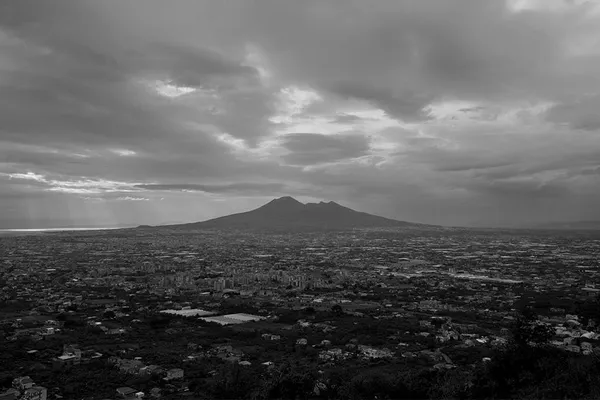

Gianfranco Rosi’s Below The Clouds (Sotto Le Nuvole, Venice Special Jury Prize winner and a highlight of the 63rd New York Film Festival) begins with an epigraph by Jean Cocteau: “Vesuvius makes all the clouds of the world.” It is a fitting send-off into the enchanted and very real realm of Gianfranco Rosi’s marvellous new documentary. Mount Vesuvius and the region of Naples below is the setting, but the apprehensions of tremors that could foreshadow catastrophe, though heightened there, are universal. The clouds in black and white (as is the entire film) and the mystical fogs swallow up distinctions of time. The great disaster that destroyed Pompeii in 79 A.D. lives equally in the past as in the future. Set in the in-between, the now includes both and is limited to neither.
An old regional tram can encroach like a monster at night and resemble the calm orderliness of the trains and stations in the films of Yasujirō Ozu. A woman in a white lab-coat studies her friends, antique statues in a vault, like a Dr. Frankenstein inspecting a head and commenting on the wonderfully graceful coiffure set in stone.
As he did in Sacro Gra and Fire At Sea, all the way back to Boatman, Rosi expertly paints a picture of a community with all its widely varied facets. The local fire department, extraordinary in word and deed, is first shown in action in the tunnels aiding an inspector investigating grave robbers ransacking the treasures hidden underground and often under abominably dangerous conditions. A find of boxes of medication that is not yet expired mean that the thefts were recent.
At the department’s call center we get a sense of what they deal with night after night. A child makes a prank call, old Mr. What-Time-Is-It checks in, and numerous scared callers wonder if the small and large tremors and earthquakes are possibly tied to Vesuvius. The dispatchers have a great sense of humour. You want to listen all night.
At the Pompeii archeological site, near where the tourists stroll in amazement and marvel about life stopped mid-action, a group of Japanese scientists from the University of Tokyo is busy with an excavation project. An antique dealer and bookseller hosts after-school tutoring sessions in his store where he helps local kids with their varied homework. English, French, history, how to prepare lasagne, the fact that 3x3 is definitely not 8, and Victor Hugo’s Les Misérables, Mr. Titti does it all and the children clearly appreciate his knowledge and care.
The quakes, the white smoke - in one second life can be altered forever. The Syrian merchant marines who transport Ukrainian grain from Odessa to Naples on a big tanker know this. War and peace, back and forth they go. Rosi shows two of them working out in the boat’s gym, steeling their bodies for what is to come. The silent workers, who without masks stand on the pyramids of grain to dust off the silo sides with hand-brushes, know it as well.
In a cinema, long out of business, it seems, Rosi projects documentary footage that tells of the region’s history. Suddenly the images look familiar and the faces of George Sanders and Ingrid Bergman make it clear that we are taken on Rossellini’s Voyage to Italy for a moment.
Lava, volcanic ash, the sea, the waves. Two horses pulling two small carts with two drivers along the beach, ancient and always. There is a statue of Lakshmi that travelled long ago all the way from the East to commiserate with Aphrodite about their tough work as fertility goddesses.
32,000 tons of Ukrainian grain arrive. 12 frescoed walls were stripped off by robbers after they had survived for over 2000 years. Now they are gone from memory. The mist of time. A procession with pilgrims. A traditional image of arranged legs that could have inspired Busby Berkeley. Some believers climb the stairs on their knees, some slide sea lion-like on their bellies, customs intact.
The cinema shows us a silent film about Pompeii, re-staging the ancient trauma. A mysterious room where all the remnants of the past are piled up, mixed together in overlapping time. Is that what memory is? Accumulation of history, preserved underground. Stone heads on one side, bodies on the other.
A kitten is stuck in a tree. A woman is afraid her husband will kill her. The officer at the fire department who takes the call is experienced; he stays calm and tries to help as best he can.
Suspended in time, the little train rattles through the night, empty, elegant, swerving. Dust particles float and glisten. Could this be a clip from Hiroshima, Mon Amour? No, we are underwater and the flecks form clouds above a mosaic. A statue is holding a bowl, as if to catch each tiny piece as an offering to us.
Reviewed on: 26 Sep 2025


Festivals:
Venice 2025Toronto 2025
New York 2025
London 2025
Black Nights 2025
DOC NYC 2025
Palm Springs 2026
TIDF 2026
Search database: