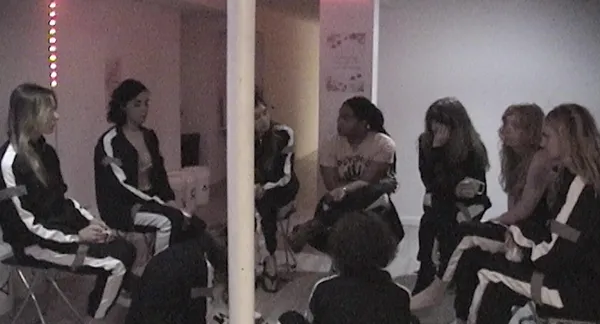
 |
| Castration Movie Anthology II: The Best Of Both Worlds |
The term ‘cult film’ is always a contentious one, but some can’t be described any other way. With its latest instalments screened as part of BFI Flare, Louise Weard’s Castration Movie is a vast, rambling construction which nevertheless makes precise points and never outstays its welcome. Like a gender-focused Heimat, it just keeps on growing, following a series of subtly connected characters through awkward stages in their lives, from break-ups and identity crises to radicalisation and an attempt to flee a cult. I was delighted to have the opportunity to speak with the director, and began by asking if the project developed organically or if she has always had a conclusion in mind.
She laughs. “We did our Kickstarter for the second movie about a year ago. At this time we thought ‘Okay, we've already shot six hours of movie. Certainly the movie can't be longer than, like, 12 hours.’ Boy, were we wrong! I was being conservative and thinking that we would wrap everything up within another six hours, five hours of film. I think I put the little title in, ‘The first half of Louise Weard's Castration Movie,’ when we initially put the first movie out, and then updated it once we realised that wasn't going to be the case.
“The movie just keeps getting longer. Not through addition so much as, like, the scenes themselves are so much more expansive than they initially come across. I can write something that's one sentence in my treatment and then it's a 40 minute scene. I think it was wishful thinking that we would wrap this up in time.”
It's an intriguing process because there's a lot of improvisation but there's some really tight writing in there as well.
 |
| Castration Movie Part II |
“I like to call it collaborative writing, where me and the cast do a lot of really in-depth character work,” she says. “Where I have an identity for a character and we begin from this rough sketch and we really deepen it by pulling in things that the cast member connects with. Sometimes it's the actor’s insecurities where we play into some sort of shadow self with some of their anxieties, and put their insecurities into this character. It's a different process for everyone, but once we've got that character really built up and we decide to actually go into the scene, it's really interesting.
“It’s very loosely written where the main focus is on the blocking and embodying the characters in an environment or in a space. We get into the location and we just walk through it a lot. I'll throw out lines. I'll go ‘When you get here, you say this,’ or ‘You're going to respond in this way.’ And then usually I'll pull all the actors aside separately and give them very private blocking notes. Like ‘Hey, if this comes up, I want you to respond in this way.’ I give them lots of little notes, secret from the other person, so I can inject additional spontaneity into the mix.
“I don't like to think of it as improvisational in terms of, like, we're just dropping people into a scene. It's more this very collaborative writing process where we can add to each other's ideas. Someone might come up with a really funny line on the day, and we'll go with that, but it is all very tightly structured and tightly controlled. By the time we get into that space, we've done so much prep and we are solid enough in where we're at in the story and what we need to get out of a story that it is quite clearly guided.
“I really want to lean into an acting style that I consider very reactive, because I feel like it's a very realistic performing style, to try to keep people in a natural element. For me, a lot of the secret sauce and the performances I want to bring out is really coming from the natural pauses that come from human speech patterns and the way people are actually thinking about what's being said to them and how to respond. For making a film that can go into such weird and outlandish places, starting with that sort of acting quality helps ground it in a sort of realism the whole time. It's a little bit uncinematic, but I think that's what draws me towards doing it. It’s a very uncinematic project.”
I mention that I’m impressed not just by the quality of the performances but by the way she’s managed to get the same tone to all the performances across such a large work. Did that come from working with the same group of people over time?
“No, actually, I think every single actor in these movies is someone I'm working with for the first time, with the exception of Cameron Petersen, who plays my character's boyfriend in the first film. He's an actor who I've worked with for over 10 years. But [they’re] all from similar artistic backgrounds, like in Vancouver, or people who I've met on the Internet who were exploring similar themes to myself or similar artistic styles or forms that I found interesting. So we had been in touch. I would say that even [with] people who I had never collaborated that directly with before, it was still within this environment of artistic creation where we had stuff in community with each other as artists.”
That first part seems relatively safe – few people are going to have a problem with critiquing an incel – but as the story develops, it takes on themes that a lot of people, including trans people, will find uncomfortable. Has she had any pushback on that?
“It was really interesting. I think that the only time pushback came up was that a big part of my character in the first movie and around making her unlikable came from the idea that she's got a very toxic relationship with the Internet and this has maybe instilled some right-wing leanings,” she says. “The way that I wanted to show that visually was her wearing this Nazi paraphernalia while she's having sex with her chaser boyfriend. That was the only thing that was ever a conversation with other cast members. It wasn't even the people involved in shooting or acting in the scene. It was cast members who were in completely separate parts of the movie.
 |
| Castration Movie Part II |
“This was the very early stages of shooting before, I think, the team trusted what the reception was going to be. My big push was ‘No, I think the audience is going to understand what we're going for with this.’ It's not just shock value. We have a very deep philosophical and ideological reason for why we wanted to pick this and why we want to explore a character like this. We talked through those things, but it was definitely a conversation early on because until Castration Movie existed, there was nothing like Castration Movie for a lot of the people who were involved.
“I come from a transgressive film background, an underground film background, so I don't think I'm really breaking new ground in any way personally, but a lot of the team coming on who didn't have that same relationship to that type of art, especially that type of art in queer spaces. Personally, it can feel quite rough to approach some of the themes we're doing in the movie. I think that by this point I think it's really interesting because the collaborators I have really understand what Castration Movie is as an artistic project. So the interesting thing is now it's reversed.
“My primary goal is to have that conversation with the audience and see if I can keep pushing them further with these exercises around empathy. I think it's fascinating where we start with this movie, where the first chapter, Incel Superman, follows the default archetype of cinema, which is the white cis heterosexual male in their mid-20s, 30s – this very stock character doing the sort of rise and fall story that we've seen before, just in a very minimalist way and very much attuned to this modern zeitgeist. I don't think it's a stretch to present that character. It's a very standard type that we see in cinema and especially American independent cinema. So then that leads the audience in to what we're doing.
“Then we hit them with chapter two, where my character, Traps, is similarly unlikable, occupying some of the same negative behaviours as this other character. So we've kind of trained the audience to empathise with this character that represents that default film persona, and now we're adding the trans element, we're adding the queer element. We're making all these choices that I think are so great in how for an audience which is not super familiar with the trans experience.
“They get this new angle at which to view transness, which is this rejection of the tourist gaze where we're seeing the trans body as this normalised thing, and we take our time with that character. Whereas with a trans audience member – obviously these movies are made especially with a trans audience in mind – I think that they're going to feel a great level of connection and reflection in those characters. It's not like a positive depiction, but it is a depiction of a community that is very much diverse and not monolithic. Our cinematic presentation has been, you know, anything but.
“I think it's an interesting thing to blow up what that representation looks like. And then we flip it with the New York section in exploring this interesting dynamic around detransition, where we're trying to heal these detransitioned characters and create this nightmare situation that takes all of those anxieties and insecurities of the second chapter and kind of turns them into a nightmare come to life. And then now with the new film, we take that a step further. We're leaving that trans subjectivity that we've been in for the previous two chapters, and we're now going into anti-trans subjectivity and exploring a character’s radicalisation to the opposite standpoint around trans rights.
“To me, I think that's going back to what I started this conversation with. It's trying to challenge the audience in a way. It's definitely not trying to push people away, but I think that as a transgressive film exercise, and to hit these overall themes – that universal human empathy and the lack of it in the modern world – I think it's an interesting experiment to see the limits to what cinema can do.
“Am I going to have a trans woman in the audience who says that they couldn’t for even a moment sympathise with the terf character, or vice versa? That’s the interesting goal of these projects. We're setting up these problems around people's lack of empathy with each other, and really focusing on gender as a linchpin moment for the current cultural zeitgeist, but it's a much more broad exploration of that than the way the internet shapes language around our ability to relate to other people in our communities.
 |
| Alex Walton in Castration Movie Part II |
“The goal is to try to not to be didactic. By setting all these characters up, we can then learn what the off ramps look like and try to see, you know, how do you come back from some of these really dark places you can end up in? If the project's successful, it'll rely on whether or not we can give a point to all of these different character journeys that we're expressing as reflections of each other.”
There's an idea amongst some outsiders that trans people are in a cult, which is actually going on in the second film. It’s interesting, I suggest, in parallel with the storylines about incel and anti-trans radicalisation, which we see in real life.
“It was really funny because I think that the whole trans cult idea came out of it backwards,” she says. “The goal with that third chapter, Polygon!!!! Heartmoder, was to write a story backwards from the point of that moment on the train with Keller and Circle. Having both these detransitioner characters and trying to think, how do I get to a point where we have that sympathetic, conflicted, but loving relationship to those characters? How can I write a story where I can have the Keller character come in and convince this other character to detransition and for them to be sitting together on the train and for the audience to feel this conflicted emotion where there's a positivity to it, but it's also this negative image at the same time?
“It's that idea of empathy. It's like, I don't agree, but I can see their side. I can understand why they've made this choice. It's that level of understanding and compassion that I wanted to end up with. So in order to make a character like Keller, in order to humble her in the eyes of the audience and make sure that the relationship would be accepted, I had to come up with something as cartoonishly crazy as a trans cult. But then by going through that, we started building up this trans cult idea. It's so fun: this literal terf talking point come to life.
“This has been a running joke with that movie in general. On its surface, to explain the plot of that movie, it sounds like a right wing film. It sounds like Reefer Madness or something, but about trans people. And I think that's definitely the point. It's taking something that's almost camp in itself, in its level of being ridiculous, and, through the performing and the running time, we bring it back into this tone that's in line with the other movies. It was a very unique challenge to get us to that moment on that train and nailing the tone I wanted to have for that scene.
“I also wanted to make sure that themes come across where she chooses to detransition, but all these other girls who are in this toxic environment are able to go forge their own community in different ways and find their own purpose. I think that's part of the reason why these movies are so long, because I'm trying to think through the political and thematic and narrative implications of every choice and then trying to make sure I'm addressing every side of the polygon. I want to make sure I fill in enough of those gaps that when we discuss what these movies are saying and doing, there's like a lot of fodder for analysis.”
There’s an earlier shot at a party, which is split screened. Keller is being quite dynamic in one part of it, and one would think that one’s eyes would naturally be drawn to that, I venture; but I found myself looking at Circle throughout because Circle just looks so unhappy. There’s a huge amount going on just in the face in that shot, and some of that seemed to be reflected in the train shot, so it left me wondering. Keller seems completely comfortable and sure of who she is, but Circle doesn't. I didn't feel that Circle was conclusively anything at that point.
She nods. “I think that even with Keller, it's so debatable because even though she's got a very strong outward personality, she has a degree of insecurity around her gender where, you know, if she was really comfortable with who she was, she wouldn't feel the need to constantly position her identity in this oppositional way where it's all always ‘Well, I used to be non binary,’ or this sort of thing. Obsessing over this thing is unhealthy and clearly speaks to her character having her own issues around it that have not been solved yet.”
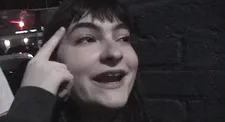 |
| Ivy Wolk as Keller |
It seemed curious language to me, I note. ‘I used to be non binary,’ as opposed to ‘I used to present myself that way,’ or ‘I used to think of myself that way.’
“Yes. And that whole chapter to me is revealing the silly ways in which we try to have the language around identity cleanly package ideas around gender. That whole scene, that's the centrepiece of the film, where we go from. There's these two great moments where we have the scene where they're asking these random guys ‘Is my friend a boy or a girl?’ They can't even come up with a definition of anything. It's so nebulous and everyone's bringing their own ideological goals into it.
“We're very clearly seeing that the way this question is framed and constructed and answered is very context-based, and given a lot of drive behind where these unique people are coming from and meeting in this moment. And then we follow that up with the scene where they meet the other detransitioner character, Brody. We get this long moment where Keller's trying to interrogate and get this information, and you have Brody just trying to change the subject and take it in any other direction.
“Both of them are very much so meant to horrify the audience around the cringiness and social faux pas around trying to make these conversations around gender a core part of your identity. I think that it's presented in a comedic way enough within Castration Movie 2. Whereas in the new one coming out, when we get into these conversations that Izzy is having, which are the exact same sort of conversations around gender and this very dehumanising language that's being used, it's not funny anymore. There's very little humour to that chapter. I think it's great because of Izzy's appearance in the New York section when she's Keller's character's roommate.
“You have Circle being tortured in this cult that she tried to escape from, and this is horrifying in its own way, but then we cut to Izzy and Keller having this conversation which is equally as violent, if not more so, or more disgusting than the much more direct horror we're experiencing because the language they're using, this Gender Critical language, is just so dehumanising and disgusting. I wanted to make those comparisons in how we push these characters through these journeys.” The earlier part of that film sees other people trying to impose their ideas on Circle as to what might be an appropriate identity, whether as a feminine male love interest or as a trans sex worker.
“Exactly. That was the reason I wanted to follow the character of Michaela, that I embody. We've seen this trans sex worker character so often, and [I was] trying to like deepen her in a way that wasn't just like a dead body in a crime movie or a side character to help with the lead character’s redemption in some dramatic Oscar-contender movie. These are the sorts of things I wanted to explore. It's no accident I dress my character like Dil in The Crying Game, with the red silk dressing gown. I love The Crying Game. I'm trying to be in conversation with these movies and deepen our understanding of how they intersect with the trans film image. Trying to figure out what the trans film image is in juxtaposition to these trans films that are made by non-trans people. Everything within these movies is looking at these negotiations between the form and the narrative, or just the general language of cinema, and trying to interrogate how it's used to look at transness both ideologically and physically.”
I mention that I spoke with Neil Jordan when the Crying Game first came out, and that it was clear that he'd had this idea and that he didn't really know anything about trans people. He was going around the UK visiting different groups and the support groups at the time had sprung out of supporting the often unhappy partners of trans women, so although there were trans people there as well, they had a very particular tone. I think he did pretty well in the circumstances, but it was a very different thing building a trans character then from doing so now. This, Louise says, reminds her of the process of building the character of Izzy, who develops anti-trans beliefs.
 |
| Castration Movie Part II |
“It's interesting because to me it speaks to the way the understanding of transness becomes, at least within the Anglosphere, such like a universal construct, because of the way that the internet proliferates information. The idea of ‘trans widows’ and UK trans Gender Critical politics and that sort of stuff touches against the perceptions of just what those anti-trans ideological movements are in general.
“Whether I'm in Canada or the US or the UK, we all have the terf bogeyman type figures. A lot of that ideology, and especially its proliferation through the media and legislation, its ground zero is within the UK media ecosystem. And so it feels really good to be premièring this movie that's very uniquely Canadian, set in Canada, following Canadian characters, in the UK.
“Factoring into that empathetic portrayal [of Izzy], you're going to have this perhaps universal distaste or whatever towards that sort of person. Then, having to sit with them for two hours, I can hopefully start to chip away at some of the preconceived notions and we can understand what makes them tick on a more interesting level. I think that'll be very exciting.”
The fact that things are so divisive here in the UK, the fact that there is a supposed big debate, makes it very hard to have nuanced conversations about human experiences and what it's actually like for somebody in a situation like Izzy’s, I suggest. She's had everything land on her at once, and has had no time to adjust to it. I like the way that the trans character, in that case, isn't particularly good at explaining or showing empathy.
“I think the thing that was really exciting about writing this story was trying to keep that balance there for the audience where, you know, the Trent/Tiffany character is going about it in a way that is objectively pretty bad. She's right in the sense of, like, ‘This is a big life change for me,’ but the fact that she can't understand that sympathy to a partner to be, like, ‘I guess this would affect you too,’ is really quite interesting. I think it's a good conversation point, because I think that different people will have different levels by which they might empathise more with one character over the other within that dynamic.
“The other really fun thing for me about writing it was working backwards and figuring out if we want to have this balance present within the chapter. I've got to make sure that I approach the character of Izzy as a fully fleshed-out person. What's defining her fear around this? Taking transphobia as a legitimate fear of trans people and working back to be like, okay, it's starting with having this fear of men. We see how she convolutes that around this other change happening in her life, and how she starts to mix all these things together.
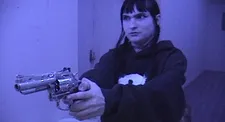
“To me, the important thing about how I was trying to write that character was like with the incel character in the first movie, or my character. It's that their downward spiral is very self-inflicted by the inability to be introspective in any way, and not make these very easy connections. I like to think of it as the movie is all about the moral or thematic grey areas. The transgression comes out of like trying to stay in the muck in that regard. And the best way to accomplish that is to have every character be such a black and white thinker. Like it's either good or bad, and that way every choice they're making is so simple. With the removal of nuance you allow these very knee-jerk reactions where every character is saying their first thought that comes to mind – sometimes the most like worst and intrusive sort of thought that shouldn't actually be spoken to another person. It creates this amazing relationship with the audience where you have them covering their faces like ‘No, please don't say that.’ Like it's like a horror movie but with people having awkward conversations.”
 |
| Ivy Wolk in Castration Movie Part II 2 |
A social horror movie, I suggest, and she likes that. I observe that whenever people are trying to increase the representation of any minoritised, people will insist that they should only present obviously good characters - but that it has always seemed to me important to have obnoxious characters, to have characters who screw up, because people relate to that and it makes them feel far more human. That's something that comes across to me a lot in Louise’s work.
“Thank you,” she says. You know, I'm a big fan of Joseph Campbell exploring ideas around monomyths, so I try to write within this mythic quality where I've got, on one hand, all these postmodern literary influences, and on the other a classic storytelling tradition – and then to put these characters who are underrepresented in it and allow them to have almost quest-like journeys with rises and falls. All of the complexities that we see in the hero's story. I think that people relate most to that. We love an underdog story.
“We love when someone can overcome hardship. We also love anti-heroes or conflicted characters. Some of the best movies of all time are things like The Godfather, right? These movies with more morally grey characters are the ones held up within the cinematic canon as classics. We don't see that so much with queer movies.
“The ones that get canonised are not the fun, peppy, queer representation. We look at how big John Waters is nowadays, or Greg Araki or like any of these titans of what we look for in queer cinema specifically. It's always the edgier ones, right? To me, it's less because the movies are so crazy or anything like that. It's more so because the characters are more relatable than you're going to get out of just another saccharine coming of age story.
“I guess I don't even think about my work within a queer storytelling tradition or within these ideas around representation so much anymore, because I'm looking at it as so much bigger than just like, ‘Is this good for trans people?’ It's more within an entire cinematic and storytelling lineage. How does me making this movie in 2026 relate to Greek myths or myths of First Nations people in Canada or something? It's trying to bring all this stuff together, but with a knowledge for history, and making up for the cinematic depictions of trans people over the last 140 years.”
I suggest that a lot of queer cinema at the moment is about producing comfort movies, filling in the gaps for people who watched mainstream cinema but never saw themselves represented. All of the bland stuff that came out about cishet people is now coming out about other people.
“Yeah, well, in a way I'd say it's like a skill issue because I was always finding myself within movies. It just was coded in certain ways. It wasn't like I was never looking for some simple, feelgood trans representation, and I'm sure some people come to movies looking for that sort of thing, but for me, even within a family film, so many villains are queer, trans or gender nonconforming – it’s just coded in this very subtle way. If you're someone who's looking for representation, you don't have to look very far to find something within that dominant form of cinema.
“I think there's so much more power even to a work of art that's not trying to be trans and just, through cultural signifiers, ends up accidentally putting forward something that could be like trans-coded in a way that I could relate to. It’s so much stronger to me than a lukewarm trans coming of age story – I wouldn't be able to see myself in that in a complex way because I think it would lack humanity. I like the edges on things.”
She’s still hard at work on the remaining parts of Castration Movie.
“We're going to be wrapping up part three soon here. It's so funny because the whole movie was always supposed to just be one movie. The whole parts thing just came out of the way indie film works. I can't release a 30 hour movie that I spend 10 years on anymore. It would be too difficult. So the third one's almost done and it's very funny because most of the third one was shot before the second one – the second one we ended up releasing. So that'll be coming out this year and continues very directly with Michaela's story.
 |
| Castration Movie Part II |
“It's probably the first one that very directly engages with sexual dynamics in the bedroom, but also within kink culture and boundaries around that, as well as dealing with themes around grief in this same way that mirrors the character of Izzy because it's the partner chapter to that one. Then we have the full fourth movie also in production. We've shot about an hour of that so far. It's kind of funny. I feel bad even saying ‘third and fourth films,’ because they are one 12 hour movie that has been cut in half.
“It’s just that continuation of Izzy and Michaela's stories. We'll finally get a moment where we realise that all of these chapters we've seen are very much directly one story. And then the fifth movie, it'll be interesting see how that comes together. It is fully written, as a screenplay, which is like the first time we’re approaching that with the project. We have not really shot more than 20 minutes of that one yet. We've been doing pieces of it as we go, because of the nature of that project. It is very much the payoff to all of the misery that we've been seeing this entire time.
“I think it'll be really quite interesting to see if we get that far. I mean, if Castration Movie continues its growth as a cult film and we continue to see an interest in it, then hopefully we'll make it to five and wrap up this whole story as it's meant to be. But at the very least we're going to get three and four across the finish line.”