





Eye For Film >> Movies >> Rose (2026) Film Review



Issues of gender and gender roles, the practice of passing in the garments of the different gender and imposture are not new and unique for our times, but somewhat eternal. Even if we leave out all the princesses, queens and empresses, from ancient to modern times, assuming the roles of military leaders and shadow lords, there are enough examples of those practices among the commoners. Simply put, the mass emancipation of women as property owners and handlers was not the case until the American Civil War – with men drafted to the army, farms, plantations and stores were left in the care of women. Heck, there is even an example from First World War Serbia, when a simple peasant woman named Milunka Savić put on men’s clothes, volunteered for military service and became a war hero whose true gender was discovered only after she was wounded in battle.
According to the Austrian casting director and filmmaker Markus Schleinzer and his co-writer Alexander Brom, a similar thing occurred in Germany during the Thirty Years’ War (1618-1648). Although they set a dead serious tone early on, there are no means to establish whether the story is completely factual, and it does not matter. After all, it is imaginable and rings true. However, the difference between the titular protagonist of Rose and the “heroic” examples lies in her motivation. As she says herself by the end of the film, Rose (Sandra Hüller) did it all for opportunistic reasons (“It is easier for those who wear trousers”), rather than some kind of patriotism.
As the title card informs us, Rose went to war, and there, dressed as man, committed some inconceivable things. At one point, the soldier decided to retire to the plot of land he claims is his inheritance and the dilapidated farmhouse on it where he claims he spent part of his childhood. Rose’s male name is never disclosed, the locals do not seem to remember a boy who lived in that particular house decades ago, but the deed on the land seems all right, and a symbiosis of sorts between the weary ex-soldier, who prefers seclusion, and the villagers is established. It gets fortified when the soldier offers shelter to their sheep and even kills a bear that attacks the cattle.
In order to expand and gain access to water from the nearby stream, the soldier marries his first neighbour’s oldest daughter Suzanna (Caro Braun). The question of chastity and consumating the marriage arises, and, “miraculously”, the baby arrives weeks before the term. An incident with bee stings leads to the “grand discovery” by Suzanna and one of the maids, which at first only interrupts the power dynamics in the household, but later gets disclosed to the village. The latter triggers the process that involves the doctor, the priest and the judge to decide “what is natural and what is not”.
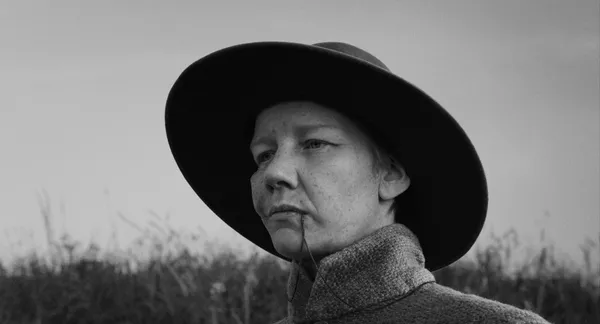
The cold black-and-white cinematography by Gerald Kerkletz, the rural setting and the topic of intolerance, as well as the presence of Maria Dragus in one of the supporting roles are a clear association to Michael Haneke’s The White Ribbon, on which Schleinzer worked as the casting director. However, the historical setting further in past and deeper in backwoods territories, as well as the unnerving atmosphere of distrust of the environment towards the unlikely union between the two individuals and the thinly veiled mystery that is about to be discovered to great consequences brings more genre-infused Austrian titles in mind. For instance, Lukas Feigelfeld’s Hagazussa - A Heathen's Curse (2017) and The Devil’s Bath (2024), by Veronika Franz and Severin Fiala, come as other associations. Also, the historically set topic of injustice, intolerance and the assigned roles as well as the written and unwritten rules to be obeyed also stood at the centre of Schleinzer’s previous film Angelo (2018).
Apart from setting the tone and maintaining it, the strongest point of Schleinzer’s filmmaking is casting and directing the actors' interactions between one another and the environment. That goes not just for Berlinale Silver Bear Winner Hüller, but also Braun and the others, down to the most minute parts, so it can be assumed that Rose may launch some careers in the years to come. Hüller’s interpretation is a stellar example of a perfect synergy between clever writing, technical and acting masterclasses. Before our eyes, Rose comes to life as an androgynous boy or tomboy who went to war, there earned physical and emotional scars, speaks in a laconic manner and moves like a proper soldier. We can also see two layers of distance between the actress and the character, as it becomes obvious through her perfectly calibrated performance that Hüller is playing a character who is playing a character herself.
Rose leaves a strong impression, so it does not come as a surprise that it was seen as a frontrunner for Golden Bear and a critics’ favourite at Berlinale. It also serves as a reminder how the injustices and brutality of our times were always here and how the world was, still is and will probably always be stacked against individuals who dare not to follow the rules.
Reviewed on: 26 Mar 2026


Director: Markus Schleinzer
Writer: Markus Schleinzer, Alexander Brom
Starring: Sandra Hüller, Caro Braun, Marisa Growaldt (voice), Godehard Giese, Maria Dragus, Augustino Renken, Robert Gwisdek, Sven-Eric Bechtolf, Rainer Egger, Maurice Leonhard, Bastian Trost
Year: 2026
Runtime: 93 minutes
BBFC: 
Country: Austria, Germany
Search database: