 |
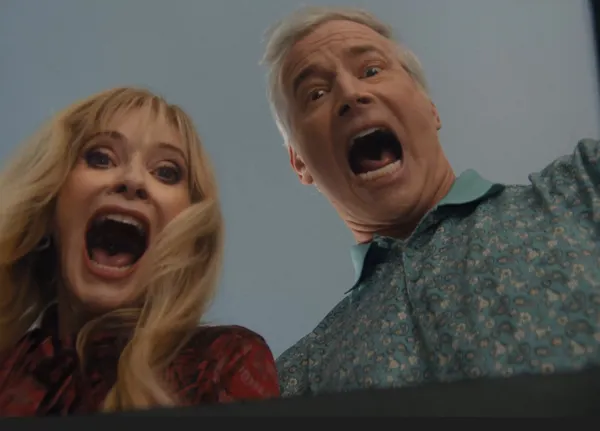
| Barbara Crampton and Rob Huebel in Grind |
In their horror anthology Grind, directors Brea Grant, Ed Dougherty and Chelsea Stardust, take aim at the gig economy. It’s difficult to imagine a more appropriate title to express the experiences of the characters across its four chapters that takes in the hustle culture of multi-level marketing company Lala Leggings and the attempts of coffee shop chain Neptulia to unionise. Then there’s a delivery driver beleaguered by repetitiveness and the soul-destroying experience of content moderation.
Grant has previously directed the organ trafficking black comedy 12 Hour Shift, and the psychological horror Torn Hearts, that plays with the idea that one should never meet one’s idols. In front of the camera, she has starred in, among others, Jacob Gentry’s Night Sky, Jeremy Gardner and Christian Stella’s After Midnight, and Natasha Kermani’s Lucky. Dougherty has directed music videos for the bands Voxtrot, A Giant Dog, Sweet Spirit, and Heart Bones, which Grant starred in. Stardust has directed horror shorts, including Where Are You? Marco Polo, and Seeing Green. She made her feature debut with the cult horror Satanic Panic.
Speaking with Eye for Film, Grant, Dougherty and Stardust discussed the making of Grind, jettisoning good advice, living in a horror story, and making messaging go down like a spoonful of sugar.
The following has been edited for clarity.
Paul Risker: What are the challenges of making an anthology film?
Brea Grant; There are creative challenges and physical limitations — there are actual filmmaking challenges. I say that because we produced the whole thing. This wasn't like, "Here, go take this money and go make your own movie.” It was like making four different movies. We had different sets, different locations, different DPs and crews. So, it was a logistical nightmare that we were not prepared for.
Early on in the process I even talked to Mali Elfman, who has done quite a few things like this. She said, "Whatever you do, just don't shoot them back-to-back-to-back. Make sure you take a break in between.” And we did not do that.
We did wait a year [after shooting MLM] and then we shot the next three back-to-back. And it was exhausting. We should have listened to Mali.
Ed Dougherty: With a feature you get momentum, and you get into a groove. And with an anthology, you get into a groove and then a whole new cast comes in. There’s the idea that it's easier because you're just making a couple of shorts in a row, but actually, it was way harder just because you're always rebuilding the world.
BG: And then storytelling wise, the big thing for us was we wanted to make sure it all felt like it was in the same universe, because a lot of times, with anthologies, you watch one [story] and then you're thrown into a different tone or world. For this, we built the world and set up its rules before we even started shooting, so we knew tonally what it was going to feel like and knew the ins and outs of each of the stories. We knew where we were going, and we even knew what the handoffs between the segments were going to be, which was really important. As far as the writing process goes, figuring all of that out was a little harder than writing just a straight narrative feature.
Chelsea Stardust: Being cohesive is the biggest challenge, especially when you have different directors, because with things like Creepshow and Trick 'r Treat, it's all one director — it’s a little easier. But I do feel it is pretty seamless and translated from script to screen because Brea had thought everything out so thoroughly ahead of time.
PR: What was the genesis of the idea for Grind?
BG: We started with MLM. Ed and I had worked together in the past and known each other a long time, and we were trying to find something to work on together. And we came up with this idea of a multi-level marketing horror movie, and so we made MLM. But we created the whole world before we shot MLM because we knew we wanted to do some sort of anthology. Then, Ed had this idea of the gig economy and bad jobs. It just seemed so obvious, and I couldn’t believe no one had even done that before.
ED: Well, the funny thing is, at first, I was just pitching you capitalism, money, and you were like, “That’s too big. You’ve got to narrow it down a little bit.”
PR: Speaking with Barbara Crampton about the changing habits of consumers, she said, “It's insane the different jobs that we've created…” Along with change comes all sorts of problems. Genre cinema has always had its finger on the pulse of the anxieties of the time, and with Grind, you’re exploring, even cataloguing these present-day anxieties.
BG: That’s our goal because obviously, there are so many fears and horrible things that we explore through genre, like trauma. And I feel there's been a lot of interesting things that have been explored in genre cinema lately, but not many people are talking about the anxiety that we were seeing among a lot of our friends, which was the economy, late-stage capitalism, and having to have five jobs to be able to afford rent.
There are so many people that are struggling financially because we're living in a system set up to fail us. And that was an interesting thing for us to talk about through genre because it is a horror story. We're living in a horror story, and we’re not that far of a tick away from some of these stories, which is wild.
CS: A lot of us directors or writers, or anyone in the film industry have to be multi-hyphenates or have side hustles. That is real in terms of the entertainment industry. So many people are doing multiple things in order to survive, because the film industry itself has changed so much.
PR: Speaking with Ant Timpson, he suggests that YouTube has now overtaken cinema, which is really pushing shorter content. Unlike the literary, which has utilised the poem, the short story, and the novella, cinema has struggled to commercialise the shorter form. Personally, this always feels disappointing.
BG: What's interesting about the short form is it's a punch to the face, like, here it is, and you give it all at once. You can say and do a lot, and you don't have to have that mid-second act or the dull moment that we all worry about.
It’s just a different form, although, what we wanted to do is make Grind feel like a full narrative feature but have these shorts within it.
And yeah, I totally agree. I'm not a YouTube person, but Ed watches so much YouTube [laughs].
ED: On the plane yesterday, I was like, is Brea gonna look over and judge me for how much YouTube I'm watching?
BG: Honestly, I did, because he was.
ED: I'm watching all the things that they talk about destroying us. It's just a guy talking to the camera. He's radicalising me into what I already believe anyway.
BG: For the good side… from the left…
But I think you're totally right, and what’s nice about this format is that we could tell multiple stories within this late-stage capitalist nightmare hellscape that we are depicting and get to actually show four of them in a very distinct way, instead of just trying to tell one story. There is an interesting story out there about a delivery driver or someone working in content moderation, and people are making those movies. But we wanted more of those poppy punches to get to see multiple stories over the course of a movie.
ED: And then it's about the economy in general, not just a movie about content moderation. It's a spectrum.
PR : The remarkable thing about horror comedy is how it can effortlessly make these broad statements, digging deep into themes and ideas.
ED: Well, life is a horror comedy.
BG: [Laughs] Wow, that's your answer? That’s the end?
I think you're totally right. You can put things like politics and other messages into a horror comedy that are important to all of us and go down like a spoonful of sugar. I also think horror and comedy go hand-in-hand when it comes to what you expect as an audience, right? You have a build up; you have a release and they both do the same thing. To me, they work really well together. Not everyone in the horror community might agree with me, but I think every horror movie needs a lot of good comedy. That’s why we ended up hiring a lot of comedic actors for this because they're good at both.
CS: It’s a hard line to walk. Ultimately, it's such a balance, and it also gives the audience permission to have fun while also experiencing something very cathartic. So, it helps bring those two things together.
ED: There's also a lot of great horror comedies that, because they're so good, are removed from that category. Get Out has tons of comedy, but no one ever says Get Out is a great horror comedy.
Grind world premièred in the 2026 SXSW Midnighter strand.