





Eye For Film >> Movies >> The Bride! (2026) Film Review


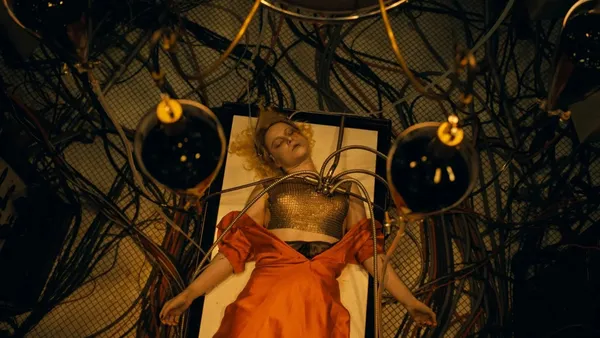

Dr Euphronius explains that she had been performing experiments that had affected the fabric of space and time. The boundaries of reality itself are breaking. Mary Wollstonecraft Shelley is speaking from somewhere beyond the grave, lit at times such that the boundaries between skin and skull are elided. To whom does she speak?
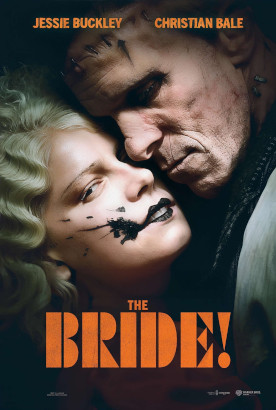
The Bride! That, too, is the now-Oscar-winning Jessie Buckley, who is at once Ida, Mary, the eponymous heroine. Not 'of Frankenstein', to be clear, indeed definite. We're contemporary with that film though, anachronistically, asynchronously, asymmetrically. In part through Mary's influence, perhaps even autochthonously. A monster wants a mate. As the film states, "this is about loneliness." Of more than one kind, the jazz age and its queer clubs and its imminent modernity. Christian Bale is Frank, galvanised by his namesake's experiments but enlightened by screen star Ronnie Reed. Among the many doublings, reflections, reinvigorations, Bale crooning in the guise of Jake Gyllenhaal's turn as someone who can perhaps not act, sing, but dance a little.

It's an astonishing cast: Annette Bening as our Doctor, Penélope Cruz as a consulting detective, any number of smaller roles filled by familiar faces. Hype for Maggie Gyllenhaal's directorial début started so early that the audition process was an important feature of John Mulaney's speech to the Academy-adjacent Governor's Awards. This is referential, irreverent, a differential tale of a revolutionary revenant. "I would prefer not to" as a rallying cry.
Some might prefer not to too. The calculus of Hollywood means that even new talent might be in service of something derivative, and The Bride! builds on more than a century of cinema. That sense of the familiar can also frustrate. Something new can come from stitched together parts, even if the joins are visible. The tonal variation is an issue. It's never quite as camp as Beetlejuice nor as cold as Sinners. While it follows some familiar paths it is more of the bright lights of Times Square than any Nightmare Alley.
The uneasiness around time and space and self has plenty of precedent. Questions of authorship and identity are so common to genre that one could get them in Bulk. There's thematic weight in graffiti that reads "DEPRAVATION = DEPRIVATION", but the subtlety of actual writing on the wall gives way to curb-stomping as thesis.
The central relationship is within The Bride herself. There are others: trailing our Public Enemies are not private eyes but glum gumshoes. The mob have also got concerns about what's being said, but theirs are not the only tongues wagging. Frank's got his own journey and the chemistry between him and The Bride is often almost literally projection. For all its quality, and there's plenty, it doesn't quite feel a thing complete. Its characters are disobedient, but their film is in part disordered. There is something there, indeed the essence of a bride is that they're not yet wed. Having gathered together quite so many things that are dearly beloved, having changed so much to align them, that which has been altered might be left at the altar.
Reviewed on: 19 Mar 2026



Director: Maggie Gyllenhaal
Writer: Maggie Gyllenhaal, Mary Shelley
Starring: Jessie Buckley, Christian Bale, Annette Bening, Penélope Cruz, Peter Sarsgaard, Jake Gyllenhaal, John Magaro, Matthew Maher, Jeannie Berlin
Year: 2026
Runtime: 126 minutes
Country: US, France
Search database:
