





Eye For Film >> Movies >> Lunar Sway (2026) Film Review


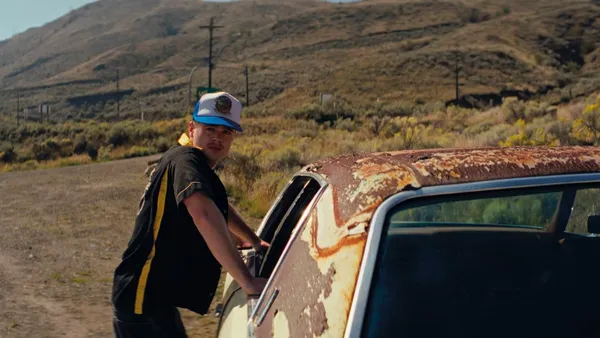

Nick Butler’s second feature, Lunar Sway, is the kind of film that seems to drift rather than move in straight lines, guided by intuition, memory and the pull of recurring images. Set between desert towns named Mooncrest and Sunnyside, it announces its lunar fixation early and never lets go, building a world where full moons seem to arrive too often, howls carry across the night, and yet no one around the protagonist Cliff (Noah Parker) appears willing to admit that anything is meaningfully out of joint.
Cliff, a bisexual man worn down by small-town inertia, lives in the shadow of an encounter that the film treats less as a past romance than as an unresolved haunting. At some point, another man painted a series of intimate portraits of him, and those paintings have now begun to resurface in ignominious fashion, discarded by the side of the road or left to gather dust in thrift stores and antique shops. Butler turns this into the film’s most quietly devastating image. To be desired is one thing, but to stumble upon evidence of that desire after it has been cast off is something else entirely. The portraits suggest not just lost intimacy, but the strange afterlife of having once existed vividly in someone else’s gaze.

That sense of emotional residue runs through the whole film. Cliff is a neon sign maker, a profession Butler smartly exploits for both its visual allure and its thematic charge. This is a world of handmade surfaces and artisanal gestures: Cliff’s adopted mother makes soaps, and Cliff occasionally reverse engineers colognes in an effort to recreate memory through scent. At its strongest, Lunar Sway carries a faint echo of Jane Schoenbrun’s I Saw The TV Glow in the way it filters queer malaise through atmosphere, artifice and a protagonist’s growing estrangement from the world around him. Butler finds in these tactile and olfactory details a language for longing, preservation and reinvention. Neon, perfume, soap and portraiture all become ways of holding onto things that are already slipping away.
Into this already unstable emotional terrain comes Marg (Liza Weil), a woman claiming to be Cliff’s birth mother. Her arrival gives the narrative a jolt, though Butler is less interested in plot mechanics than in what the possibility of origin does to someone already untethered. The film begins to circle questions of inheritance, desire and self-recognition, not in a rigidly psychoanalytic mode, but in a looser, more suggestive way. What Cliff seems to want, as much as any concrete truth, is to be claimed, explained, perhaps even reauthored.
At times, Butler pushes so insistently toward metaphor and aphorism that Lunar Sway risks becoming heavy with its own meaning. There are stretches where its dialogue edges toward platitude, and where the film’s symbolic density threatens to congeal rather than deepen. Still, there is enough conviction in Butler’s imagery, and enough intrigue in the sensory richness of Cliff’s world, to keep the whole thing compelling. If Lunar Sway does not always know when to stop reaching for significance, it at least reaches in ways that feel sincere, peculiar and cinematically alive.
Reviewed on: 24 Mar 2026