 |
| The Pearl Comb |
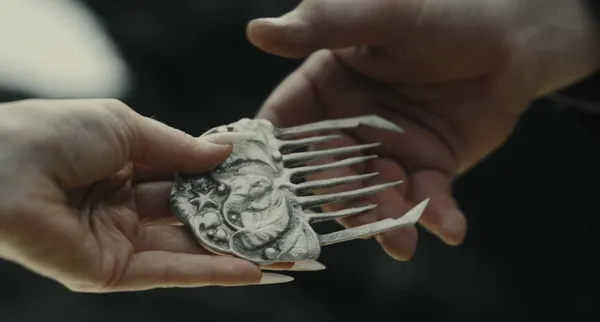
Ali Cook began his career in stage magic and comedy; he’s done a fair bit of acting for film and TV, but only recently got involved with short film. One wouldn’t think so when watching The Pearl Comb, a Cornwall-set tale of mermaids and medicine which is wildly ambitious and impressively put together. It screened at Fantasia earlier this year, and has now made it onto the longlist from which Oscar contenders are chosen – a big step for a first-time director who is the first to admit that he had a lot of learning to do.
“My first short [as a writer] was The Cunning Man,” he says. “I wrote that and my friend directed it and it had a good run. So I kind of thought, ‘Right, I’d better jump in the deep end. People can do this.’ So, yeah, it is my directorial début.”
I tell him that I’m impressed by it. Does he think it works that well because he’s spent so much time on other people's sets learning as he went along?
“I think so, yeah. And I've been a live performer for a long time, so I'm used to having an understanding of clarity from an audience point of view. I've done loads of one man shows in Edinburgh where the audience has stood there looking at me like, ‘What the hell are you on about?’ Over 20 years of doing stand-up and theatre shows. I think I've got a feel for when an audience is understanding what's going on and when they're not.”
This film has a lot of detailed work and a really rich sense of place. Did you have a full, feature-sized crew, or was he managing with a smaller team?
“Once I realised how hard it was to have a mermaid in any movie, I thought ‘The days of me trying to do this with my mates are gone.’” he says. “I actually contacted Matt Wilkinson, who's a features producer. I've been in some of his films and really I needed his help and he pulled a lot of favours from a much bigger team because there's no way you can really film on a coastline, putting actors in the sea and pools and trying to do that amount of VFX, without a proper crew. Specifically we had a woman called Izzy Pirillo who did the production design with me, and she was absolutely fantastic.
“I first heard about legends of mermaids whilst I was on holiday with my daughters in St Ives, so I wanted to film in Cornwall because I love this idea about trying to stay as true to the original world of where myths and fables might come from. But personally; it's not the only way to do it. There's something about Cornwall that I think helps to create the world.
“We were very lucky because basically that was a private holiday cottage and we managed to hire it the one weekend no one was there. That is how we did it. You know, quite often in horror you need to have a sense of isolation and a sense that with the elements, you're not quite in control. So in the opening shot, we've got the powerful ocean and all you can see is that little house on its own. I wanted to try and get over that point that it's an isolated cottage straight away.”
How did he handle filming in the sea? The film makes it look pretty challenging.
“It was!” he says. “We had to do a lot of recce. There's a scene where he carries the mermaid down the beach and the day before, the actual beach got washed away. So we were dealing with these sorts of issues. The first AD was a guy called Nick Justin, who was brilliant with the weather. He'd already foreseen a lot of issues that could go wrong with the weather. So really, I was just very lucky to have someone with that sort of foresight.
“We could do the interior shots at any time and if it was suddenly was going to be thunder and lightning, we could just go indoors. So that was one thing. And then the other thing where we got a bit lucky was, there was a lido in Penzance where they'd cornered off a little bit of the sea. So sometimes when you think you've seen the mermaid in the sea, she's actually in this lido.”
Was there a big safety team for the sea scenes?
“Oh, my God, yes. This is where, again, with the idea of filming a mermaid, you don't realise that you need to have a marine safety team. Even though we're only really filming on the edge, they still get into the water. The minute people are concentrating on the lines, no one's thinking about the elements. And Simon [Armstrong], who plays Lutey, he got washed away once.
“We filmed it in November. The sea was brutal, so it was full on. We had to have four guys surrounding the cameramen and the two actors as were doing those scenes.”
I remark that it must have been freezing for the mermaid.
“Poor Clara [Paget] was an absolute trooper. You know, she's a very svelte lady, so there's not an ounce of body fat on her. But I feel the cold a lot as well, so I really planned ahead. So, for example, she was always wearing fur lined bodysuits on the bottom half of her, and that gave a little bit of extra heat. And we always had a keep warm jacket literally next to the set. Also, when she was laying on rocks, we would have cushions under her as well. Fortunately for my character, I'm always indoors.
“Whenever you write your own story, you have to think ‘What would I best at?’ He means well and he's a gentleman, but he is quite stiff. And then quietly, he gets increasingly more condescending as the story goes on. For some reason, I'm good at being condescending. You've got to play to your strengths, really.”
Did the story come to him as a legend or is it something that he adapted from legends?
“It's a little bit of both. I heard about the legends of mermaids down in Cornwall. What first drew me to them is that they were killers. They weren't like Disney princesses. And I just love trying to get to the root of the real firsthand story. If you were telling this story 200 years ago, a mermaid wouldn't be a princess in a teen drama, they would be a vicious murderer. So that was the first thing I wanted to portray, but then I was struggling to try and come up with a story and I had this kind of thing where the mermaid was the main character for a while.
“It was actually my ex-partner, she was telling me that a lot of the first female doctors in Britain, even though they were qualified, they weren't allowed to practice medicine and the public was scared of educated women. And the doctors, the male doctors themselves, they were threatened. They thought they might lose their jobs. And in particular, there's a true story, the Edinburgh Seven. The first seven female doctors.
“Quite often, female doctors would come up with these tales that they were midwives or herbalists. And I pushed into that. That maybe they were a witch and that really they're running a GP practice, but they tell everyone in their area, which is still a remote area, that would believe in superstition, they're a natural healer. And that's really when I came up with that. I was like, ‘Yes, now, this is the story.’
“I was playing, this short at Fantasia. Two women were actually nurses and they said ‘We’ve faced this our whole careers.’ And they liked the film. Then, at another screening in Tampere in Finland, someone told me that in America the first female surgeon wasn't until 1970. So there's just been this weird stigma in the medical profession in particular. It felt like the real drama that I could add to elevate a fantasy film.
“I really went town in terms of [working on] it visually. You don't know if a story is going to work. You know, for a long time I performed stand-up comedy and it feels a bit like when you come up with a new joke. You don't really know. It doesn't matter how long you work on it. Either the audience like it or they don't. You're always trying your best, but you're never quite sure. Who would have thought a story about a Cornish mermaid would be very popular in America? You just don't know until you do it. It’s lovely, really.
“I'm just really happy that we've got this far and also that I feel that I’ve found this niche that people seem to enjoy. I think we often see high end TV with fantasy, but we don't often see people trying to do it in shorts. So I’m just thankful that we’ve managed to do pretty well, obviously in the horror festivals, but then also in quite a lot of the drama festivals as well.”
Is he going to stick with directing now, as at least part of his career?
“I think so, yeah. I really enjoyed it, I'm pleased to say. We had a really good experience. The whole team had a great experience. I think that directing is a whole different ball game when suddenly things aren't going how they should.” He pauses for a moment. “Maybe that will be my next short. I don't know. Maybe I'll try and do the Loch Ness monster or something.”