 |
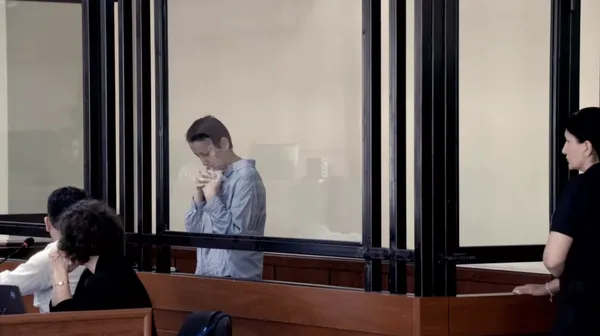
| Mzia Amaglobeli Photo: Courtesy of Kutaisi International Short Film Festival |
The pro-European protests on the streets of Georgia’s capital Tbilisi last year resulted in the government imprisoning citizens and accusing them of disorderly behaviour which endangers the state.
The “Prisoners of conscience”, as they have been termed, gained much attention and support from other protesters who could have just as easily shared their fate, as many were detained without any real proof of misconduct. Several of the country’s filmmakers turned to cinema to express their support, notably in a series of short documentaries originally intended to become a part of the protest itself by being projected in front of the parliament building. These films have now being collected and screened at the Kutaisi International Short Film Festival under the banner “Cinema and Resistance - The Memory of Protest”.
The anthology eschews the signature style of each of the directors involved, focusing instead on telling the personal stories of the prisoners and bearing their individual names as titles.
The shorts are completely free of their distinctive vision if compared to the feature films these directors are famous for: they are told in a direct, unpretentious way that only aims to convey a personal story to the viewer, in a raw and natural manner. Personal archive footage and home videos appear sometimes in the vertical format of phone-recorded clips, underlining both the contemporary value and sincere straightforward methodology, shrinking the distance between the film and the audience.
The shorts use film language as a weapon, urging the audience to observe a world which has become desolate in the absence of a person. This form of protest has a special meaning in the Georgian political context, where the film industry was one of the first spaces that the government interfered with. The screenings of films in front of institutions, sometimes even on their building walls, became an innovative method of demonstrating, effectively turning reality into a formalist simulacrum.
Salome Jashi, a documentary filmmaker whose previous feature Taming The Garden (2021) enraged the government by exposing the oligarch’s peculiar desires, has also participated in this project, making a film about a prisoner with a special court case. Mzia Amaghlobeli is a journalist who was unfairly judged and sent to prison for slapping a police officer. A personal fight against injustice has brought the director and journalist together, with Jashi heading to Mzia’s family home in her village to further discover her story. As a result, she offers us a peek into Mzia’s past by browsing through the family photo albums with her parents.
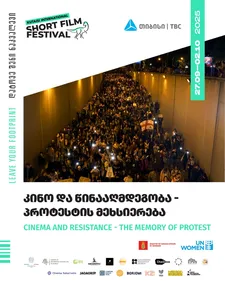 |
| Kustai Poster |
Films in the selection:
- Temur Katamadze - Dir: Anna Dziapshipa, 4’
- Insaf Aliev - Dir: Giorgi Varsimashvili, 4’
- Irakli Kerashvili - Dir: Elene Naveriani, 5’
- Giorgi Akhobadze - Dir: Vajiko Chachkhiani, 3’
- Zviad Tsetskhladze - Dir: Tiku Kobiashvili, 5’
- Giorgi Gorgadze - Dir: Levan Shubashvili, 6’
- Mzia Amaglobeli - Dir: Salome Jashi, 5’
- Mate Devidze - Dir: Sandro Katamashvili, 5’
- Giorgi Mindadze - Dor: Keti Machavariani, 3’