 |
| Bad Haircut |
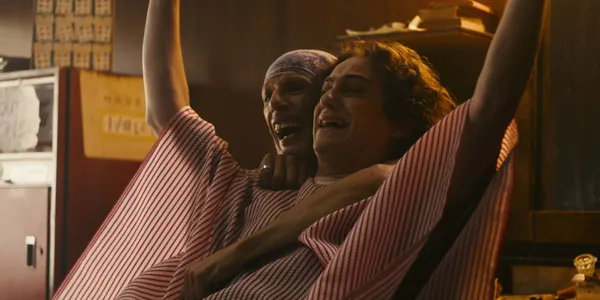
Sometimes a small seed of an idea is all you need to make a film. Bad Haircut, directed by Kyle Misak and produced by Jon Petro, begins with the simple premise of a couple of guys going to get their friend a haircut because he needs to feel more confident around bullies and girls. When they then go shopping, leaving young Billy alone in the barber’s chair, events rapidly spiral out of control, leading to a pistol duel, car chases, hostage situations, a crash course in the importance of Federico Fellini, body disposal, escapology and more.
“The story is based on a real barber that I had in college,” says Kyle. “Act One of the movie is a lot of true to life things that happened for real. I just embellished some of that stuff. And then the rest of the movie is steered in a direction that's fictitious but felt like it could happen if the worst things happened.”
His film is due to screen at Fantastic Fest, so he and Jon and I have arranged to talk about it. We begin at the very beginning, with a party scene.
“In terms of the story, we just wanted a really big opening,” says Jon. “We wanted Billy to feel really out of place, like a fish out of water. Initially the concept was a little smaller in scope, and we felt like if we could just get it big, both to have a grand opening for the movie and to bookend it that way, then it would work. We wanted it to feel real and believable as a party, but I think it becomes a little more.
“It makes everything a little more intense and increases the stakes where it's like he's already in the situation he's in, but he's extra uncomfortable because it's huge. And there are these stereotypical circumstances that someone might encounter. There's this specific type of girl, and a bully, and all those things.”
There’s also a stereotypical piece of advice, from his friend, about how women love confidence, I recall.
Kyle nods. “Yeah, the confidence part of it was the thing that catapulted them to want to take Billy to get a haircut. In the end, it's kind of a cliché thing, but we wanted to do it in a unique way because it is such a universal thing for people. Instilling confidence, having confidence in yourself. And so that. That was the whole reason to get the haircut: it was about him finding that inner confidence. And ultimately it's not through the act of actually having his hair cut. It's all the adventure that happens in the movie that brings him that confidence, and he finds his kind of inner voice along the way.
“We wanted to have a movie that had some of those universal things. Specifically teens and young adults and, I mean, anybody can connect to that stuff, but I think in the formative years a lot of that stuff is really on the forefront. So we tried to be intentional about that, and like John said, we were trying to make a fun movie that was a roller coaster ride. We had a lot of inspirations from movies that he loved growing up.”
Joh agrees. “It’s an exaggerated universe in general, so I think some of the stuff is just a little larger, a little extra, a little exaggerated. Like, Michael Bonini is an awesome actor that played the bully, Harper, but he fits that stereotype. He plays to that character so well that you know who he is.”
I ask if the actors were familiar with the same kinds of movies, but Kyle says that they didn’t really discuss that.
“I think where we really got fortunate was with our casting. We spent a lot of time trying to cast the people that we felt were right, and then once we felt we had the right people, that was like 90% of the job is done. Then a lot of them brought a lot of their own stuff to it. With Michael Bonini's character, all that stuff in that opening shot, pretty much, except for the first line and the last line of that, was all improvised by him. He knew who this character was, and so he just brought that flair to him, which was really cool.
“All of the actors did that across the board. They brought their own spin to it. We allowed a lot of creative liberty with things, and there were a lot of improvised moments in the movie. To John's credit. We did a cast retreat early on before filming. We spent five days with just our lead actors. The four of them got them together, spent time on a lake, just had a ton of fun, and they bonded, which was the goal.
“Early on, Jon was like, ‘We need them to feel like real friends on camera. And the only way to do that is if they are real friends. We want them to feel genuine. So he made the call to get these guys together. We did a trip and brought them to Michigan and had so much fun, and by the end of it, they were really good friends. And so when shooting came around, they had that rapport, they had that shorthand. They weren't afraid offending each other with off colour jokes or making fun of each other, so that fostered this environment where they could have that authentic, jokey nature come out and it feel as real as it was.”
And there's so much going on like that as well with Mick. And I think when you're talking about some of the movies that you liked and your inspirations and referencing things, there are a whole lot of different things that were packed into that character. How did you bring all that together so that it was hear and make sure that you weren't sort of having a character who was just going in all directions and wasn't going to work?
“I had the most vision in my mind for that just because it was based on a real person,” he says. “I was trying to kind of bring this person that I knew in real life to the screen. Jane, our costume designer, brought a lot of really cool ideas to the table for his wardrobe and she ultimately designed that look. And then obviously Frankie, the actor that played Mick, he was just perfect casting for that and brought that energy that we wanted for that character.
“There was a period of time with rehearsals when we were kind of guiding him and finding it together. But then once we got into filming, we did this thing: every time, at the end of him doing a few scripted takes, we'd always do an ‘artist take’, as we called it, and something would just click with him where he would slip into Mick and just really channel this character. And I don't know if there's any really non-artist takes that we used.”
He looks to Jon, who confirms this.
“It was really cool to watch him do that,” Kyle continues. “And then of course, Spencer Harrison Levin is just phenomenal. I don't think he gets enough credit for playing Billy because the extreme of Mick doesn't work without this grounded character. Billy is so natural and funny, having that comedic intuition, just dramatic ability to react off of Mick and play into it.”
“Spencer made it seem effortless because he's so good,” says Jon. “Frankie's so big in this movie, but with Spencer, you know, he's believable. He's got a lot of really good intuition. It's in the subtleties, keeping it grounded. There's so many moments where it just seems normal or he brings it back down to earth or it's more relatable or believable. But that's him acting really well to do that. He's a talented guy.”
Getting the balance right with Mick wasn’t easy, says Kyle.
“We always wanted toe toe the line for Mick of making him feel like he's this really misguided guy doing terrible things, but at the same time, there is a heart to him. It's just really twisted. He means well, in a weird way. He's not malicious. You see a lot of movie villain characters where it's all about them just having one goal, to kill everybody or something. Mick's not like that at all. So were concerned: how redeemable is Mick going to be in the end? Will people have any empathy for him or feel that there's any kind of redemptive qualities about him? Because he does so many terrible things.
“It's easy to see that Billy is the hero of the story. The story is told through his perspective. But we did want it to feel like it wasn't just a complete black and white of good and evil. We wanted to make it feel very complicated and complex and just a unique kind of character that you haven't seen before. That we can make people feel empathy for this psychopath. Then that's an interesting story.”
They’re also excited about having worked with Martin Klebba, who plays Mick’s gun-toting, silent henchman.
“He's amazing,” says Kyle. “He's somebody that I just didn't think we were going to be able to get in the movie. There's a whole story with the casting of him, but ultimately I was able to get in touch directly with him and he gave me his phone number. I called him and told him what we were doing and he was like, ‘Alright, yeah, I'll do it,’ and we were like, ’Really?”
“He's a fellow Michigander as well,” Jon points out.
“Yeah, we’re both from the same area. And he agreed to it without even having read it first. I think he knew the general log line of the movie. He read it and he was on board from the beginning, but he just was so cool about it. And it was neat because, yeah, there is no dialogue for that character, but there was such power in that performance. I think Martin was perfect for it because I can't really imagine anyone else playing that role. His size and everything played into that character being something unique. And that dynamic relationship between Mick and Wimp, it's hard to picture with any two other actors. It just doesn't work. Martin brought all of the nuances of character with him with his expressions, his physicality and how he approached different things, so we owe him a lot for that. But I'll let John speak about Martin a little bit.”
“Yeah, well, he's a great guy in general, awesome to work with and be around, and also has a lot of really cool stories,” says Jon. “He's been in the industry for a while. But, yeah, there's a lot in the movie that was brought to it. There's some stuff that we laugh at every time we see it. He just brought his own personality to that character and added his own layer on top. There's a part where Mick is bending over and Martin comes up and hits him on the head with a tray of tacos. Frankie's reaction, Mick's reaction is genuine, because it was when it happened.”
Then there’s the character of Sam, who presented a different kind of challenge.
“From the beginning it was like, okay, how do we not make her feel like a damsel in distress because of the position she's in?” Kyle recalls. “It pretty much lends itself to that. This character wasn't based on a real person, per se, but I drew a lot of inspiration from somebody I went to high school with that had that kind of personality that Sam has in the movie. So I pulled from that person when I was writing that character and trying to think, ‘How would my friend have reacted or responded?’ Just trying to do my best guesswork, but having a voice in my head and a sense of humor and personality that I could channel through that.
“Nora was the person that best fit that voice and that kind of persona. She brings an agency and this kind of charisma that maybe somebody else wouldn't have been able to bring. John and I did work in the script to try and create moments where it feels like, okay, you know, Billy does his thing here and he's helping Sam here, but also now here's Sam contributing and having agency and providing help to Billy or having a big moment here. We were intentional about his script trying to do that because we didn't want it to feel just like a one sided thing.
“Billy's really not a hero in and of himself as he starts off. He's the dorky, kind of nerdy character that is always getting made fun of and stuck in situations he doesn't want to be in and just finding misfortune all along the way. And so it wouldn't have made sense for him to constantly be the one winning every battle.”
“As long as Sam could sort of take things into her own hands – and she does quite a bit – I think we felt like that was the move,” says Jon. “So it's never like without Billy or anyone else, she's in trouble on her own. In the climax and a lot of different parts, she's in control also. At least, hopefully it feels that way.”
We talk about the set, which adds a great deal to the story, and Jon is quick to credit production designer Don Joseph Chase.
“He's fantastic. There's a specific colour palette. There's a lot of intentionality. We built all the sets inside a warehouse, like a makeshift soundstage, so we had control over lighting and everything else. The basement and the barbershop are built from scratch. Everything was very planned, and the barbershop is based on real barbershops.
“We sourced stuff from all over the country. We drove to different states, got things online. Everything definitely had a purpose, even down to the walls and the textures on the walls and the colours of the walls and every item that's in there. A lot of them we can see in the movie.”
“Don definitely contributed a ton to the look and design of everything, but my dad actually was really the architect behind building the sets and constructing them. And my mom was in massive help, too, with helping,” says Kyle. That group of people where we owe them so much. And John's dad was there building stuff. We knew that weren't going to be able to find or film inside of the real barbershop because the lighting would constantly change. That guy has a business to run. We need to be in there for weeks. There's not enough space to have a camera crew. So building it from scratch, even though it's a big undertaking, we wouldn't have been able to do it without having done that.
“It was kind of fun to put that together with Don and figure out the look. Like, we want these tiled floors and we want the old Seventies wood paneling. And this is the feeling, this is the vibe. And then the same with the basement. We tried looking for existing locations just to make things cheaper.” He turns to Jon. “Can you imagine if we had shot in one of the ones were looking at? It never would have worked in a million years. And Reid [Petro], our DP, told us that right away.
“It was important to try to make it feel like a bigger movie than it was and try to make it feel like it exists in this kind of movie world and it's not some random real life basement. It feels like we're in a movie and it's kind of this heightened reality.”
His family tends to be involved in his films, because he’s been making them since he was a kid.
“Since high school,” he says. “So it's been 15 years of making movies. My mom's always been making the food, doing the catering on every film. My dad's always helping all these projects too, building stuff and helping us construct sets. Hopefully we are in a position in the next one where we can not have them do all the grunt work. But yeah, they've been amazing. And my siblings, too, have been so supportive and helpful. It's really been a family endeavor and I'm always dragging them into these things because we need the help.
“My hope is to be able to move up and keep making things, but making on a bigger scale, and do the movies we always dreamed of making. We have a lot of similar kind of movies that we love. Things like Jurassic Park and Hook and Twister and ET and Jaws, Spielberg type stuff. That’s what we aspire to make someday. Every project has gotten progressively bigger in scale. This was a big leap from where we were.”
It was certainly a big leap musically, as despite being a small film shot mostly in a single location, it has a full orchestral score.
“There was this particular composer, Geoff Zanelli, who I was a fan of and had reached out to – not to do the movie originally,” says Kyle. “I just wanted to talk to because I loved his work from Disturbia and Pirates Of The Caribbean 5. He was just a really talented composer that I admired. And so we had a relationship. I talked to him probably a year prior to ever doing the movie. And then Geoff knew we were working on this movie and we talked to him and we just were very fortunate that things aligned and he was willing to do it and work within our budget. The idea of having a real orchestra was something Jon and I always wanted to do.”
The orchestra performed in Macedonia and they watched it on a stream Jon explains. “It was so cool to see that with our film on the screen and the time code, like all the behind the scenes footage from every great movie that you've seen. Now we know every string is a real instrument. I think it does something, you know, and it's important.”
“I feel like I'm hearing a different score than if it was made on samples in a computer,” says Kyle. “There’s the imperfections of human musicians playing something that gives it this kind of subconscious energy and visceral quality. It made it feel a little more, I don’t know – dangerous is not the right word, but just organic and I guess visceral for the movie. And that was important for us for this because obviously the movie is very contained with the sets, and we wanted the music to make it feel larger than life.
“I think Robert Zemeckis had talked about Back To The Future with his composer, Alan Silvestri, and at the time was like, ‘Hey, this is a really contained movie.’ When I think of Back To The Future, I don't think it is a contained movie. But he was talking about how there's actually very minimal locations in that movie compared to other studio movies, and there's not really any big, wide vista, sweeping shots in that film. But the music makes it feel so grand. He talked to Alan. He was like, ‘What do you want the score to be?’ And Robert Zemeckis was like, ‘I want it to be big. Huge. I want the movie to feel larger than life and big.’ And so that was. That was kind of ringing in my head when I was talking about doing music for Bad Haircut, because it is a contained movie. There's not any massive, wide, sweeping, epic shots of landscapes or things like that. But the music helps make it feel bigger and more dangerous and more exciting than it would be without.”
So thinking of being bigger and more exciting, how do they feel about being at Fantastic Fest?
“This is actually my first film festival that I'll have ever gone to,” says Kyle, a little shyly. “So I'm excited about that and just excited to promote the movie and see it with a crowd that has never seen it before. It'll be a whole new experience.”