 |
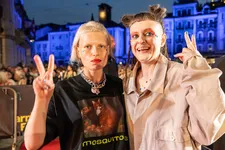
| Nicole Bertani and Valentina Bertani in Locarno's Piazza Grande Photo: Courtesy of Locarno Film Festival/Ti-Press |
Can you tell me a bit about the look of the film, because the narrow framing of most of it is an interesting choice?
The Bertanis:: The format is one to one, which is a very precise square frame and we chose that because it reminds us of a Polaroid and the Polaroid is so typical of the Nineties. So there was this connection but the film itself also reminds us of the process of a Polaroid because there is a flash – a shot which is sudden – and this is what happens with the sudden arrival of the little girl and her mother. And then you have to wait, there's a development time, and only at the end of the development, like the Polaroid picture, what comes out enables you to see the whole field.
So why do you decide to break that at certain moments, for example, with a shot of the car radio tuner?
TB:The restricted frame means the limited, partial vision of the world the three girls have because the children can't get the whole picture. So their awareness is limited like the frame we chose to use. The scene with the radio, which you rightfully evoke, is the beginning of a kind of night story and night world which the girls are not familiar with.
The representation of adults is fascinating. For example Azzurra and Marta’s father, who is a kind of drifting presence. We see more of his effect on the environment, via his constant smoking, than of him directly interacting with them. It taps into that childhood sensation of being in a parent’s presence and feeling them there rather than necessarily interacting with them, was that something you were keen to evoke?
TB: In the whole film, we tried to adopt the little girls’ point of view, as if the world is seen through the eyes. So in the case of the other dad, when you're a kid, everything is kind of exaggerated or kind of bloated, so to them, the dad smoking a cigarette is to them a room full of smoke. For the smoking scene, we used a smoke machine and electronic cigarettes, which produce a lot of vapour because it’s in the kids’ minds. There’s also a scene where the mother goes to get a doll and she goes to the next room. It takes her about three minutes and that’s when time becomes dilated, and it’s the kids’ time, in their mind it’s dilated like the exaggerated image of their father smoking.
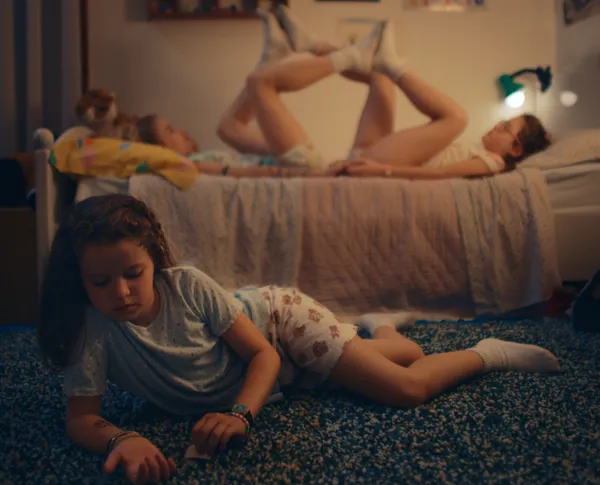 |
| Mosquitoes. 'To make a film, you need a lot of discipline and order, but at the same time you need to break all those rules to be really free' Photo: Emma Film |
At this point we break into a discussion about being Tamagotchi parents, it turns out Nicole was the nurturing sort who would take care of their Barbies, while Valentina was the opposite – “she would kill them. She would cut Barbie’s hair and chop off their heads”. But they add: “When we are making a film, all these differences and oppositions no longer exist. What exists is this feeling of sisterhood against the whole world. To make a film, you need a lot of discipline and order, but at the same time you need to break all those rules to be really free.
The character of Eva straddles the two worlds. Although she’s an adult, she still has a child-like aspect. She’s impetuous and does things you would almost expect the children to do rather than an adult. Could you tell me a bit about crafting that character?
TB: The important thing to note is that Eva has a proper name because, as you notice in the film apart from the kids, the twins Giulio and Angelino and Carlino, the babysitter, all the others have no first names. The characters who have a name are those who manage somehow to communicate and interact with the girls. Eva is something in between adulthood and childhood. She’s more than a mother, she’s still the daughter of her mother and she’s one of those who became a mother before becoming a mother, which was very typical of the Nineties. So that’s why she has a name, because she is in between the world of the adults and the world of the children.
There’s a saying in the UK that you should never work with children or animals, but here you are doing both. Were there any particular challenges with that?
TB: Well, you mentioned the kids and the animals but another challenging element was that there are many night scenes and shooting at night is also complicated. Also, working with the twins, who have a cognitive disability, so you have to take certain measures. What was extremely important was the coaching we did. With the girls, we would rehearse a lot. The difficult thing was most of all to make the three girls, the three young girls interact, because a trio is not an easy formation. If you analyse the three people from a psychoanalytical viewpoint it’s quite complex because it’s based on alliances and disagreements. The good thing was that when the three girls got to the set they were extremely well prepared because they had been rehearsing. So this excellent preparation allowed us to work on improvisation.
We wanted the coach to be a woman because they had to talk about intimate things. When it was a matter of explaining the kind of orgasm that Azzurra reaches, we had to resort to all sorts of tricks like a ride at a funfair where we explained that you go up up up to the sky and then you come down. There were different ways to try to explain something which was completely new and maybe still unknown to them. We also used music a lot to get her to understand. We asked the sound designer to compose a special kind of music that would create a climate that starts slowly and then would explode. She had to represent with her gestures and body what the music would express.
Casting the adults is also important, especially the character of Carlino, the babysitter who, again, occupies the space between the children and the adults.
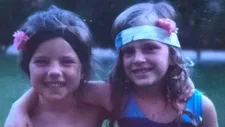 |
| Nicole and Valentina Bertani as children. 'When we are making a film, all these differences and oppositions no longer exist' |
We asked to audition Milutin because we remembered him from a short we had seen years ago and were impressed by the kind of sadness about that period in the Nineties that he bore. He came to the audition and he was extremely nervous. He was shivering and extremely tense and nervous and we loved that kind of attitude and the kind of sadness he had within himself from having lived in those years when being queer was not perceived as it is now. That’s why we wanted him.
Are you planning to work again together in the future?
Valentina: We’ve been working together with different roles. My role is directing while Nicole is the art director. This is the first time we co-directed and, for me, it was the first time I was making fiction because before we were making things that were hybrid. As to the future, for sure we're going to work together. That's something we're going to do all our lives. But on what, that's a question mark. It could be a photo book, it could be T-shirts or actually, what we would be interested in is that after doing a documentary film and this long feature film, we might adventure into a TV series. It must not be a commission because we want to keep our freedom, but that could be a new field of exploration.