|
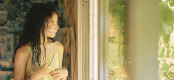
| The Bearded Girl Photo: Fantasia International Film Festival |
Anwen O’Driscoll’s eyes have the same intense look in conversation that they do in her films, giving the impression that she’s twice as alert as anyone else and has already scrutinised one’s soul before one has the chance to speak. It’s a look that Jody Wilson makes good use of in her début feature film The Bearded Girl, in which Anwen plays the title character, a young woman who turns her back on the circus and, taking a razor to her face, goes out into the world to seek her fortune. The film had its world première at the Fantasia International Film Festival, and it was there that I caught up with the excited actor and enthused but still slightly overwhelmed director for a chat.
“I grew up in a very rural part of Alberta province, Canada,” says Jody, “which is kind of what I tried to depict in the film – a fantastical, nondescript version of that. I think growing up in a place like that, that is pretty conservative country, and trying to be your own version of yourself and trying to explore yourself outside of the constraints of what that life usually provides for you, and those expectations, was one of the narrative lines that I wove into there.”
“The first time I ever saw the script, I was sleeping and I had woken up because I got the little notification and I saw ‘The Bearded Girl’,” says Anwen. “Those were the only words I saw. I just remember jumping up, and every cell in my body was like, ‘I need to do this!’ I don't even know what this is yet, but it's called The Bearded Girl, and I feel there would be a beard. And I read the script, and I fell in love with it because I love Jody's brain, and I love fantasy and I love magic. I've always been into those genres and that style of things.
“I also loved the way that Jody made the script – the colour really popped off the page when you were reading it. You could visualise everything. I think that's something that's really amazing about Jody's writing, is you can really visualise it when you're reading it. It's very colorful and kind of seeps into you. But also Cleo, the character, is very relatable. I feel like we've all experienced what she's going through, seeking outside validation. Everyone does that to this day, so I felt she was very relatable. I also grew up on a horse farm, and she's a horse girl, so there were lots of little special things that I connected to.”
Some actresses might have hesitated to put on a beard, but for Anwen the experience was very different.
“It's so funny because when I first read it and I was picturing myself with the beard, I had a big exciting feeling. I just really wanted to wear that beard. I remember first trying it on and we were doing all the tests for it. I think before I had done the test, I had had the little thought in the back in my mind of ‘Oh my gosh, what if I look terrible?’ But then I did the test and I just felt kind of badass in it. Putting it on, I was like, ‘This is really, really cool.’ And also it kind of gives me a little bit of freedom to move around and do whatever I want without being so self aware and conscious of what I look like. Because you know, on film the camera is right in your face so there are all of these little details you need to be aware of, but it just kind of felt like armour, in a good way.”
I tell Jody that I think something she does very effectively from the start is to put viewers on the position on the side of the outsiders, as it were, so that their world is normality to us before we move into the rest of the world.
“Thank you for that compliment,” she says. “That's such a pivotal part of the film – how to make the audience feel uncomfortable when they're in the normal world and more community based, familiar, like a better feeling when they're at the circus or the freak show. I think that was conveyed by when we're in the normie world, as I call it, I just leaned into liminal spaces and not a lot of people. We had a lot of extras that I hardly ever used because I wanted it to feel empty and lonely in a way.
“It wasn't like I used like obvious tropes, like made it look ugly, because it still looks beautiful in its own way. It just felt lonely. I used like sounds that I remember, when I was young that like, used to make me feel slightly uncomfortable, like waking up to a lawnmower in the summer – that used to make me feel uncomfortable. And there's wind chimes that you hear when they're in the pool, and just like little things that would call me back to my childhood that used to make me feel not grounded or comfortable in the space that I was in. It was like being a kid who didn't like going on sleepovers because you missed your house. I was always one of those kids, and so I just tried to convey that feeling for the audience.
“I didn't want it to be like Cleo's character felt so out of place there. I wanted it to be a sort of match for how she felt when she was at home. Like she didn't feel any more out of place in the normieville because she had this beautiful connection that she always wanted, whether it was surfaced or not. It wasn't exactly the deepest love connection, and that was purposeful, but it was what she was looking for. You know, she was looking for that silly attraction, a visceral thing. In order to keep, stylistically, a through line that didn't feel bumpy, I just used sparsity and space.
“Harold was the intro into that world. He was the bridge; he was the shepherd who brought her over. He was a nice person to do that because he felt wholesome. So him at the bus stop bridging her to the normie world and then going right into the milk scene, which is uncomfortable in its own way, I think lent to that being successful just through acting and intentional sound and stuff that a lot of people might not even notice.”
We talk about the distinct look that each world has.
“I like to be very intentional with how I like to frame and use colours,” she says. “I had a very precise deck of references for the theme when we first met, but I was fortunate to have collaborations with an amazing production designer who just got it. He got everything, and he actually exceeded.
“I hung out in the art department room a lot during prep because it was my favourite place to be, because they were all real artists who were having so much fun with this project. Because it's not every day that you get to do a project like this. They drew every single thing, and we were making hand painted signs. People were just so artistically invested. My art department was amazing. Danny Vermette, who is our production designer, he just came off Longlegs and he brought his whole team with him, and they were amazing. And then Francois, our dp, was so good as well, and he just got it – he understood exactly what I was going for.
“I do tend to like really symmetrical, down the barrel shots, and sometimes I would have to nudge them back to do that because they would be like, ‘No, it's too simple. It's too long, it's too straight.’ Like, this is how it's supposed to be. It was neverending, me having to say that, but that was the only part where I gently nudged it back, because everything else was perfect. So it was collaborative with my crew.”
“Everything selt so fun,” Anwen remembers. “The beard was almost like an invitation for freedom for me as an actor. When Jody's talking about all the artists being so invested and loving this so much because they can go wild with colors and all of their ideas, I also felt the same. Jody created a playground for all of us to just be children and let our child selves go and create color and magic everywhere.
“Bouncing back and forth between each actor was really amazing because everyone was so different. Everyone felt like their own little world, their own little universe. And it was kind of like a discovery. I mean, anytime I do a role, I feel like I find the character as I'm going, and by the end of it, I feel like I’ve found who the character is. And I always want to go back to the start and be like, ‘Oh, man, I know now because I was growing along with the character,’ but I felt a little different on this like everyone was linked telepathically. It felt like a playground. Everything was just very fun. And I knew that the audience would have fun as well, because it just felt like pure play for us.
“Jody and I talked a lot about backstory. The thing about Jody is she likes to create detailed backstory for everything and everyone. As an actor, that's amazing because I can just go dig through her brain for anything. If I had a question, she had an answer for it. Personally, when I do backstory, I love detail. That's the way that I like to work. I'm a big fan of Stella Adler, and her acting style is just really finding all of the detail, all of the backstory, even little things like favorite colours or temperature, because that changes how you act as a human.”
“To add to that, if the backstory is this, I probably have more,” says Jody. The film is this, and I know way more about everything else. I even have a hard time when I do pitches about other stories because I talk so much about the backstory, and I like it.
“I kept it simple story purposefully to create a space for this backstory to be felt by the viewer subconsciously, because I was able to give that to the actors and they were able to ingest it and take it and then come up with these brilliant characters that felt so real and so rich in such a short amount of screen time. And that's what I intended to do. One of my greatest feelings of accomplishment on this film is that that's what audience people are telling me. People who are watching it say they love the characters so much and felt the richness from them. I think that’s the most important thing about the film for me.”
We talk about the deliberate obscuring of time in the film – we never know quite when it’s set.
“With the art department, costume, vehicles, we had nothing past the Nineties,” she says. “Nineties was the latest. So we had stuff all the way from the Fifties, like those showgirl outfits they were wore. Those were super old, actually. Those were from the Twenties, I think that costume designer was telling us last night. But the thing that juxtaposes it is the dialogue is of the now. I wrote the dialogue very contemporary, like the way that my niece talks, the way that I hear Gen Z talk, especially with the sisters. But everything else is, you don't know where you are.
“There's no tech. Everything feels like it means something. Like, even the Polaroid, when she throws it, it really pisses her sister off because things had value back in the day. So I was reverting back to little, simple things having value again. It's not the most fantastical film ever. Some people would argue that it's not even a genre film. But I think that by leaning into these things that aren't quite grounded in life, and these nondescript things, it's almost like a fever dream. That’s what makes it fantastical in a way.
When I heard that Carolyn [Mauricette] wanted our film for Fantasia, for its world première, I was so excited because I obviously, as a filmmaker, have a great admiration for this festival. In the filmmaker world, it's the festiva that you want to première at or show at, because the audiences are so great. I was a little intimidated, to be honest, because of the feeling of maybe not being genre enough, because my other projects are quite deep into sci fi and fantasy, and I know that this one's not like that. But then I just kind of settled into it.
“I think Fantasia represents the real audiences of the world. Go to other festivals like TIFF or Sundance or stuff, you are getting a little more of the. The business people who are there. It's not really easy to go to see a film in one of those festivals for audiences. This is an audience festival. So if it's your first time as a filmmaker watching your film interact with real people, outside of the film world, that's such a special experience. And I'm a huge Fantasia fangirl forever, now especially. I'm just so stoked about the people who run it. This festival is amazing. Montreal is so great.”
“Yeah, I'll add on to that that I'm loving it so far,” says Anwen. “It's always really interesting to see the film with an audience for the first time because there's little gasps and little laughs in places that you didn't expect, and you’re seeing new humor and new, more intense moments based off of everyone's different reactions. So that's just really cool and interesting to see, and everyone seems really passionate too. I love it.”