 |
| Saint Clare |
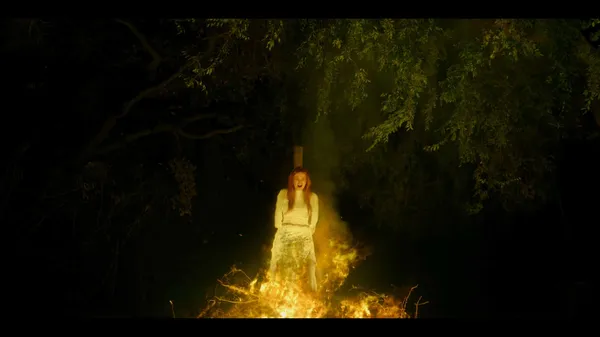
Clare is a vegan, an animal lover, a good student and a devout Catholic. She’s also a sociopath, haunted by the first man she killed but always ready to kill again. Mitzi Peirone’s adaptation of Don Roff’s book, under the title Saint Clare, looks at what happens when this morally complex young woman - played by Bella Thorne - finds herself in a new neighbourhood where other young women are disappearing at an alarming rate. It’s an arresting piece of cinema, with some great action scenes and darkly comic sequences alongside gorgeous hagiographic imagery. Some months ago I had the opportunity to talk to the director about it, and this was the result.
“I actually didn't know of the book [before taking on the project],” Mitzi says, already buzzing with excitement when we’ve barely begun. “The title is Clare At 16. Being a 33 year old woman, it wasn't on my radar, but it was passed to me in 2020, originally by Arielle Elwes, who produced the film. And she produced my first feature film, Braid, that came out as Nobody Leaves. At the time, though, I was stuck in Italy because of travel bans – because I work in the US, and I got my green card that year, and so I was exiled for a year, which was a really tough blow on me.
 |
| Saint Clare |
“It was tough on everybody, I think. Looking back at it, I'm like, ‘Oh, how dare I complain?’ People actually lost their lives during that time. But my point being that it was tough nonetheless, and I couldn't take on the script because I was in Italy. Then I got back at the end of 2021, and Guinevere Turner, who adapted American Psycho from Brett Easton Ellis’ book, wrote a draft. But it wasn't clicking with Bella's ideal for the film, and Bella really wanted to work with me and I wanted to work with her. She loved my first film, and so the producers felt emboldened to give me carte blanche and just take what was best of Guinevere's work but make it my own.
“That was a lovely process because I was able to fire up rather quickly what clicked, what worked, what didn't, especially knowing Bella for three or four years, I knew what she wanted out of a script. And I knew what I wanted to bring as far as European culture goes, because the whole Joan of Arc element definitely wasn't in the book. I had to graduate Clare from a 16-year-old girl to a 23-year-old woman. I was also a Catholic school girl myself, so I drew from personal experience.
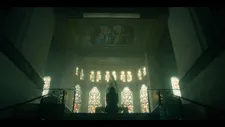
“Catholic iconography and Catholic guilt and Bible imagery can be very, very, very impactful in mind. There's a reason why, I think, whenever there is a religious film, it's about Christianity. Because it's baroque, because it's over the top, because it's gory, because it's dramatic. I take no offense. I'm very happy that that's the case, honestly. I gravitate towards church and cathedrals and art history in general, also because of the beauty of religious art.”
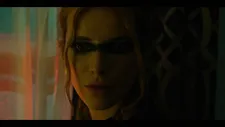
I mention that there were some images of Clare's face that made me think she'd been lit in accordance with certain types of religious art.
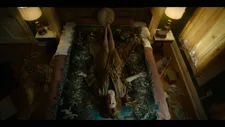
“Thank you for noticing that,” she says. “The film was shot in 15 days, and it was the opposite experience of what I had on my first film. My first was 25 days almost in a single location the entire time. So we had the time to design the shots and place a mirror behind her head so that it would look like a halo. And that was my bread and butter, designing shots and cross—referencing and doing storyboards to a tee. Then I would put my storyboards next to the monitor and just be like, ‘I need this.’
“With Saint Clare, due to scheduling conflicts, we ended up shooting the film in 15 days. I had several panic attacks leading up to production because 15 days just seemed unfeasible and undoable. My hair went gray at 32. I suffered through pre-production because of the tight schedule. I was really scared. And then at some point, something clicked, and I just said, ‘If I'm here, it's because I can do this.’
“We put in a lot of work in production to make sure that the storyboards and the shot list were militarily studied. Specifically, [cinematographer] Luka Bazeli, an angel and an incredible person, such a talented man – him and I just, every night, we would go down the shot list and memorise it just so that we would have it almost like a script. Then we would throw it away because we couldn't be like ‘Oh, but we missed my shot because we didn't have the time to do that.’ Whatever was left on our skin and in our bones, we fought for the next day without thinking about it, almost without talking about it. And so I think that what was left was the essential stuff.
“We did about 65 set-ups a day, which is a lot. Usually it would be 25, so we were shooting like crazy. It was so challenging, resources, time, and everything. But I'm so happy that some of that came through because it is crucial for me to make sure that aesthetic choices are there, because of the thematic choices. Clare has this inner conflict that I think is very relatable to women, but I think maybe relatable to everybody who's got a sense of vision for themselves or ambitions of any kind, where you realise that what you want and what society will allow you to do don't necessarily coincide.
“I also feel like Claire has this inner conundrum, this ethical and moral dichotomy issue of ‘I have to eradicate evil, but in order to eradicate that evil, I have to turn into evil itself.’ She kills people. She's an anti hero. She does it for good reason, I guess, but still.” She shrugs.
 |
| Saint Clare |
I remark that I find Clare interesting because for much of cinema history, sociopaths have been treated as the ultimate evil. Clare is somebody who doesn't have that emotional response to killing that other people might, but she uses that as a tool, and it's a very different way to look at that situation. Was Mitzi interested in exploring the way that people like that can still make moral choices?
Mitzi nods. “Absolutely. I think it's more relatable than being just your typical hero. I feel like often, if you think about a Joker character, for instance, I think that he comes from a schism in society, where the schism bleeds in a sense of how we have let certain people in society down to the point where they feel like there's just no hope other than turning into your own self and fighting for your own values, which I think is where Claire is at. She does not trust regular authority. At some point Juliana, her friend, tells her ‘Why don't you just go to the police?’
“Perhaps a lot of women have felt let down, and not just women. I think minorities in general are outcast society people that don't necessarily feel propped up by society, like a certain type of person may. I think all these people will relate to Clare, because they understand that it is a moral choice still to believe that you can make a change in society even though you're alone. And she sees it not in a vicious and emotionally engaged way, but as something that has to be done for the greater good. But then she applies the same rules. ‘Eventually,’ she says,’what has to fight must enter destruction, which means I will die, too. I will die by the sword, because I am a criminal, just like them.’
“She's accepting of the fact that she will become a martyr eventually. And to circle back to what we were talking about before, the dichotomy, I feel like it's reflected in the use of chiaroscuro, that lighting. We're speaking of light and dark. Young Clare gets her face covered in blood at the beginning of the film, and light and shadows are on her face. I feel like that sets the tone of the philosophical issues of the film.”
There’s a lot going on visually as well, to explore the dissociative episodes that Clare has. How much of that was it possible to plan out ahead of time, and how much developed in the edit? Given the short shooting time, it seems an incredibly ambitious thing to take on.
“The edit was definitely challenging,” she says. “I’m lucky to have been able to work with incredible editors. It really did help and shape a lot of the film. Especially those neurotic moments. I feel like the way that we were working on set was that any little minuscule chance that we had to rehearse, we would, but we were never really properly, you know, block, rehearse, block, shoot. There was never enough time.
“I went to this theatre school in America, in New York, called the American Academy of Dramatic Arts. I showed up and everybody was like, ‘Oh, I want be an actor because of this and that.’ I was like, ‘I don't want to be an actor. I want to write, but I feel like I need to be here.’ And it came in handy because I spent two years training as an actor, which taught me everything about blocking and how to get there fast. You know, like theatre, you either are there or you're not. It's an ephemeral art form. You need to be committed to the moment instantaneously. You don't get a second take.
“Because I had this very hardcore, intensive acting training, I think I was able to trigger the actors very rapidly. I was extremely lucky to be working with people who are committed and are kind. Most importantly, because when you're shooting at film that fast, things do get heated. Everybody was always so gracious and collaborative. If something felt wrong, I would always ask ‘How do you feel about this scene? Is there anything that you want?’ And I never take it personally if an actor tells me ‘I'm not sure about this one line.’ I'm aware of the fact that filmmaking is a collaborative effort.
 |
| Saint Clare |
“If somebody brings something new or interesting or challenging to the script, I welcome it as an accent, not as a threat. I feel like because of this environment that allowed everybody to thrive and feel emboldened to say ‘I don't feel like she should be wearing this,’ or ‘I don't feel like this is the right line or the right way of saying it’ – I feel like it made things faster and easier. Instead of saying ‘No, I'm the director,’ which, of course, is caricature what a director would say. There are egos run wild. It happens. I think the fact that there was this very gracious and kind, loving atmosphere and set allowed us to move faster.”
At this point we’re running out of time, but I tell her that I wanted to ask a little bit about Rebecca de Mornay, who plays Clare’s grandmother, because it's the best performance I've seen from her in years.
She’s delighted, and assures me that she’ll pass that on.
“I need a second because that really warms my heart,” she says. “Rebecca. I was a little intimidated at first, obviously. We got on a Zoom together and I just started rambling about all the things that I wanted from the film, all the things that I thought of. She was just listening to me. And she's like, ‘You know, you're way more educated than most filmmakers are.’ And I'm like, ‘Thank you.’” She blushes.
“She says ‘This is very interesting. You really thought this through.’ And then she takes a long pause and she's like, ‘You know, I am not just saying this –you can look it up, I've said it before: Joan of Arc is my favorite character ever in history.’ I was like, ‘No way!’ She's like, ‘No, it really is.’ And it was just like it was meant to be. It was fated. She's my mother's age and on set, I genuinely felt like ‘This is my best friend and my mentor.’ It was so beautiful. I adore her. I'm obsessed with her. She's kind, she's gracious, she's talented, she's so committed, and it was love at first sight.”
Saint Clare will be available on digital from Monday, 21 July.