 |
| Craig Russell in Protein |
A drifter arrives in a small Welsh town, carrying a rucksack and a good deal of psychological baggage. He’s a man with strange appetites, damaged by war and perhaps looking for a way to change himself, but that’s not easy, especially in a place as troubled as this. A hit at Frightfest, Tony Burke’s Protein has garnered critical attention for its craft and for the way that it uses horror tropes to explore a deeper social malaise. I recently spoke with Tony and with the film’s star, Craig Russell. They’ve know each other for a long time and Craig began by telling me about their work on short film Large Double Room In Zone 2.
“In 2012, I did a short film with Tony and he told me whilst we were filming about another short film. He didn't think I was right for it because he thought I was a nice guy, but I convinced him to let me audition for it...”
“I thought he was too good looking,” says Tony, and they both laugh. Recovering, Craig continues.
“That other short film was called Protein, and he told me about it. It sounded amazing. I wanted in and convinced him to give me the part after he let me audition. We shot that 11 years ago or something, and it was really good fun. The reason it was such good fun was because he'd done such great work, and there was such depth to this short script that I knew there was more in there. And every time we screened the film, which wasn't that many times, at festivals and stuff, the question I got asked every time was ‘Is there more? Can we see more of this?’
“I said to Tony ‘I think you should write this.’ And he went ‘Yeah, all right,’ because he's ace. And he did. And for a while it all seemed to be going quite quickly. We got this producer guy on board. Nothing came of that, and he went off to do something else. And then I eventually met Broadside Films from South Wales, Carmarthenshire, and told them about it. I introduced them to Tony. Tony told them he'd written a film and was ready to go and he had some money. I later found out none of this was true, but they fell for it and they came on board and then helped us raise the money needed to shoot the feature film that we are here to talk about.”
“Just to add to that, these guys stipulated that it needed to be set in Wales with a Welsh cast,” says Tony. “I was like, well, this is the difference between making my film and not making my film. It's not like I've got a queue of suitors at my door wanting to produce this film. So I instantly just said ‘Yeah, absolutely.’
“When we made the short all that time ago, it was very much an East London gangstery type, quite blokey film. It had that London sensibility to it. And the Welshness of this film really elevates the film. I think Welshness is very much a character in this film. It's very much part of the texture of the film. The subcultures of Wales. That wasn't an editorial decision on my part. That was just circumstances dictating that if you want to make this film you’re going to shoot it in South Wales. And that was the best decision that someone has ever made for me, because I think that's what makes this film. Because it is so hard to watch at times, yet it still maintains its charm.
“There's a lot of humour in the film and there's a lot of endearing qualities in the characters in the film. I think that Welshness makes the film more sympathetic than if it was a blood and guts gangster drug fest in East London.”
Craig interrupts to say that he was the one who told Tony the film should be Welsh, and Tony accepts that.
“I knew that we'd be in with a shout of making it if we told these guys it was,” explains the actor. “Well, and also because I'm Welsh and I know enough people in Wales that – because he'd written a brilliant script – all we needed was the money and we could shoot it. Everything else was there in the script. It was a no brainer.”
Tony asks if I remember an early scene in the film in which Craig’s character is walking away from a mountain.
“I was shooting a commercial up on the Isle of Skye for some whisky,” he says. “When we shot the film in Wales, I couldn't find the right mountain. I couldn't find the right setting for that shot. And I was saying to the producers, ‘Find me a mountain. I want Sion walking away from a mountain. I want that to represent the trauma that he's trying to get away from.’ And we couldn't find the right mountain in South Wales. There's a load of hills, but not any mountains. So a year later, we went up to Scotland to shoot this whiskey commercial. I cast Craig in the lead of this commercial and I said ‘Bring your outfit from Protein and we'll get that shot.’ So that the film is 99.9% Welsh, 0.1% Scotch. Scots, Scottish..?”
“Literally Scotch,” Craig points out.
I mention that I think a lot of what makes the film successful is its depth of understanding of the community, because much of it is about how a toxic community dooms people from the start, and has been doing so for generations. Has either of them had much personal experience of life in those sorts of communities?
“I don't have firsthand experience of living in beleaguered communities,” says Tony, acknowledging his good fortune. “I consider myself creatively an empath. I've suffered trauma in my life. I'm a recovering addict. I've been to the brink about some difficult times in recovery or before recovery. I've been in rehab and stuff like that. And, you know, I had a support network in my family, but I didn't have a glamorous support network and I don't come for money. So part the backstory of me wanting to become a film director was coming out of rehab and realising and reassessing what I was doing with my life.
“When I moved back to London after coming out of rehab, I was quite frightened, really, of living a sober life. It was something that I had no knowledge or experience of, and I actually hid in cinemas. That's where I put the plan together to make a film. Film became a refuge for me and a sanctuary and a hiding place. And that's why I decided this is what I wanted to do. So the making of this film is very, very firmly intertwined with my own emotional frailties, my own insecurities, my own trauma, if you want to call it trauma.
“I think having been there as a human being and understood what that feels like, it enables me to add some emotional depth to those characters. Every single character in Protein is on a journey from trauma, to hope, to release of that trauma. Some achieve it in life and some achieve it in death, but everyone's suffering something. That's my own meditation on my own experiences. I think that's why I'm able to write beleaguered underdog characters, because I've been one emotionally. Not physically. I come from a very stable background. My parents are great. I'm very lucky in that respect. But on a human level and on an emotional level, that gives me the tools to write those kind of characters and write those kind of situations.”
Craig has also had a difficult experience in his life, with a brain tumour that could easily have killed him.
“I had it during shooting, but didn't know I had it right until we found out after,” he says. “They estimated it to be growing there for about 15 years. They found it during the final stages of post production. So luckily we were able to get through the film before, because that would have been it, you know? Because I had to have the back of my head rebuilt. Luckily, during filming, it was all quiet on the Western front from that.”
His hair has grown back now and one can’t tell, at a glance, that anything was ever wrong.
“It's quite interesting to think that that thing was there growing all the while, and that's kind of captured on film,” says Tony. “Obviously, if we'd known before we locked the film then we probably would have given his tumour a credit. You know, Best Supporting Actor or something. Assistant of Mr. Russell. Or special thanks. It feels like the treatment should possibly have had a mention, but unfortunately we'd locked it by then.”
Alongside trauma, there are different kinds of bullying explored within the film.
“Toxic masculinity, bullying, broken systems,” Tony nods. “Which I think is how the military treats its people, how society treats men and the expectation on men. I haven't been bullied myself, but, yeah, there's definitely a large societal through line running through this film. And, you know, Wales has obviously seen its fair share of suffering in terms of industrialisation, coal mines closing and the impact that that's had on local towns and villages and society in general. So without being didactic, the film is definitely trying to say things about life and about people, about men, about the military and about how we treat people in general, in society. That's all very much in there.
“Also, it's very, very important to say that, you know, obviously he's eating the flesh of bad people. What he's really doing is eating a malignancy and trying to turn it into something good. I think there's a malignancy running through society, which we have a choice about. We either continue that malignancy or we try and consume it, turn it into fuel and turn it into something good. I think that's what makes essentially a fairly deranged cannibal murderer, a sympathetic character. We know that for all his complication and complexity, everything comes from a good place.
“I'm not for a second kind of justifying his actions, but I think we now live in a society where bad things do happen. It's up to us what we do with them and how we recover from them. I think maybe that goes back to my own experiences with alcohol. I could have carried on drinking. I chose not to. I chose to rebuild my life. I chose to do something with my life and become a better person. I think there's a lot of me in Sion, probably as a loner, as an outsider, as someone who's suffering and who's trying desperately to lead a better life.”
We talk about the film’s surprisingly sparing use of gore.
“I look at it in two parts, really,” says Craig. “All the background work, Tony's brilliant script. He created the character, he wrote Sion. If he didn't write it Sion didn't do it. So Tony did that. I backed his great work up with watching as many documentaries, reading as many articles, book pieces, whatever I could get my hands on that related to PTSD, cannibalism, serial killers. I spoke with people who suffer from PTSD. I spoke to psychiatrists and doctors.
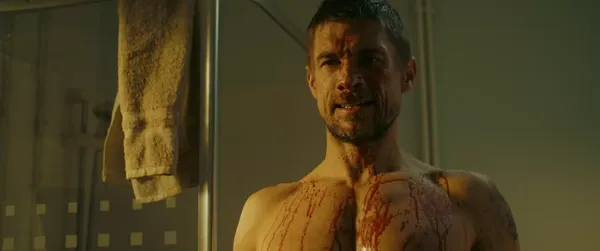
“When we got there, I was there first thing in the morning until last thing at night. I watched them build, I helped mix the blood, I chatted with them while they made the drinks. I lay there speaking with whoever, making sure the lunch was going to be on time for them whilst they put the blood on me – you know, that sort of thing. So I see it very much in two parts. All my work really as an actor came in the run up to the first day and obviously losing all the weight and doing all the weight lifting and the weight loss. And so while we were there, I was just able to immerse myself in the scene at that time.
“It was no stress in the build up to it because I was doing other stuff, and then we said action and then that was it. And then I'm in this fake blood and it's sticky and itchy and things like that. I don't care because it's part of it, isn't it? For a film that is so dark in its themes, it was just a great laugh to shoot because we surrounded ourselves not only with these incredibly talented and driven professionals, but also with the loveliest bunch of people. And it was just a pleasure and I think it had to be really. And also, off camera, we had a lot of women in the crew and it was a really good balance of banter. It kept the mood really light and positive and fun. So the whole thing for me, given what we were shooting, was just a privilege.”
“What I wanted, what I've always striven for in my work, is to make people feel things,” says Tony, explaining that this matters more to him than them liking or enjoying his work. “I want the work to be visceral, I want it to affect them. I want them to wake up with the film the following day. I don't have an encyclopedic knowledge of horror. I'm not a horror aficionado. I'm a filmmaker. I would think I'm just as adept at making a non-horror film as I am at making this film. It's the only gory film that I've made. But what I always want to do is make people feel things and then remember what they watched.
“That was my guiding light, really, in all of this. Whether it's humour, whether it's horror, whether it's on screen, whether it's off screen, I want people to be fully engaged, I want people to be fully focused and I want them to be feeling. I think we live in a society, in a world now where our feelings and our emotions are dampened by digital media, social media, and just by everything being done for us – automation, technology, etc. I want people to sit down and watch this film. I want them to laugh, I want them to cringe. I don't want them to cry, but I want them to feel it. I want it to leave an imprint on them. It's as simple as that.”
Protein is in select cinemas 13 June and will be released on digital platforms from 14 July.