 |
| The Revisionist |
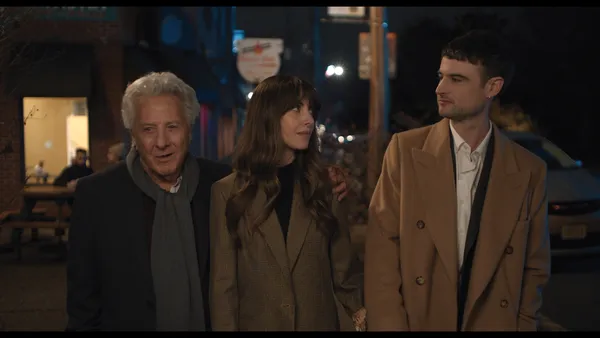
American director Alex Vlack's The Revisionist, revolves around four characters: Elise (Alison Brie), a bestselling novelist working on her next novel, her husband Jacob (Tom Sturridge), her father-in-law David (Dustin Hoffman), and John (André Holland), an old friend, and the one who got away.
Elise is struggling with writer's block, and Jacob's aging father, a legendary author, refuses to give his son permission to write his biography. The return of John, who David always had an affection for, stirs Elise's cunning mind. She suggests that John secretly record his conversations with David when he drops in to check on him and share the recordings with Jacob. It's not long before the clearly defined boundaries start to blur as secrets are dredged up and John calls his shot to redeem his once promising career.
The Revisionist is Vlack's début feature. He previously co-directed, with Demani Baker, the documentary Still Bill, about the American singer and songwriter Bill Withers. He has also co-produced the short film High Falls, starring Maggie Gyllenhaal, Peter Sarsgaard, and Ebon Moss-Bachrach, about the drastic consequences when a couple choose to confide in a friend. Vlack has also collaborated with Archbishop Desmond Tutu on a series of books and films, which he produced and edited. Among other notable ventures, he has produced the media for Moscow's Jewish History Museum and Denmark's Lego Museum, as well as creating a 200-screen installation for the Milan World Expo.
In conversation with Eye For Film, Vlack discussed manipulating his own life, feeling titillated in a gloomy way, and being out of touch with his own emotions. He also reflected on moral rationalisation, art and suffering, and finally staying put.
The following has been edited for clarity.
Paul Risker: A director's first feature is a milestone moment. It must be a surreal experience, because you go from looking towards it, to suddenly being on the other side of it. However, in your case, this could be dwarfed or rivalled by other things that make up your diverse output.
Alex Vlack: It's fair to say that it's still the hardest thing I've ever done, even though I do have 30 years of experience making media and complicated things. It might be a combination of the fact that it takes 700 miracles for a film to happen, especially when it's your first film, and you have to get people to trust you as a director. And then there are 699 counter miracles that are happening. So, you have to be at least one miracle ahead, and part of the difficulty with it was just how stressful that is. Things will line up for you, and then they'll be ripped apart again. You have to have tenacity, and I actually went grey doing the movie.
The technical parts of it were not particularly challenging with my experience, but the least amount of experience I have is working with actors. So, I was excited but scared, and also the most gratified and surprised about that experience. They were extraordinary, all of them, and they were emotionally in touch with the characters more than I was. And not only did I write the story, but it was manipulations of my own life and people in my life. So, you would think that I would be close enough to understand it on a deep emotional level tonally, and where these characters were going to go once you turned the camera on. But I didn't know as much as my actors did. The biggest revelation for me was watching the actors work and bring it to this emotional and profound level that I didn't even see coming.
PR: Are the actors able to see those things you didn't necessarily see because, like the audience who will offer unexpected readings of a film, they see the characters and story through their own unique lens?
AV: That's part of it, and again the characters were very close to my heart. The movie is, as you know, about someone who is doing what all types of novelists do: you write from what you know. So, you take characters in your life, and you base someone on a part or multiple parts of them. Then you can pervert them into being somebody who's angrier or more manipulative than the person in real life, and that's what the movie is about, and that's also what I did.
Dustin's character is based largely on my father, and some of the dialogue is verbatim, but he was not a cruel person. It was looking at what would happen if my father had been cruel, and I took him all the way to that place. And Tom Sturridge's character was ostensibly based on me. I've had experience of advertising long enough to know that it is hard on the soul. And I've gone catatonic myself, wanting to explore my own creative writing instead of making campaigns for other people, which Jacob's going through.
You would think that I would be so close to these characters, and in a way, I am. And that closeness is a reason I was able to write the dialogue that I did. But that closeness, at least, initially, prevented me from looking into the mirror on their behalf in the same way that you can look into the mirror on behalf of yourself.
Tom is a very good example of someone who is an extraordinarily deep thinker and thespian. He showed up in a very dark place for the role of Jacob. When Alison, Tom and I went to dinner the second night of filming, I told him I was delighted with everything he was doing. I was more than delighted, I was in awe, almost titillated in a kind of gloomy way of where this was going. We went to dinner to actually talk about their relationship and whether they have a happy marriage. I said, "Tom, you're playing this very melancholy. I love everything that you're doing, but boy, it's dark." And he basically rattled off all the horrible things that I have piled on top of his character. He said, "What do you want from me?"
I had become so used to all of these things that happened to Jacob, that if anybody out there is familiar with not being in touch with your own emotions, which is a very male thing, they'll know what I mean. Tom was absolutely right, and he played it to the hilt, as he should have. But it's a reflection of me, and I'm so used to all my problems that they don't hurt me anymore.
PR: I might have the opposite problem where I have a level of self-awareness that can feel suffocating. It's odd to say, because surely, we cannot be too in touch with our emotions.
AV: Maybe we don't have to call them problems, and I envy that of you. I'm going to therapy to try to be more in touch with my emotions. And my therapist even said that going to therapy might make me a better filmmaker. I would have liked to have arrived on set and known exactly that tone, but it still was wonderful and delightful to have them teach it to me as we went.
PR: There's the idea that no story is ever complete, and the process is one of trying to understand the story's themes, ideas and characters. If you get to the point where you know the story like the back of your hand, does it become stagnant?
AV: It's a real delight to be able to go into the making of a movie as a collaborative experience with everybody. This is a cliché, but it's true that a movie isn't made by one person. There are all these people on set, and you want everybody to collaborate, and you want all their ideas to rise to the surface. And with the actors, the last thing you want to do with them is to be so unbelievably prescriptive that they feel like they're just pawns on your chessboard. The better experience is to create something together and the only way to do that is to be open to that, and I tried to create that space for them.
I was very clear about that from day one with Byron Werner, my DP. He was unbelievable with prep. For a movie that only has five locations and four characters, and is very small, we had a 150-page-long PDF of every single shot blocked out. This film was highly prepped, and I also wanted the kind of clerical detritus of filmmaking to not be present as much as possible. So, we designed the rooms to have all the lighting that we could control built into the practical lighting and so forth. That way, we spent very little time changing camera angles and lenses, and there were very few C-stands in the actor's view. I wanted them to have the freedom to not be thinking about people clanging around with stuff and moving to the next position.
PR: It's interesting that you, Alison and Tom spoke specifically about whether they have a happy marriage, because Elise's first scene provoked me to ask this question. There's something askew about that relationship that doesn't quite fit.
AV: Part of that also comes from the fact that André's character is the idea of the one that got away. And Elise is playing with this idea of what it would be like if he actually came back into their lives. It's there right from the beginning, and you don't get to see them without him until after a lot of bad things have happened to them.
PR: Andre's character is like a pebble thrown or dropped into the water that creates ripples. They've been able to build this façade, and his return exposes the faults in the foundations of their so-called perfect lives. It returns us to the idea that people are good at repressing things but not being in touch with either their emotions or their reality.
AV: Absolutely, and that's very astute of you. We human beings do a lot of what Elise does with Jacob in their first scene together, where she tries to cheer him up and says, "Look, it's gonna be okay. It's gonna be fine with your father; you'll get him to talk." But you've just seen the level of cruelty that his father is able to unleash on him, which would be practically unbearable for any of us. So, yes, there's a bit of artifice that they put on. They have this beautiful house, and it’s a perfect life and all that stuff. So, you're waiting for it to be pebblised.
PR: There's also an aspect of the film that's about self-preservation and moral rationalisation. It's as easy to condemn John's actions as to understand that we ourselves could be tempted to make a similar choice.
AV: John says he had no choice and, on a meta level, I'm playing with a couple of things here. One is that sense many of us have when we feel: Well, I really have no choice. I understand that there may be some ethically compromising things about what I'm doing, but I have to do them. I just have to. I'm at that stage in my life where this is what I have to do. And then, on a meta level, there's a part of me that is interested in, and this is going to sound a bit goofy, but I guess only a writer would have this kind of goofy thought, which is, how do our characters actually feel? They don't have any control over what we're making them do. So, when John says he feels like he has to do the things he's doing, which is a universal feeling for even the most ethical of us, I'm playing around with the idea of a character who's being made to do things by this masterful hand.
PR: A theme that is not telegraphed, but whose presence you can sense is the tension between free will and fate?
AV: I play with it a little bit at the end. It's really meant to be just on that cusp of the playful meta thing and the things that people will actually do and say to each other. When Elise says that you need to "kill your darlings", she's making a joke about what writers say to each other, or is she killing her darling and all that? So, it's playing a little bit with which one of these things is it? Is it the puppet master of Alison's character or just the reality of the way that people still speak to each other?
PR: There's an intriguing scene where Elise is speaking with her publisher that touches on the idea of art feeding on suffering, which is somewhat of a naïve and silly cliché.
AV: I also want to make sure I really come out strongly on the side of I don't think that you have to suffer to make art, but I do think that art itself, almost invariably, needs to communicate at least some level of tension. And tension comes from suffering, and from the dark side of humanity, whether that's betrayal, grief or wherever it may fall on the scale. But pure joy is usually boring.
PR: I've often said that watching a happy film is less interesting, even insightful than a sad, tragic, and painful film. The latter is more likely to open up doors in your mind to explore memories and self-reflect on the person you are. That's just an inherent reality.
AV: Well, even really good comedies, and some of my best comedies are full of all kinds of cruelty. Great comedy like Monty Python is just one violent, cruel, and dastardly thing after the next, and that's why it's so good. I can't even think of any comedies that are truly great that don't have an extraordinary level of cruelty in them. And when they don't, they don't work, and they end up being pretty terrible. I love a great romantic comedy, but you have to have foils and foibles or else you can't laugh at those things.
PR: There are a lot of lines that pop, and I'm curious, is writing a great line one of life's simple pleasures for a writer?
AV: It is incredibly pleasurable. I'm a very structured writer and I fall heavily on the side of mapping everything out, just as Elise does on those note cards. And I don't start writing the script until I've got it pretty well mapped out. I also write pretty long biographies for all the characters before I start. That then gives me the freedom to know exactly what's happening next so I can just sit in the dialogue and not have to be thinking about structure. Then, I will heavily overwrite. The script is now somewhere around 110 pages, and I'm sure my first draft was closer to 200 pages because I just vomit out everything that I think is funny and clever and what works.
There were probably 40 or 50 revisions of the whole thing, and it's just a matter of wheedling it down. Then you get to these nuggets of gold that are left. And you do have to kill your darlings. While there were some great zingers in this, that's what happens in the writing and then in the edit.
So, yes, it's incredibly pleasurable. The only thing more pleasurable than that is seeing them work, first when you're shooting, and it lands, and then, of course, when they land with the audience — that's the drug. And honestly, sometimes it doesn't. It might sound too much of a joke or like it was written on the page, and nobody would ever say that. But when you're shooting, and they land, it feels so good.
PR: A filmmaker once told me that the person you are before you start a film is different to the person you are when you finish a film. Is filmmaking a transformative experience, or is there a delay to recognising any transformation?
AV: I don't know if I'm necessarily a transformed person, but I will say that yes, I have at this point roughly 30 years of experience making various forms of media — some of it documentary, some of it advertising, but most of it very complicated stuff for museums.
All my life, the longest I've ever stayed in one place was about five years. If I get to the point where I feel like I've stopped learning, then I quit — I just can't take it anymore. And the difference here is that after making this film, which was so exhilarating, I'm dying to make my next one — I want to do this forever. So, that's the big transformation for me. I called it a drug a minute ago, and it absolutely is the most exhilarating and rewarding art form I've ever been part of.
The other thing is I spoke to a number of directors who I'm friends with to get their advice before shooting. One of them told me, "It's gonna get really crazy; don't forget to have a good time because if you don't have a good time, why are you doing this?" It's good advice, and you have to remember that because it is insane. But I had an unbelievable time, and I really felt I was in my element. I've just gotta make another movie.
The Revisionist premiered in the Spotlight Narrative section of the 25th Tribeca Film Festival.