 |
| Ghost School Photo: Berlin International Film Festival |
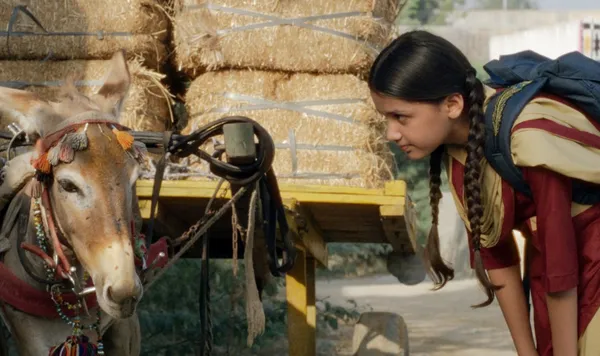
One of the highlights of this year’s Muslim International Film Festival, Seemab Gul’s charming but incisive Ghost School follows a ten-year-old girl who refuses to give up when told that she can’t attend school anymore because it has been infested by jinn. Her fictional investigation highlights a real world situation which is scary in a different way: the impact of corruption on education for the world’s poorest and most vulnerable children. Shortly before the festival, Seemab joined me to talk about both these things.
“Ghost School is my first feature after having made many short films, and in Ghost School I am the writer, director and producer and I also acted in it, in one of the small roles,” she tells me. I respond that that’s a lot to take on, first time round.
“Yes, well, it's a very long story. My first feature was already financed but the producers kept on stalling it and postponing it every year. On the third time it was postponed, I decided to self finance this film because I was tired of waiting and I was so ready to make a first film. So it was a momentous task. It was the most difficult, most courageous and most challenging thing I've ever done. I borrowed, I put my life savings in, I took a huge risk. I had cast and crew already in place in Pakistan when the producer refused to pay them. I wanted to do the right thing and I wasn't sure if I would do a short or a feature.
“Then I wrote this feature. I wrote literally eight drafts in ten weeks and shot it. So it was something extraordinary. It's not normal to do that; it usually takes two to four years to develop a feature. The other film took four and a half years to develop.”
It’s especially remarkable when depending on a child star. It must have been difficult finding someone who can carry the film in the way that Nazualiya Arsalan does.
“Let's just say I was lucky in that aspect, because the child is one of the most professional actors I have worked with. Her parents are really on board; her mother spends time with her. She knew the script by heart. Nobody else did. Neither did I.” She laughs. “You know, she is a very special and talented, almost genius child. She understood all the directions, she understood the story, the complexity of it, the lies in it. I asked her, did she know the meaning of ‘bribery’? And she even pretended she knew that.”
It's a fascinating subject. Are ghost schools – on-paper entities with no real life existence – a widespread problem in Pakistan?
“Yes, unfortunately. There are tens of thousands of ghost schools, approximately 7,000 alone in the province of Sindh and maybe thousands in Balochistan. I've seen some with my own eyes. And they're also in big cities, so no one can deny it, yet very few people know about it. This term exists amongst the English-speaking elite of Pakistan as well. So the term is, you know, an understood term, yet not everyone knows about it. There are approximately 24 million children out of school in Pakistan. There's millions of girls who are child brides. There are millions of children working, meaning child labour. All of these things are intertwined and a lot of it is to do with, sadly, poverty and lack of development as a nation altogether. Lack of resources, lack of opportunities, and then sometimes mismanagement and corruption.
“It is the worst for girls because first of all, parents fear their children, girls especially, travelling to a different village, to a different vicinity, to a different neighbourhood, even. So that fear is there. And then, like I said, there are millions of child brides. Children are married so early due to poverty, due to desperation of the parents or lack of education for the parents, and many other reasons. So, yes, it is worse for girls and there are a lot of NGOs supporting girls’ schools more than boys’ schools. But at the end of the day, ghost schools affect both boys and girls. It's the peasant class which is affected. A lot of these schools I came across, they were funded by NGOs to be girls’ schools, and there are boys studying there because parents are desperate to send their children to school, you know?”
Is the idea commonly linked with the idea of jinn and actual haunting, or is that something that she came up with just for the film?
She shrugs. “I think any building you leave empty in any city in the world for a long time becomes haunted, if that makes sense. In the loose meaning of the term. And then I had heard some wild stories, but I also wanted to fictionalise and metaphorically embrace the idea of ghost school and the term ‘ghost’, and I want to explore that more. And fear, for example, parents fearing their children going to a different neighbourhood, a different village. I wanted to address the idea of fear and, even more strongly, fear that stops girls in Afghanistan going to secondary schools today in the 21st Century. That fear I wanted to address through the idea of a ghost story, so the girl experiences fear, although it's not a horror film. The girl experiences fear and we experience that with her for as long as she experiences it.”
It feels relevant beyond Pakistan, in that there are many societies in Europe at the moment that are being driven by fear, in the media and politically. Was that something that she wanted to address?
“Yes, I did want touch upon the wider thing. Where the old blind man mentions that we blindly support these politicians and we give them our trust and then they let us down, it's a little commentary on the wider issues around the world. I also discovered that ghost schools are not only a problem in Pakistan, sadly, but of course beyond it. They exist in the Middle east, they exist all across South Asia, East Asia and further afield, as far as Turkey. These are the places that I have researched, but I don't know how much further these schools exist. So we're talking about absolutely millions and millions, if not hundreds of millions of children who are affected by ghost schools, and people don't know about it.”
At one point, Rabia is told by her mother’s employer that if she will move to the city, she can go to school – but she would end up being a servant. This too is a common situation, Seemab explains.
“Like I said, there's a lot of child labour and a lot of children work as servants in even middle class households. And so those children, they could come across abuse and they're open to violations and they're vulnerable. I wanted to address what are the options this girl really has if the only school in the village is closed down. Many households in the city where educated people live and even go abroad to study, they have child labourers, children working in their houses, so I wanted to address that too.
“I wanted to address the class division, you know? The fact that the principal says ‘Oh, some people don't need to study’, you know? It's interesting showing the film to children in Europe. At the Berlinale there was a thousand seat cinema with more than 500 children, and those children asked a very innocent question. They said, ‘...but why doesn't she go to the city?’ And they could not imagine children working. That really blew my mind. I would have put it more clearly had I known that children in Europe, couldn't imagine children working in Pakistan.”
We do see Rabia’s discomfort with the situation, I note.
“I think that's the rich lady,” she says. “Yes. And then some people asked, ‘But why isn't it better to be an educated servant than to be completely uneducated?’ And that's a very big question. It's a moral question. But for a child, a vulnerable child, to be in a private household, it exposes her to much more abuse than anywhere else. I mean, of course, some people are very good and educate them all the way and everything is fine and nothing bad happens to them, but that is a risk that her mother cannot take.”
Everything in the film feels very immediate, because it takes place in a single day. Was that always a central part of the idea, to make it a journey like that?
“Yes. To be honest, I was naive after watching some very low budget Iranian films and some classic Romanian films. Romanian New Wave was an inspiration, and I thought that these films were low budget because they were shot in daylight and it would be cheaper. But actually, for filmmaking, you need to have time or money. You can't shoot just daylight if you have just a very few number of days. So that was a huge lesson learned, that daylight is fine if you have a ridiculous number of days, if you can shoot again and again, which I couldn't. So the story revolved around one day – also because I wanted to see the child's impatience.
“I wanted to explore her impatience. You know, how children want an immediate answer and ask innocent questions really simply. So whatever she discovers in that day is what we discover, really. And then there's only one night that turns to morning.”
It's beautifully shot both by day and by night. How did she manage to pull that off in the circumstances?
“Thank you,” she says. “At the end, it wasn't as low budget as it could have been. I had this wonderful cinematographer, Zamarin Wahdat. She's Afghan born and living in Germany. We had this very strong understanding of our reference, our vision. I am trained as a fine art painter originally. So all of those things, they came together so beautifully.
“It was so hot – it was 40°C and we were shooting in November! So it was so hot, the children were passing out and I was really scared for their health. And I couldn't see because the heat. I was wearing sunglasses, I couldn't really see what was going on. So I actually started to see the beautiful images come through in the grade many months later, and then I started to really appreciate the work of Zamarin, who I would love to work with again. We have worked in the second feature together too.”
So how has the film fared since completion?
“I'm still looking for UK distribution. I would love to have UK distribution. It's very important for me. It also opens me to the awards opportunities in the UK. The film is not a British film, sadly, because I didn't register my company fast enough. It was a German co-production with Pakistan as a lead country, which is rare, although the money came from my savings from the UK, so...” She sighs. “It's complicated. We are going to cinemas in Pakistan in August, in Germany in September and in Italy in November. I'm very happy about that. But you know, in London, in my home country, I would love to bring the film to cinemas. We have the largest South Asian diaspora in the whole of Europe. It makes the most sense to have it here in the cinemas. So that's my aim, to find a distributor in the next few months.”
“It's great to be at the Muslim International Film Festival. I think, more than ever, we need diverse voices. We need a better understanding of different cultures. There is a lot of persecution going on these days. So I think, to address that, the Muslim International Film Festival is a great place to be. I'm very pleased and I can't wait to bring my film to new audiences in London. I got the best director award at the UK Asian Film Festival. I'm really honoured to carry on travelling. We are still going to three or four festivals a month.”