





Eye For Film >> Movies >> Immrám (2025) Film Review


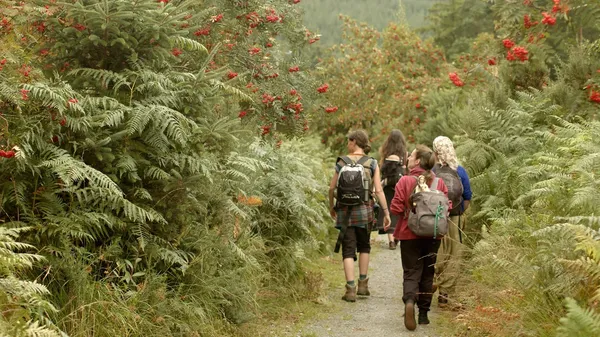

“When you pray to they statues you’re really praying to God, your mammy,” the boys are told, as they part a thick curtain of ivy to see the face of the Virgin Mary before them; “but the statues help.”
Every year in recent memory there have been a few more of them: Irish people returning, as best they can, to the old Celtic ways of living, trying to revive in spirit what has been erased in practice. Not quite able to shed the deeply ingrained habits of Catholicism, they fuse them with scraps of older lore. Throughout this film the Hail Mary resounds, but with different objects, different interpretations on each occasion. The curious boys are schooled in ideas about ancestry: the love they find in their parents, who were loved by their own before, all the way back to the Great Mother and Father who created, and love, us all.
The chaotic ways of children run through every aspect of this documentary, which screened as part of Docs Ireland 2026. It focuses on a family headed by an Irish celebrity: former Wexford hurling captain Diarmuid Lyng. Inspired in turn by the teachings of mystic John Moriarty, who pops up at intervals, preserved in archive footage, to wax about the wonders we can find all around us, they are engaged in a conscious process of spiritual wilding, and attempt to throw off the learnings of colonialism and become wild Irish.
Diarmuid speaks fluent Irish already. To achieve their shared goal, his partner Siobhán is learning it. Their children flit between Irish and English, but seem to favour the latter. As the adults strive to become more childlike, more open to possibility, they endeavour to impose rules on the world, to bring it within their sphere of understanding. Uisne, the oldest boy, is learning practical skills like how to cultivate a fire. His wee sister Ériu, a sprite with a mop of yellow curls, is a ball of energy, quick to run and climb. Balancing precariously on a gate, she urges their dug Dubhy not to noise up passing cattle. “The cows are our friends,” she says repeatedly, sternly, whilst the great brown and white beasts take turns to press their snouts into her face as if to return the sentiment.
They spend time on the beach; they spend time among the trees. They notice how the people of the town like to stare and point at them. There are more folk in their community, a cluster of interrelated families. They sing as they walk, bathe beneath a waterfall, and hold ceremonies on the moors, where a giant wicker sculpture sits on a mound overlooking a circular pool. A hungry Siobhán takes a bit out of the sacred apple of abundance, using her pregnancy as an excuse. Later we see the baby, but we never learn the circumstances of its birth. Would that be too intrusive? It seems pertinent, as they mingle sometimes with others. Do the people of this community make use of hospitals, of modern medicine?
Questions of that sort go unanswered. Directors Michael Holly and Mieke Vanmechelen simply immerse themselves and observe. It helps that their subjects often openly discuss aspects of their lifestyle choice and faith. This isn’t always coherent, but they don’t pretend to be experts; they’re more interested in exploring. There’s a wonderful sense of liberty to it, and yet that liberty seems to be a product in part of past success in acquiring wealth. Still, though one can see why people might mock them, seeing them as feckless hippies, it’s interesting to take a step back and ask oneself how we learned to think that way. How eagerly do we reinforce structures that keep us in line?
One night, in the darkness, the men engaging in a chanting ritual to seek out the mother inside of themselves, and it feels far healthier than the popular male bonding rituals most of us are used to, whilst clearly serving as profound a need. Diarmuid draws on similar techniques as he coaches a hurling team. Siobhán swims in green water and sets her tired body at ease. The gender divisions are accepted by al, but stark; one wonders if the community will be as easy going should somebody refuse to accept them. It’s another unanswered question. Perhaps speculation is itself inappropriate here. Everything is focused on the present moment. In the wonderful child-infested chaos of the couple’s home, there is no time to worry about possible futures; and that, too, is freeing in its way.
Scored by Caoimhin O'Raghallaigh’s fierce strings, sometimes sweet and sometimes full of dark presentiment, Immrám is a cleverely ordered look at a carefully disordered way of being, an Irishness hewn out of the land, not yet fully sculpted. If one is going to give oneself to a cult, better one with a dead leader. Better something still full of possibility itself. Likely more radical than Irishness ever was the first time round, it might yet find its magic.
Reviewed on: 21 Jun 2026


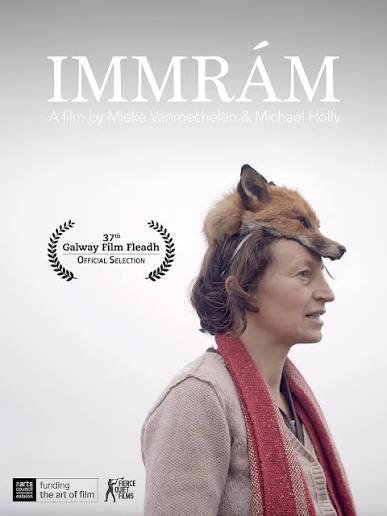
Director: Mieke Vanmechelen, Michael Holly
Starring: Siobhán de Paor, Diarmuid Lyng, John Moriarty
Year: 2025
Runtime: 90 minutes
Country: Ireland
Search database:
