 |
| Summer War |
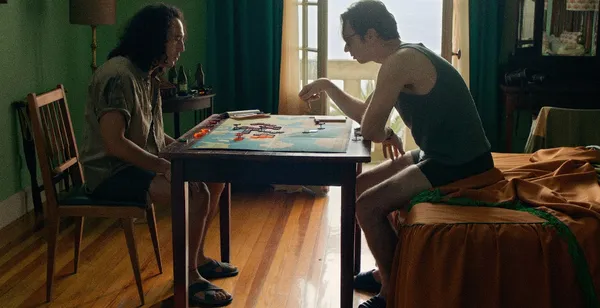
Chilean director Alicia Scherson's Summer War is an adaptation of Roberto Bolaño's posthumous novel The Third Reich. Set in 1989, a referendum has seen the democratic rejection of Augusto Pinochet's regime placing Chile on the precipice of significant change. Vacationing at a beach resort is American wargaming champion Udo Berger (Dan Beirne), accompanied by his girlfriend Ingrid (Lux Pascal). Risking her annoyance, Udo finds ways to isolate himself in their hotel room, playing a tabletop game that recreates the European theatre of war during World War II. But it's not all about play — he has a print deadline for a gaming magazine he writes for.
Udo and Ingrid befriend another couple, and when the man disappears after going for a swim in the sea, their vacation takes on a dark mystery. This is offset by Udo's obsessive lust for the hotel owner, who he remembers from vacationing there in his adolescence. Then there's the mysterious local he invites to play, which reveals the depths of Udo's obsessive nature.
Scherson's The Future (Ill futuro), about two orphan siblings, a brother and a sister navigating the perils of adulthood, was an adaptation of Bolaño's A Little Lumpen Novelita (Una Novelita Lumpen). She has also co-directed with Cristián Jiménez, the comedy Family Life (Vida De Familia), an adaptation of Chilean writer Alejandro Zambra's short story. Scherson made her feature début in 2005 with the comedy Play, a story about a nurse, a depressed architect, his missing briefcase and estranged wife. Her sophomore feature Tourists (Turistas) follows a woman abandoned by her husband on vacation, and the unexpected connection she makes with a former Norwegian pop star. Tourists has shades of the relationship dynamic that will play out in Summer War, albeit in a different context.
In conversation with Eye For Film, Scherson discussed made-up art, finding freedom in literary imperfection, and simple plots. She also spoke about being forced to forego a traditional three-act structure, marrying Forties and Eighties cinema, the birth of a new world, and being content with the impossible.
The following has been edited for clarity.
Paul Risker: Why filmmaking as a means of creative expression? Was there an inspirational or defining moment for you personally?
Alicia Scherson: Wow, that's a big one. Well, I guess I came to filmmaking randomly. I was actually studying science… I'm a biologist. And as an undergrad I was not happy with it as a career prospect.
I liked theatre, photography, reading, and writing, but I wasn't a musician or anything like that. I notice now, with my students, when you feel like you want to be an artist, but you don't really know what that looks like, you end up in filmmaking. No kid is a filmmaker; it's such a made-up art. And so, when you're a little confused, and you don't know where to go, you end up in filmmaking. That's my theory at least.
It was by chance I found this amazing international film school in Cuba that offered scholarships. I applied and ended up leaving home when I was still young. Once I was making films, I felt comfortable there.
I was always interested in theatre, writing and photography, but never enough to just pursue one on their own. Instead, I liked cooking with all of these different ingredients, and that's how it started. I stayed on that path and never went back to science.
PR: There's the obvious conversation about the striking difference between a first and a second feature, but is it the same regardless of what number film you're on?
AS: Of course, and as you say, the biggest difference is between the first and the second ones. That's where the big gap is. You either do it or you don't, and that's all there is to it.
The first big difference is that in the first movie you want to do everything. Then, after the second one, you become confident that you're going to make more films, and you can try different things, meaning you can narrow your goals for each one. That's when I started doing literary adaptations, for example, which is something I wouldn't have done before, because at that point, you want to express everything you have inside of you. By your third movie, you say to yourself, "Okay, I'm going to just adapt this book because I know I can do something else afterwards." So, that's one difference.
One measure that is useful for me is that I now tend to use more of the material that I have shot in the final edit. With my first film, there were a lot of scenes that were written, shot and edited that were left out — whole parts of the story and actors that were never able to see themselves onscreen. Gaining experience, you shoot what you need, and the gap between your ideas or what you dream, and the final result of what it looks like onscreen starts to become smaller.
It's always the same in terms of risk, in that you don't know anything at the beginning. And then there's financing, of course, which gets harder because the movie world has shrunk so much, and also because there are more opportunities for first-time filmmakers. This is not a criticism because it is as it should be — it's important that we promote new talent. But the older you get and the more movies you have made, it becomes harder to finance them, unless you're a superstar.
One, of course, becomes more ambitious, and when you are trying to make international co-productions and put together the financing, the films only become more expensive and difficult to finance. So, it hasn't become easier, even though I'm on my fifth movie.
PR: When adapting a literary work, is it more about capturing the spirit of the source material than offering up a faithful adaptation in terms of plot and character?
AS: Yes, and in the three books I've adapted, especially in the two Bolaño ones, which I directed solo, I wanted to capture the atmosphere and the tone. And that's the hardest thing, because it's not written down anywhere; you have to find it. When you read a book, it'll conjure up an image, but when you try to adapt it, and you go through it word by word, that image is not written down anywhere — it's only in your mind. That's magic and that's the beauty of literature. And I really do consider literature to be the superior art compared to filmmaking. I think it's on a whole other level.
The first of Bolaño's books I adapted surprised me. I said to myself, "It's all there. I don't even need to write a script. It's so visual, I'm going to just shoot it." And then when I started going through it line by line, there wasn't even one adjective. There was nothing to describe the room as big and orange… nothing. Where had I read this? It must have been in another book. So, then I had to write a script.
Movies are concrete. If you put a chair in a movie, it's made of a certain material, it's a certain size, weight, colour, and style. When you put a chair in a book, you just write 'a chair'. That seems obvious, but I really discovered this in my adaptations. And it's something I find fascinating, because then you get to the question of where I put the camera to create this feeling?
At least in the adaptations I've done, I tend to respect the plot. My own changes and input are not what matters for me — it's about trying to recreate this feeling.
PR: What was the motivation to adapt Bolaño's The Third Reich?
AS: Well, I think I got a little trapped in the Bolaño universe after the first adaptation. It's a big one, like a swamp with its many layers. I've also read a lot of Bolaño's other books too, which are connected by the themes and the characters. And because of the first film adaptation, I found myself in deep, and it was really hard to get out. At that time, I read this other book, and the one thing I wanted was to make a movie with a main character that wasn't like a man. It's difficult to explain why some things move you, but I just found myself drawn to it.
The two I have adapted are not considered to be Bolaño's best novels by literary critics, which for me is good because you can play around. When I read The Savage Detectives, for example, I felt it was perfect and didn't need to be adapted, nor did 2666. But the two I've made, that are a little B-side, the first one, A Little Lumpen Novelita, Bolaño was commissioned to write it. So, that's not the same as something original that is borne inside the writer. And this last one, The Third Reich, was his first novel. He never wanted to publish it and so, it was published posthumously. But the seeds of many of his other novels can be found in this one. Being his first, there are a lot of obsessions and even characters that will repeat themselves. But this is raw and it's not perfect. It's very good, but it's much messier than his other books, and that was appealing to me because I was freer to adapt it.
PR: Summer War appears to be driven to impress on its audience a feeling of claustrophobia, of being trapped in this place with Udo. Instead of presenting us with themes, we wander around casually observing the milieu, and one might say, without a sense of purpose.
AS : There is always a very simple plot in my films, but then, there are other things to distract you from the plot once you're into the film. And the plot is something I like to work around. In this film, the main character gets trapped in this place. It's supposed to just be a vacation, but then things start getting complicated, and the movie is also in two parts — it's split in the middle, the same as the book.
When I was writing the script, I tried for a while to make it the more classical three-act structure, where the initial turning point where a character disappears is in the first third instead of right in the middle. But it just didn't feel right, and so, the story ended up being in two halves.
One half is a vacation movie where you're waiting for something to happen, and then when it does, the plot twists completely and the film becomes more of a psychological game. And what unites the two halves is the main character and his obsessions.
PR: One of Udo's intriguing obsessions is with the hotel owner. It can be read that she's a cat playing with a mouse or a woman toying with a young man. This interaction tells us a good deal about him and his relationship with Ingrid. But could we also say that outside of this obsession, he's a sad and tragic character, who appears to think he has more awareness and power than he does?
AS: It was a mysterious character in the novel because he met her in his adolescence. So, he has an infatuation with this woman but the main thing for him is it's always gaming. And the reason he stays is because he has kissed this woman. He's self-indulgent, and once he resumes playing the game, then everything becomes about gaming again. That's the main thread of the film and all the rest of it kind of falls apart.
Udo is very self-absorbed. He doesn't connect with his girlfriend, and he doesn't connect with the political situation in Chile. He sees only himself, and his guilt or his sin is not seeing what's around him.
PR: The film's playful visual language complements the film's humour, which, given the character's obsessive nature, can lean into the absurd and extreme. What was the thought process behind the cinematography?
AS: We had two time periods of film mixed together in this movie. One is World War II and all the references to movies from the 40s, including classic mise-en-scène as well as the credits. Then there's the 80s, which is when the movie takes place. There are some connections between these two periods. For example, the onscreen effects, like the iris in the split screen are from the 40s, as well as the 80s, but in a very different way. It was fun to have the playfulness of going from one decade to the other.
And then we really wanted to have it be contained. So, the composition of the frame was very strict, and it always centred on the main character. Everything we see is either him in the frame, or it's what he's seeing. The visuals also change, becoming slightly deformed as he starts going a little crazy from being stuck in this world. And there's also all the archival material from World War II.
I talked a lot with Manuel Ferrari, the DOP, and Marcelino Carballo, the art director, and while there's all this playfulness, it's still very strict in terms of the usage of lenses and the colour palette. And then, we wanted to really make this a specific world you experience, that's not really Chile in the 80s, nor is it the war years. Instead, it's inside this guy's mind, and that's why we wanted to make very specific choices in terms of the visual language.
PR: The archival images of a war driven by a dictatorial strongman, feed into Udo's own insecurities and efforts to empower himself. Outside the archival images, was there any other political messaging or metaphors used to deepen the film's subtext?
AS: 1989 was a very special year. And when I realised the novel was written that year, this whole other layer appeared that's not really in the book. When you write something, you're living it, and you don't have the historical perspective.
In Chile, the dictatorship ended right at the end of 1988. A referendum was held and the no-to Pinochet side won. But Pinochet and the military stayed in power for a whole year, and then at the end of 1989, we called an election and got ourselves a democratic president. It was a weird year in terms of how mistrusting people were, and how nobody knew what was going on. It was like: Okay, we're a democracy, but this guy is still here. We were trying to open ourselves up to and become part of the free world, to capitalism, and the influence of the US, but we still had the military on the streets, and nobody trusted anyone. So, there was an intense atmosphere and 1989 was also the year the Berlin Wall fell, marking the end of the Cold War, which began at the end of World War II.
Udo's final line is that a new world is about to begin. The film is the last moments of that world, after which the world we're living in right now began. We don't know when it will end, but I think this current post-Cold War era started then in 1990.
It was interesting for me to add this layer to the crazy mind of the main character, who is living in a world that's about to change. All his obsessions of war, this world he has lived in that he adores and is passionate about, is going to end. And in the final scene, you even see the first computer version of the game. He says, "I'm gonna buy a computer." A new world is about to begin in this regard too — computers and the internet, and the way the political world now functions.
PR: Picking up on your point about Bolaño not having the benefit of hindsight, is there a sense that your adaptation completes or adds a final layer to the story? And do you see the audience playing a role in completing the film?
AS: I began adapting The Third Reich during the pandemic, prior to the current political situation. It was like another world, and when the audience sees it at the festival, what war means now is totally different to what it meant seven years ago when I started, and, of course, in 1989. I'm curious and anxious to see how the film is read because the world has changed so much.
PR: There's a tendency to assume a filmmaker has a thorough understanding of the film they've made. However, a story speaks to its author who themselves are trying to understand it.
AS: There's another layer in the movie about masculinity and violence, and I really took the process as being about researching that subject. I tried not to be stereotypical and find a macho man. Instead, I found this guy that is fragile and isn't violent, but he has violence inside of him.
I don't have a conclusion at the end to say this is my theory about men and war. And I don't think I'll ever get there because it's impossible. But we'll see what happens.
Summer War premièred in the International Narrative Competition at the 25th Tribeca Film Festival.