 |
| Shadows Of Willow Cabin |
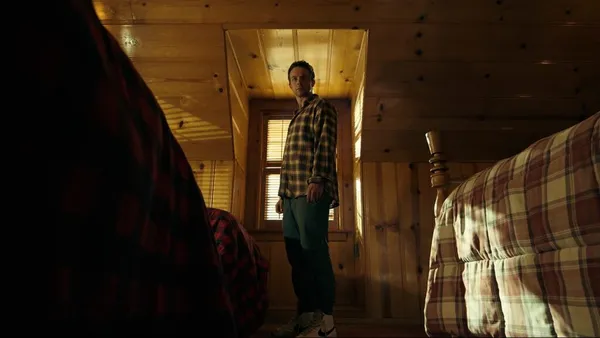
People from lots of different backgrounds enjoy horror films in lots of different ways, but are they always horrified? Not really. Although there will always be exceptional works which scare pretty much everyone, it’s difficult to be scared by yet another monster or maniac if one has dealt with scarier things in the course of one’s own life. Joe Fria’s Shadows Of Willow Cabin which plays with familiar genre tropes but whose true focus is on something much more true to life. “I always like to think of horror as like, what are the things that truly scare you?” Joe explains when we meet. “When I was searching for an idea that was contained and small in order to make this budget small and be able to do this film quickly and efficiently, I was trying to think of something that really terrified me personally. And one of the ideas that popped into my head was this.
“It’s the idea of the secrets that men keep from each other and the damage that they do over generations. And that to me, like the trauma and the cycles of abuse that spawn from that problem, is terrifying to me personally, as a father now. It seemed like a good launching point for a deeper and more terrifying level to a traditional haunted cabin in the woods kind of scenario.”
It's certainly a practical film for doing on a low budget, with just two characters most of the time, and a small location. Were those aspects of the film motivated by the need for economy?
“Yeah, that's almost exactly why I had been wanting to transition into film directing for a while. Mostly, for my job, I direct voiceover for animation and dubbing, but I have been wanting to transition to directing film. I had a couple of scripts that I had written and wanted to make, but they were very expensive and nobody really wants to give money to somebody who hasn't done a film yet, at least money of that scale. So I really wanted to do something contained and small that I could do quickly and efficiently and get it done and turn it over and get it out into the world to prove to people that I can do it so I could move on to the other projects that I wanted to do.
“It began with that, and it began with the idea of keeping the cast very small, in a single location, and then it built onto that. As I started to deepen this initial idea of these two men in this cabin, I started to explore deeper issues that I personally was dealing with and started to weave those in. That's where it sort of took off and flourished and became what it is.”
Sometimes a small, pared-down film is better suited to showing off one’s individual style as a director, I suggest, and he agrees.
“When you're dealing with a tiny budget like we had, in a really limited amount of time, it forces you to really expand your mind creatively and find creative solutions to make the film feel bigger and more expansive and more generally impressive than it otherwise would be. I think that's why I'm really proud of it as the thing I intended it to be. There were so many aspects of it that I had to devise in order to make it something so intimate and small and expansive and chapter driven – anywhere from the different colours of the film as you go along, to the geography of the cabin, switching and changing – and of course the climax of the piece, which is all very meticulous editing to really push the storytelling in a way that feels a lot more effects-driven than it actually is.”
Drawing on viewers’ familiarity with genre film allows him to take some shortcuts, I observe.
“That's right. And again, when you're dealing with something in limited time and limited space, you really rely on those who came before you – and I'm a huge student of horror. There are certain things that can be tools in your toolbox that come directly from other directors. It's not like you're copying them, it's just that they created great ways to efficiently tell a creepy tale. I need efficiency. I'm telling a creepy tale. I'm going to go ahead and borrow from the masters and use their techniques.”
It's a great pretext for that because there are two characters who don't really know each other at all, who are going to be in an isolated space together, and over time each man becomes aware of his vulnerability vis-a-vis the other, keeping viewers uncertain where to place their sympathies.
“The actual chemistry of it all with the two actors was something that occurred almost by accident,” he says. “The casting issue that came up was the two men that I wrote the story for ended up having other jobs that they had to go do. And I was left without a cast two weeks before we started shooting. And so last minute, I got a wonderful theatre actor I've known for years and years, and this beautiful young actor to play opposite of him that I had just known through a casting director on Facebook. They literally got to know each other as we shot the movie. They had a week online to rehearse with me, and then we had one day in LA where we physically rehearsed and blocked with each other. Then they drove up together to Big Bear. So they had that two hours together to get to know each other, and then we shot chronologically all days and all nights. And so really what you are seeing is their true chemistry building in real time. It was really them figuring each other out on set and that genuine sort of relationship forming on film. It just took the whole film to another level that it was real.”
I note that there are two things going on in the film most of the time: the men’s fears and their uncertainty about the situation in the cabin; and then also their insecurities about each other, which to me is what makes it an interesting relationship.
“Absolutely, “he says. “I'd actually written a whole scene about it initially. For me personally, that is a big ordeal in my own personal life: the physical insecurity issues, and particularly with my body. I wrote a scene between them in the hot tub where they talk about it, but the problem is that scene ended up feeling a lot like some of the previous scenes where they're discussing personal issues. I just needed to kind of move the story along at that point, so that scene got absorbed into the montage.” He smiles. “I'm a child of the Eighties and a musical theatre person, so there's always a montage in my movie.
“I told the story from a very personal point of view. I'm bisexual. I didn't know that at the time when I wrote this – I was sort of coming out. I mean, I knew it, but I hadn't really come out about it. I had these interactions in, you know, in. In homosexual environments, and it was always encased in shame for me. I never really thought about it in a way that was, well, public, for one, but also healthy, for two – so there absolutely is that aspect of it. But at the same time, I wanted a universal sort of feel to the relationship as well. I didn't want it to be a gay thing or a bisexual thing. It's just a relationship that's forming. I wanted it to organically flourish, all based on where these two men were coming from.
“I think for me, the most interesting thing was that it's two people coming from a need. They each had an individual need and they just happened to meet with each other. And that's what changed the pattern of things that was happening with them. So that is a universal concept that happens to anybody who falls in love. There's a time when it clicks and all of a sudden you're like, ‘Wow, I feel like I've known you forever, and suddenly I'm comfortable with who I am, and I feel like I can tell you anything.’ I wanted that to be something that all audiences can relate to.”
I tell him that I'm always interested in films with failed sex or sex that doesn't happen in the ways people expect, because I think there's storytelling potential in that. I like the awkwardness in this relationship and the connection that forms as a result.
He laughs. “Yeah, absolutely. I’m really proud of the way it came out was the, that the intimacy of their situation allows there to be a connection without sex. You know, they do have a version of intimacy, but it's not like straight up. I went back and forth as to whether I wanted them to have sex or not, and at the end of the day I came to the conclusion that it doesn't matter. That's not what it's about. And once I released myself from that, the true intimacy of their relationship came through. It was more about the emotional experience of it.”
He goes on to tell me that shooting in chronological order extended to the special effects.
“We did it all in real time,” he says. “We tried to make it so that it was scheduled out in a way that could accommodate whatever makeup and stuff we needed, and we did it chronologically like that. It’s all practical, of course. We didn't have the budget for special effects, but also that's my favourite thing, practical effects. And there's one particular shot, actually, the daytime shot where we pan the camera across the room and a bunch of things are happening. That was very much like a Jim Henson crew of hidden puppeteers. It makes me smile every time I watch it just going ‘Wow, we made it look haunted!’ It's so cool.”
So was this a big learning experience for next time?
“Yeah, absolutely. I mean, I learned how to be a captain. That was the biggest thing for me, learning how to be the person that keeps people inspired and keeps the atmosphere positive and light and engaged so that everybody feels like they're doing something important and equally that there is no hierarchy. That was something I learned that I could do, and I'll take it on to my next one.”
How does he feel about how it has been received?
“It's pure joy.” He beams. “I don't even know how to describe what it's like not only for people to like the movie, but to understand it in such a profound way, especially when it's something so revealing. It was definitely me walking out into the world with my pants off, you know, in the beginning when I first showed the film. And now I feel so loved and embraced and accepted.”
So what’s next?
“We are working very hard on our next film, which is called Jacob. It is a darkly comedic horror film about a legendary Eighties slasher character who decides that he wants a second chance at life and gets a job and falls in love with a deaf waitress, only to be confronted by his past with the US government. And he has to make the decision to be the monster he was designed to be or the human that he wants to be.”