





Eye For Film >> Movies >> Colors Of White Rock (2026) Film Review



If you ask people to conjure up a mental image of the Gobi Desert in southern Mongolia, most would probably say they are thinking of a wide open sandy space that is potentially home to nomadic people. Mongolian director Khoroldorj Choijoovanchig – expanding on his 2022 short Lady Of The Gobi – shows us the reality is very different. That’s because the desert is a rich coal resource, something the country is exploiting to improve its economic prospects by shipping vast amounts of the stuff from open cast mines to China.
Early scenes in Colors of White Rock – the region where the mining takes place – show the impact of the mining on the landscape. The black scars of the open mines stretch out, while a huge line of trucks snakes across the desert. Drawing closer to them, we see blasts sending gouts of black coal dust upwards like a fog.
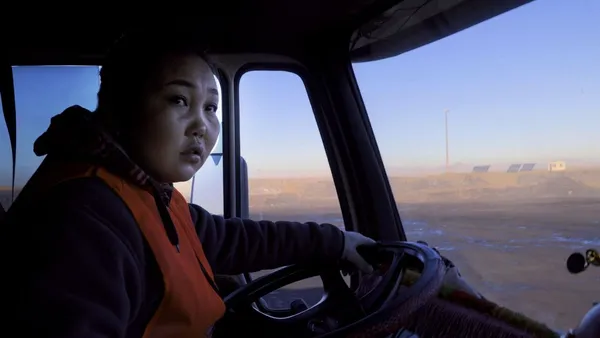
This is where single mum Maikhuu, the focus of Choijoovanchig’s film, works for a living. One of the few female truckers, her life is spent arduously loading or unloading coal and navigating the treacherous and truck-crammed road that leads to the Chinese Border. Her voice-over narration guides most of the film, although there are key moments when she speaks more directly to the camera, which adds to their emotional impact.
Her narration is an evocative mix of personal biography and observations about the massive changes that Mongolia has undergone during her lifetime, as coal hauling has replaced sheep herding. Despite the poetic nature of much of what she says, this is also a clear-sighted view that acknowledges the economic benefit of the mines – which support a whole network of people beyond the miners and truckers themselves – while still lamenting the environmental impact. “Nature cannot speak, it weeps,” she says. The sense of melancholy is further underlined by the mournful electro score from Gael Rakotondrabe.
Choijoovanchig shoots with Maikhuu in the cab on the journey south, the bumpy movement of his camera highlighting the state of the roads, with accidents also shown to be an occupational hazard in an industry that doesn’t care much about its workers. The director also shows Maikhuu on her visits home to her young family, who are being cared for by her younger sister in her absence, offering joyful breaks from the routine. Choijoovanchig strikes a fine balance, using drone shots to illustrate the bigger picture while retaining the intimacy of the cab and home environment. He also spends some time with a union representative, nicknamed Gray, who notes that the truckers “are buried in debt but they still want to make their children happy”.
Shot across several years, the timeline would benefit from being clearer, but the impact of Covid on the truckers’ work is shown to be acute. The toll the job takes on Maikhuu’s personal life is also evident, but her ability to keep on trucking, not just at her job but through her homelife struggles, shines out.
Reviewed on: 11 Jun 2026