




 |
| Journacide: The War On Truth |
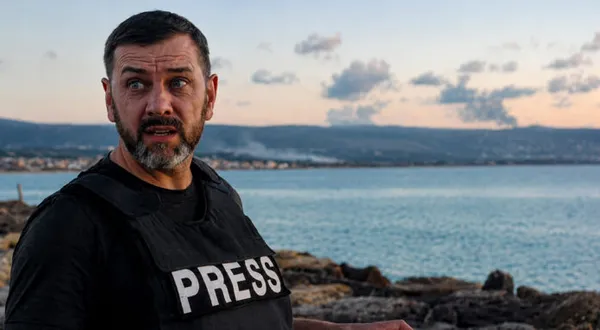
Seán Murray was in a good mood when we met just ahead of Docs Ireland, where his film Journacide: The War On Truth is screening. He had just had a call telling him that Amy Goodman wanted to meet him, and inviting him to appear on the Democracy Now programme. It’s a big deal for him because he doesn’t think it would have happened without the festival, and because for him the point of his work is not simply to get attention to his work for its own sake, but to get a message out there – to let more people know the truth about what’s happening in Lebanon and Gaza.
The film centres on the killing of journalists in Lebanon by Israeli forces. The current count is 28 dead and at least 15 seriously injured – far too many for it to be accidental – and as I write, cameraman Ahmed Washah has just been declared dead after a targeted strike on a refugee camp in Gaza. It’s something that feels personal for me as I have friends in Gaza, and I tell him that I found particular resonance in an early line in the documentary, where he says that this isn’t a film about war but about friendship, love and the indomitable will of the human spirit. In particular, there is a great warmth towards those who are trying to get real stories out.
“I think for this kind of Gaza doctrine to be enacted on Lebanon and what happened also in Gaza, the need to dehumanise people for the genocide is the first thing that they have to do,” he says. “And you have to have an effective media for doing that. You have to effectively attempt to control the means of mass communication. Historically, the West and Israel in general are very good at that. But they do not want you to show you how human these people are, and we see that, and that's the reason why I give that message of love and friendship. These are ordinary people who have families, friends and that sense of the human spirit. I think it comes through in the documentary, you know.”
So how did you decide to make the documentary in the first place?
“I was in Lebanon in 2006 at the end of the 34 day war, but I was just a neutral observer. It's been interesting because I'd seen the many parallels between Lebanon and where I came from in the conflict in the north of Ireland. Coming from Belfast, I'd grown up with the conflict, and living in West Belfast here on the Republican side of the peace wall, if you like, we were badly affected by state violence. There was always that apathy towards state violence because we had experienced it. The first four members of my extended family were killed by the British state here. So I’d always longed to go to Lebanon, and I just took it upon myself to go.
“Once I did, in 2006, I fell in love – primarily with the people, but I mean, the country in general is just absolutely beautiful. Even amongst the devastation in the south – because the south is really bad – there's just such beauty in the people. I think I mentioned that in the documentary. You know, people who are affected by conflict, there's this inner beauty that just shines through.
“It was June 2024, and all I wanted to do was document. I built friendships up and became friendly with a number of journalists and filmmakers there. Of course, that takes time, but I just wanted to document from the beginning. When you're a filmmaker and you're a storyteller, something will come through, and for me, the story was very different because the story was in the people that I was working with. They were the story, you know? If I just kept with that, I think that would have confirmed something special, and I hope the audience sees what I see now.”
It’s strange to see the early scenes of him in Tyre, I say, because it looks so peaceful and far away from war, but when the camera turns to look across the bay we can see that villages there are already being bombed.
“Yeah. I don't know if you’ve seen Oliver Stone's Salvador. It's a drama, it's not a documentary. It's funny because there's a scene at the main base for the journalist, in this hotel with a pool. It was exactly the way, and it's one of my favourite films. Besides the fact that James Woods is one of the leads in it. I've had a wrestling with that over this last couple of years. But, you know, it just reminded me of the scenes in Salvador during that period then: there's this beauty but there's this destruction all around. I remember leaving here that night to go to Beirut, and we were warned not to go, and I didn't really tell it in the narration, but if you see the car journey on the way up to Beirut, we're the only car on the road.
“It was the only time in the last couple of years that I've been scared, and I was there during the war. I thought ‘I don't want to be killed’ that night, I really did. I felt that was all, you know?”
I mention that the other thing that I've found with talking to people in Gaza is that journalists are just loved over there in a way that we don't encounter in the West. People see that danger, and they're really respectful towards people for coping with that. Also, just the idea that people are there to tell the truth is a huge thing to them.
“It was quite different when I was growing up in the conflict here,” he recalls. “Journalism and the media in general were used as a weapon against the community that it come from. There was this monopoly on the narrative about what happened here, so basically, I came from a terrorist community the same way that the Israelis try to portray the Palestinians or the Lebanese who resist. So the media, filmmaking, journalism was kind of a bad word for me, and still to this day is not great. I identified with that in quite a different way. But you’ve seen that we were loved with. You know, we couldn't film in a house without having to sit down with a meal. People just are so giving and so loving in Lebanon, and it's the same for the Palestinians also.”
There are a lot of dangerous situations in the film. Did he every worry that he could be putting people he was working with at risk?
“I don't think there was a point that I was putting anyone in danger because whether I was there or not, these people who tried to make sure I was safe would have been working with someone else anyway,” he says. “That's their jobs, that's their daily routine and that's what they do. But yeah, there is this always this sense, even when I leave – I feel this kind of guilt when I leave Lebanon. Is it going to be the last time that I see my friends?
“Just two nights ago there was someone killed, and the description that was given for that person to be killed, I was almost certain it was a friend of mine. So I called that friend and I couldn't get through, and lucky enough, someone else who I contacted informed me that no, they'd been with him a couple hours ago and it wasn't him. So it's a daily routine of checking the news and checking social media accounts to see if your friends are still okay. And all that happens on a daily basis now.”
There's so much obvious targeting of journalists by the Israelis now, and so much undisputed data on it, that it becomes stranger and stranger that it doesn't make the news. The UK’s National Union of Journalists is concerned about it. One would think that journalists would report on what's happening to other journalists.
“Yeah, well, I detail a bit of that in the documentary. You see that the BBC is 33 times more likely to push the Israeli angle. That's just factual, that's true. Survey, that's a quantitative, qualitative survey, you know. This is not disinformation that's being pushed by any NGOs or the organisations as a breakdown of what happened. And there is no doubt that the main narrative that’s being pushed, as it was in Gaza, in Lebanon, is the Israeli narrative, that the Western media are still pushing the Israeli narrative. I think that's the reason why independent journalism and independent filmmaking is so important. as there needs to be some kind of pushback against this impunity that Israel has and also this almost complete controlling narrative that they have had in Western media.”
Yeah. What I found interesting is people's reaction to that whenever there is something which tells another aspect of the story, there seems to be a huge public appetite for it. That people know that there's something missing from the story they're getting and they're really hungry for something else. Have you found that in reactions towards your work?
“Yeah,” he nods. “It surprises me that people are so surprised, though. Does that make sense?”
It does, I say.
“It just surprises me that even though that we see a livestreamed genocide on our TV screens, and we see people live streaming from their phones in Gaza, people still are surprised at what the Israelis are doing in Lebanon. But I think that the means of mass communication has changed now. The proliferation of digital and social media has moved a lot from when those kind of conglomerates had the monopoly on these kind of narratives. So I think there is a sea change in public opinion since what happened on October 7, 2023. I think visibly, for me, the big change has been what has happened in America.
“I don't think that we're going to see much change unless we see the implosion of what's happened in America. We're seeing particularly younger people, influencers, who are going public and saying that they have been approached and been given money to push the Israeli narrative, and they've rejected that. For me, that's the most visible sign that we are seeing change. People just do not accept that this rogue country, this apartheid state, can just go around and be genociding people and applying that same doctrine to Lebanon and just getting away with it. I have a bit of hope around all that. I know it's very demoralising to see that this is a continuing cycle, but I feel that something good can come out of this, and I kind of see that the lives that we have lost in Amal Khalil and, you know, Mohamed and Fatima Ftouni and Ali Shoeib, that their deaths were not in vain.”
Obviously, one of the things that's missing when we talk about genocide in terms of statistics and so on, is those human stories and that human experience.
“Yeah, it's very important to me. In storytelling and film and documentary, whatever it is, anything through the arts, we have to make that human connection. You only really make that human connection if you speak. Our families are an extension of ourselves, and we show Amal Khalil's family home, Ali Shoeib's family home, and his son speaking so elegantly about his father. People need to see that these people have names, they have families, and they hurt like we do in the West. We need to bring that to a universal audience, you know?”
Did any of what he experienced in Lebanon change his perspective on his own experiences as a kid growing up in Belfast?
He’s considerate in his response. “Of course, although there are many parallels in Lebanon, we never got it as bad as what the Lebanese people got it. But I still heavily scrutinise the state. That's the thread that runs across all my work. I'm not trusting to the state. I will not trust the state. The state where I live murdered human rights lawyers, murdered innocent people around the streets where I live now. There was a murderous campaign against civilians from the community that I come from, which was organised and armed even though it was loyalist death squads that done it. The British army murdered plenty of people, and of course their death squads, they armed also. So I understand how the state works. And even though it's at a very different level of what we see in Lebanon, my whole body politic is shaped by that. That's why I can feel such an affinity with the Lebanese and Palestinian people.
“What this film is about is getting the names of Amal Khalil and the others out into the world, and countering the narrative and the lies and the slander that these people were affiliated with Hezbollah. Even if they were affiliated with anyone, it's never okay to kill journalists. It's never okay to slaughter health workers and use double tap strikes. I mean, how Satanic is it not just to kill them, but then to bring other medical workers to hit them in a double tap strike? To do that with journalists and health workers, we are in a very different place. I don't think humanity will ever allow Israel to get away with what it's gotten away with in Gaza, in the West Bank, in occupied Palestine.”
A lot of ordinary people are horrified, I agree, but they don’t know what to do. What would he advise?
“I think help comes from the grassroots. The most powerful movements come from grassroots. Get yourselves involved in any Palestinian movements, any movements that can help resist the kind of narratives that Israel are putting out. Get involved in any kind of solidarity movements. It's okay to shout at our TV screens and be angry about these things, but there are many things you can do. Go to a march, let your feet be seen on the streets. That's what I would encourage people to do.”