




The assured feature debut from Louise Bagnall brings the adventures of a little boy vibrantly to life. Julián, expands on the book Julián Is A Mermaid by Jessica Love to follow a few weeks in summer that Julián spends with his Dominican Abuela in Brooklyn. While initially his grandmother’s ways seem a bit strange to him – especially the food she cooks – Julián’s imagination is swept up with talk of the district’s mermaid festival and soon becomes part of “Team Mer” with some new found friends. Abuela isn’t too sure of Julián’s creative and flamboyant approach to life at first but his excitement soon sets her on a journey of rediscovery of her own.
The film has its premiere at Annecy International Film Festival on June 23 – and it wouldn’t surprise me at all to find we’re still talking about it when awards season arrives. The Irish filmmaker, who is a creative director at Cartoon Saloon – which previously made films including The Secret Of Kells, Breadwinner and Wolfwalkers – says she was captivated from the moment she read the book.
“I opened it up and the first page I saw was this beautiful, colourful splash of fish. It looked really fantastic and very imaginative. Then, when I read the story, that was when I really connected with what it was doing,” she recalls. “I think the characters are wonderful. The story is told very simply, there's very few words, but there's a lot there to dig into when you actually look at what's happening.
“There's a brilliant moment in the book where Julián's grandmother sees him dressed up for the first time and there's a pause, it's not an immediate reaction. You don't know what she's going to do. You don't know what she's going to say. Maybe she's annoyed that he ripped up her flowers to put them in his hair. That moment showed me that there's a space there for the audience to think about it, to take it in, maybe reflect on their own thoughts about it, their own experiences.
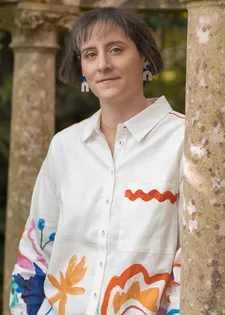 |
| Louise Bagnall: 'My heart is definitely in animation. I love it as a medium' Photo: Peter Searle |
Although Julián, with his newly found secret sprite friend Luna, dreams of being a mermaid, this is less a film about notions of gender identity than about having the confidence to be yourself in the world in a period of life that Bagnall notes is when you’re “starting to understand who you really are and how society understands who you are, how you're seen by other people”.
She adds: “At the heart of the film is this relationship that he has with his grandmother and through that relationship, he gets to know her, but he also gets to know about his own culture a bit more. He gets to live it a bit, and that is also exciting for him, and it brings new aspects that he didn't know about into his own identity.
“So, for me, the film is much more holistic in that sense. It’s much more from a child's perspective. An exploration, and a gradual understanding of these things. He's not thinking about any labels, he's just thinking, ‘Oh, I love this thing, and I'd love to try that, I wonder what that is over there’. So I think it’s more of an authentic and more organic exploration.
“A lot of kids at that age, they're trying lots of different things, they're trying on lots of different hats, and they're seeing what feels right and what fits them and you kind of have to give them a little bit of space and a little bit of leeway to do those things. I think we all can also relate to that feeling of looking for a place where you can be yourself. That’s very much what Julián’s journey is all about.”
While this is Julián’s story, as he plans his mermaid costume and tries to convince his Abuela to help him, the film also gives space for the older woman to examine her own thoughts and feelings.
“She's such a fascinating character because she has a wonderful life and she's ready to do what she can for Julián,” says Bagnall “But at the same time, she's not without her own regrets or parts of her background that she hasn't resolved. So, I think what's lovely is that, although it's Julian at the centre of the film, she also goes on a journey, and her journey is also part of something that she needs to reconnect with.
“I always find her character to be quite interesting because by encountering Julián, she's sort of unlocking something again in herself and has another chance to reconnect with part of herself that she maybe thought she'd lost. So she’s also going on a journey, it’s not the same one as Julián but they’re kind of helping each other to get there.”
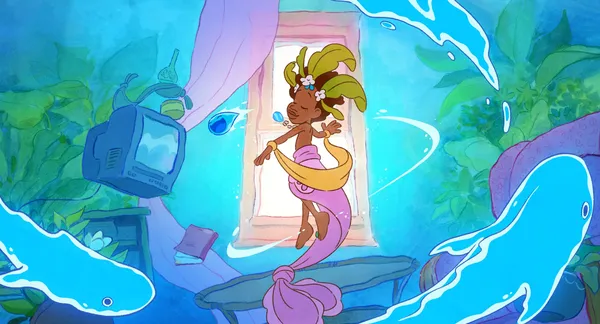
One character that’s new in the film is that of Luna, a little blue sprite who helps Julián to express himself and unlock his feelings. Bagnall says that writer Love was “very generous” when it came to adapting and expanding on her source material.
 |
| Louise Bagnall: 'I think we all can also relate to that feeling of looking for a place where you can be yourself. That’s very much what Julian’s journey is all about' Photo: Cartoon Saloon |
“Then, also, she talked a lot about the way the book was received and what the things were that really people gravitated towards, so those were all things that we could keep in mind in the adaptation. When you boil it down, what things are really integral to the book that we could bring into the film. Then throughout, she was able to give us some feedback through different scripts, through different stages, but she also very much understood that we were adapting something and it wasn't going to be a one for one – it was going to grow and change, and it was going to be a little bit different in some ways. She was really wonderful to have onboard the film, and I'm very enthusiastic about the whole thing.”
Bagnall adds that Luna was a character that came into her mind at an early stage.
“Part of the reason was that we had this need in the story. Julián was not always going to be with his grandmother, not always going to be with his friends, so he has this time where he needs to process things, he needs to come to terms, or he needs to explore his inner world.
“For me, Luna is a manifestation of this part of Julián’s awakening, and it helps him to start to understand himself better, but it also allows him this little chance to explore and be curious and it’s like a sort of safe space to explore that. Luna essentially gives him a chance to interact with something rather than it all just being in his head. So there's kind of two aspects to it. There's a kind of a practical need to help him on screen to get those ideas across and, secondly, it's manifesting something back for him makes it easier to think about it and look at and start to explore with. That's kind of where Luna came from and what her purpose is.”
The distinctive look of Luna was also important to her.
“Coming from 2D animation., I love characters like Luna in terms of how they look and interact because they just become this kind of figurehead,” she explains. “It’s expressive but you can project a lot of identity onto Luna, so it was a really fun character to have in the film and it allowed us to see a part of Julián that I don't think we would have seen otherwise.”
The script features Spanish as well as English, something else that helps ground the film in the lived-in reality of modern Brooklyn.
“That was originally there in the first published version of the book,” says Bagnall. “When our writer Giuliani Herreres came on, they’re coming from Brooklyn themselves but their parents came from the Dominican Republic. So they had this growing up in the US with English as a first language but Spanish as a second language but, of course, it’s Dominican Spanish.
“I thought that it added so much specificity to our characters, and it kind of made them feel more real. Abuela uses Spanish words here and there but the idea is that you can either understand them from context or you don’t need to understand them.
“It allows you again to be with Julián in those moments, because maybe he doesn’t always understand what she’s saying and we don’t subtitle what she’s saying. It’s just peppered in a little bit to put us in Julián's frame of mind. And to make us feel like this is how families are with each other when there's a second language in the family, or when there's different first languages. Little bits and pieces sneak into conversation.”
When it comes to colour, the film is arguably even more vibrant than the book, filled with different textures and splashy, summer hues.
“In terms of the colour, I have to really give props to my art director Emilie Bach,” says Bagnall. “She spent a lot of time working on the art direction to figure out how we were going to translate it from the book into something more cinematic as well. Something that feels like the real world, feels believable, but isn't realistic – that's what we were trying to find. The other way we always thought about it in terms of what we're seeing on screen is that we're seeing Julián's point of view.
“Even if we're not exactly looking from his eyes, we're always seeing the world with his ideas, his way of looking at the world. The world of Brooklyn, for example, is this wonderful, exciting place full of possibilities. It's vibrant, it's full of life. It's not perfect. It's not pristine. It has graffiti on the corners and cracks in the pavements and all that kind of stuff but it's still a source of a lot of inspiration for him. So that was also part of it – we wanted the film to feel exciting.
“The nice thing about that is by basically heightening the colours of the world that we're in it also allies with when we bring in magic and imagination and those kinds of flights of fancy, they meld in with the world and they flow out of that world so they feel connected.”
It’s early days for Julián as he’s just taking his first steps out into the world with audiences but Bagnall – who previously made shorts, including The Late Afternoon and worked on features, including Wolfwalkers and The Song Of The Sea, says there will be future projects.
“My heart is definitely in animation. I love it as a medium. I'm particularly drawn to characters, so, I love being able to explore characters through that medium.
“It's good to have made shorts and I think the other thing that's nice in shorts is that I was able to kind of find my voice as a director, so that when it came to making features, I had confidence in certain areas and I understood when to collaborate.”