 |
| Via Negativa Photo: Maximilian Pittner |
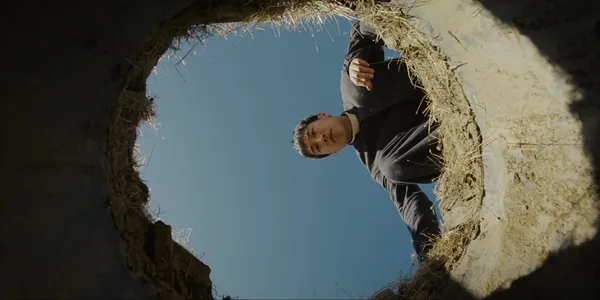
American director Hannah Peterson's Via Negativa, an adaptation of Daniel Hornsby's first novel of the same name, introduces Dan (Young Mazino), a young man of the clergy who describes himself as a 'rent-a-priest' after being rejected by his diocese. He sets off on a road trip across America, encountering strangers along the way and taking in roadside attractions like the Hole to Hell. When he accidentally hits a coyote, he finds an unlikely companion on his journey that takes on a deeper metaphorical meaning.
What can feel like a lighthearted road movie intersects with heavier tones: the death of Dan's childhood friend and classmate at seminary school and the search for a former mentor. On the open road, Dan reflects on the past. Ridden with a feeling of guilt that he could have done more for his friend, as he gets closer to his destination, questions about reconciliation and whether he can find self-compassion are answered.
Via Negativa is Peterson's sophomore feature. Her début, The Graduates, told the story of a young woman and a community trying to heal in the aftermath of a shooting. Peterson's short films include East Of The River, about a student spending the day on the streets of the American capital after she's suspended from school, and Champ, where a group of friends decides to strike back against the school's basketball coach who harbours a secret.
In conversation with Eye For Film, Peterson discussed motherhood and filmmaking, human connection, and her interest in the themes of grief and friendship. She also spoke about marrying the sacred to the profane, the passage of time and her desire to ask big questions.
The following has been edited for clarity.
Paul Risker: Speaking with Ido Fluk, the director of Köln 75, he spoke about how streaming is the reality, and filmmakers need to adapt, so films are still impactful from the audience's couch. How do you feel about the current trends in how audiences are consuming films?
Hannah Peterson: I really like that point of view because it is the reality of how we live now, and especially the younger generation. I have a kid, and he's only two, but I can see this is what his world is going to be.
We just don't go to the theatre as much anymore, and I often think about how restaurants that adapted during the pandemic are the ones that survived. And as filmmakers it's similar. There is the need to adapt, and the challenge is to be able to make something that trusts the audience to engage in it both on the small and the big screen. And for us to be a little more democratic about how we think someone should experience our film and not have the expectation that everybody should see it in a theatre, which, of course, would be great if they did.
Via Negativa was shot on 35mm, and it certainly is meant to be seen on a big screen, but that's just not the reality for most people who review it. This comes back to why I like the festival experience. It's that it's more and more special. It is that time that you do get to drum up word of mouth with people that are connecting to it on a big screen, which might then lead other people to connect to it on a smaller screen.
PR: Regardless of the space in which a film is watched, we should never underestimate what an audience brings to a film and how they emotionally shape it.
HP: The purpose of making a film is just that and why this part here is so special is because you get to learn from people who are watching it — how they're connecting to it, how it resonates, and how they feel it reflects them. There's so much about a film that is craft and visuals, but it's nothing if the relationships on screen aren't credible and don't relate to the people watching it.
PR: Filmmakers can be dramatic when describing the filmmaking process. For example, it's like going to war or giving birth. As a mother, what are your thoughts on the comparisons to childbearing?
HP: It's interesting because they have a similar chronology in that there's the gestation and the birth. You develop a film, then you make it, and then you release it to the world. It is very aligned with having a child, the intensity of which, of course, I don't know if the comparison is valid [laughs]. But that's probably why a lot of people talk about it in that way. And my experience of having a kid is very intertwined with making movies because they happened alongside each other. My kid was there for the production of this film, and those two identities informed each other in my own life. So, I see them as being intertwined, and I get why people say it, and yes, they definitely say dramatic things about making movies.
PR: Why film as a means of creative expression? Was there an inspirational or defining moment for you personally?
HP: Rather than being a definitive moment, my journey toward film was an accumulation of things. I think it's a place where I felt I was intellectually engaged from the get. It was a place to really think about and gestate on these personal preoccupations that became artistic preoccupations. And that was really process driven, and it felt like I was understanding life by making films. That was what initially drew me to it. Then, as I started to make films, the first time I got to show one and connect with an audience was the moment I thought, 'Oh, this is the thing that I want to do.'
If you can get to the other side of making a film and actually speak to people about how they feel reflected in the experience of the film or its characters, it becomes something outside the film itself. It's just about sharing stories with people who you may not have otherwise met. To me, that's what life is all about.
PR: I remember speaking with a novelist who described the journey from a first to a second novel as being like climbing a mountain and then coming down the other side. He said that walking towards the second mountain you can feel the intimidating presence of the mountain you've conquered over your shoulder. As someone that has made their second feature, what for you distinguishes the two experiences?
HP: Candidly, my experience was very different from that. Making my first film, I had so many expectations of what it would mean for my career and my life. These expectations about the outcome were naturally built up in my mind. Having gone through that process, when I came to make my second film, I became so much more present in the making of it. I let go of the outcome because at that point, I'd understood that it's actually out of your control. The only thing in your control is the way you hold people on set, how you approach your creative process and the collaborations at the center of it. And I could really be present with that because I knew that was the mountain to stand on. It wasn't the aftermath, but you have to go through your first experience to understand and grapple with that.
PR: What led you to decide to adapt Daniel Hornsby's novel?
HP: The producer, Jonah Disend, had optioned the rights to the book and sent it to me to read. And just like he had, I fell in love with the book.
For context, this is about a priest who, for reasons you come to understand, leaves his church and goes on a road trip to find an evil presence from his past. And along the way, he picks up a wounded coyote and begins to rehabilitate it. He also meets these other strangers as he stops at roadside attractions.
I was really drawn to the book's compassion, and I was struck by how funny and heartbreaking, strange and deeply human this character was. At its core, this book was really about friendship, love, and connection, but it's told through this protagonist who is deeply in denial and is posing the question whether he himself can accept forgiveness in the way that he, as a priest, gives to everybody else. And so, I immediately felt like this was something that could be a cinematic adaptation.
My last film was also a story about grief and friendship, but I didn't get to access those themes in the way that this book does. There is a lot of humour and mystery here, and there are these strange encounters along the way. I loved the idea of going into that theme and story again, but from a different access point. So, that was my initial affection for the book and there was no question I wanted to adapt it.
It was Daniel's first book and when I had my first conversation with him, he told me to take this into my own psyche and world. His generosity gave me a lot of freedom about how to think about it, and when we adapted it, we ended up de-ageing the character in the book. He was in his 70s or 80s and reflecting back on his life. It was structured in a way that as he goes on this road trip, he's remembering his past.
One of the things I love so much about the book is that the past is interacting with the present and applying pressure. So, I wanted to challenge myself in the adaptation and keep it really focused on the present, and that's why we don't have flashbacks. It's really just him in the moment, trying to evoke the past in the way that the book does.
PR: There's a wonderful line when the female bartender tells Dan, "There's no one left to apologise to." The film is filled with these subtle and insightful moments that could easily be overlooked, in part because of the levity you bring to the drama. However, the raw emotions beneath her words, that are hinting at something, struck a note with me. Via Negativa effectively strikes a balance between light and heavy moments.
HP: What was so exciting about adapting this book is that it's littered with these little nuggets. I really wanted to make sure that we retained that because he's a priest, and people, even though they're strangers, are confessing, talking, and opening themselves up to him. In a way, he's reflecting on himself through these people, and that challenge of marrying the levity with these deeper seeds of ideas was something I was drawn to in the book itself.
And the thing that I wanted to retain most in the film is how it places the profane and the sacred right next to each other — like when the priest is singing a karaoke song, or he's sat in a bar. The profane and the sacred were always on my mind in every scene that we shot, every relationship we were delving into between the characters, and even with the locations.
One of my biggest inspirations philosophically and image wise is obviously William Eggleston, because he has a way of paying attention to these mundane spaces and finding something sacred in them. And that idea is very spiritual. It's akin to writing; it's akin to this character.
PR: There are moments in the film that genuinely capture the reality of what it's like to lug around emotional pain. For example, in the scene in the motel, the way he just lies on the bed is evocative of exhaustion from despair. Or when he's driving, it's as if he's present, but he's not.
HP: The thing that I love most when I watch films is when you feel like you're having a private moment with somebody. And this film is filled with those moments. The title itself is based on the theological idea that describes what God is by what he isn't. It has also been called, "the way of denial" because it has to do with absence. That is something that's taken quite literally in this film, both in the character and the images, by being able to hold space and experience the time passing for Dan when you are alone with him in the car, in the hotel room or in the rectory.
To your point, that is what it feels like to be alive and to be a human. There were so many opportunities in this film and a lot of creative freedom to really grasp onto those moments and make them feel very charged. Like that scene on the bed is one of my favourites because we don't cut. It's just like a slow push in, and the whole thing is in one take. To actually feel real time passing by in that moment was important narratively. And I always feel like I want to be there with the character, so I'm there for them when they need me. That scene is emblematic of that.
PR: This approach requires patience because you're settling between the dramatic beats, and the dramatic structure doesn't always look like cause and effect. One example of this is the motel party Dan winds up at, where we see him having to navigate an awkward and revealing encounter.
HP: Yes, I definitely believe in that, and this film was a great opportunity to flex that muscle. Thinking about the scene at the motel party, his priest's collar is covered up. Usually, he's in a situation where people can see it, and so, they immediately open up to him. He ultimately admits he's a priest, and this stranger sort of confesses to him. But that awkward tension between them was always funny and interesting to me.
It reminded me of when you're a smoker, you are used to spending time with people that is measured in the time it takes to smoke a cigarette. And when you stop smoking, social interactions become awkward because that time is no longer there.
PR: There's value in trusting the audience and not over-explaining because it encourages them to become active participants. After all, the aim is to create space for the audience to enter the film.
HP: I'm so glad you felt that way and I think so too. Like you said, there are these plot points, but the way that I'm thinking about films through the writing and the production and especially the edit, is the emotional journey of the characters. And that doesn't always look like cause and effect. It's a different way of processing narrative time, but I trust that the audience, if they are able and willing to lean in and engage, will come along on the journey.
As a filmmaker, it's up to you to make the audience feel like they can trust you to do that, and to lean in so that it does go somewhere. That's the way I'm thinking about films, and this one in particular feels like it's centred on the character's emotional journey from start to finish.
PR: Is filmmaking a transformative experience?
HP: Yes, because by the nature of making a film, you meet so many people, and you have a lot of really deep conversations. It's not only, first and foremost with your actors, but in the prep, I was able to sit down with priests and ask questions about the experience of celibacy and intimacy. Everyone you're collaborating with brings their own point of view and life experience which they project onto the film. And so, you wind up having these deep conversations about life, and this film, in particular, was about asking the big questions.
I remember when I sat down with a priest in Portland before we began filming. He said, "I may not have romantic, intimate relationships with people, but in some ways, I have more intimate relationships with people than those I know who aren't celibate because I'm sitting down with people, and we're asking the big questions." And I remember feeling envious when he said that because I want to cultivate that kind of relationship in my life, which found its way into this film. And going into the film wanting to have these conversations with people and to be open with them, that in itself changes you no matter what.
There's no place where you grow more than in the making a film. It is filled with deep collaboration where the stakes are so high. You're under so much pressure, but you grow through that, and you ultimately do evolve as a result.
Via Negativa premiered in the US Narrative Competition at the 25th Tribeca Film Festival.