 |
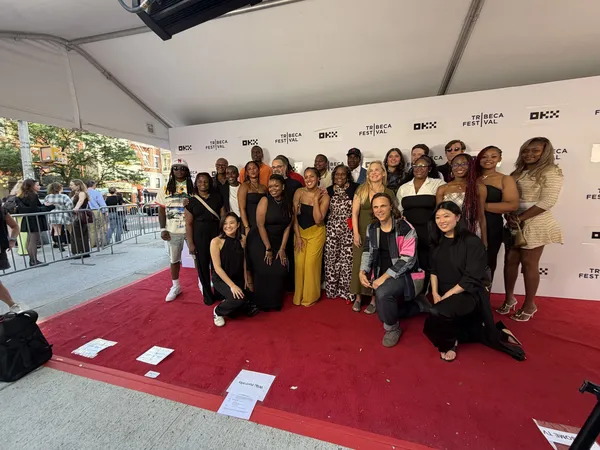
| The Harvest team on the red carpet at Tribeca |
Festivals like Tribeca always attract high profile films: high concept work, films with big name directors and stars. In the thick of that, it can be nice to kick back for a couple of hours with the gentle – though by no means unimportant – story of a farming family whose work may be shaped by global factors but whose trials and triumphs take place on a human scale. They are the Nolans, and the film is Harvest. When I met directors Natalie Baszile and Hyacinth Parker to discuss it, I felt obliged to note, first and foremost, than in the 35 years I’ve been working in film journalism this is the first time I’ve encountered a mother/daughter filmmaking team. How does that work for them?
“Hyacinth and I teamed up about six years ago,” says Natalie, who is the senior partner, as it were. “In the midst of the pandemic, she was home with us. I had a nonfiction book called We Are Each Other's Harvest that looked at the history of African Americans and land and agriculture from emancipation to the present. It was very forward-looking. And we were talking about what we could do to bring that book to life on the screen.
“I was coming from the world of being a novelist, and Hyacinth was coming from the world of journalism. I'll let her tell you what she did. But we decided that we wanted to work together and expand both of our creative practices into film. And this was just the beginning, really.”
“Just briefly about me. I worked for the New York Times on the business side, so doing advertising and creative strategy,” Hyacinth explains. “Then I moved into documentary production. And so as we were working on Harvest and our other projects, slowly Harvest became one of our main things. So it's been delightful, but, yeah, that's the gist of it. It's been fun to see how our complementary instincts come together.
What it was like for them approaching working as people in the same family and then working with a family of people as their subjects? Did that affect the dynamic?
“It really did,” she says.
“You know, I met the Nelsons because they were featured in my nonfiction book, and so I already knew them,” says Natalie, “but they call me Mrs. Baszile. You know, I'm not as old as their parents, but I am in that middle generation, and we have a very warm and respectful relationship. Hyacinth is their age.”
“Younger than most of them,” Hyacinth notes.
“Younger than most of them, but she is really their peer. And so she was able to, you know, engage with them in a dynamic that was different from mine. You know, it was all warm, but they just saw her as someone their own age, and I think that made it even easier for them to laugh and joke and reveal parts of their lives that they may not necessarily have felt as comfortable revealing just to me, because they always wanted to be respectful and all the rest.”
Hyacinth laughs. “In short, I could ask them about their love lives and it wasn't weird.”
How did they split up the filmmaking duties?
“Well, you know, it's interesting,” says Natalie. “Our producer often says that we are really of one mind, and that was really the case during filming. There were times when we would tag team for the interview questions. I would ask maybe the first half, and then Hyacinth would ask the second half. When we got to some of the more sensitive topics like the passing of one of their sons, I could come in with a lot of empathy and care, and then Hyacinth would follow up with a lot of sensitivity and also empathy. So we really did tag team the same for the story development. We were both on the ground together with our crew for probably 90% of the shoots.
“There were occasions when I couldn't go, so Hyacinth would go, or Hyacinth couldn't go, so I would go. But I would say for the bulk of everything, we were really together, operating as one unit.”
They talk about story development, but one never knows exactly what one is going to get with a documentary like this, especially when shooting over quite a while. Did it develop in ways that they expected? Were they able to stick to much of a plan, or did they find themselves going down different routes?
“That's a good question,” says Hyacinth, pausing for a moment to think. “We knew a few things. We knew that we wanted to follow these brothers from harvest to harvest. We started in June of 2023 and ended in the fall of 2024, and then we had one final shoot just to wrap things up. So we knew we wanted it to be in a confined period of time. You know, I respect and appreciate documentaries that go on for five, six, seven years, but we wanted to make sure that it felt tight and had momentum. But in terms of what actually would happen on the day to day, when we showed up, we had no idea.
“We would go basically every six weeks and there would be times where we would get there and the brothers would have a very clear plan, like ‘Tomorrow we're going to be planting,’ and it would just start raining, so we'd have to completely pivot; or, you know, we had no idea that there was going to be a moment in the film where they gained that extra thousand acres. That just was incredibly convenient and just happened. And so there were things that we knew that we wanted to hit and there were ways in which the story kind of fell together along a natural story arc. For example, the fight that they had happened in March and it was halfway through shooting, and so that moment maps onto the midpoint of the movie perfectly. But we had really no idea. On the day to day, it's best laid plans, and especially when you have best laid plans in relation to farming, you have no idea what's going to happen.”
That comment about the Nolans getting the extra thousand acres reminds me of a scene in which the brothers learn that, for the first time in their lives, they’ve been offered a low interest loan. There are huge problems for Black people accessing finance in the US, so was that something that they wanted to make a point of?
“Well, you know, really that was something that just happened in the course of filming. We weren't trying to make that point,” says Natalie. “We were really just following them as their lives unfolded, capturing the joys and the triumphs and the challenges. And, you know, we didn't come into it with any objective when it came to financing.
“What I think we were interested in, what we were more focused on, to be honest, was the dad story and how his history with USDA and not being able to get loans had informed his experience, and how the brothers were really trying to achieve what their dad could not.”
There’s a huge scope to the film, going back into the past like that as well. I mention that it feels as if, through the openness of the landscape, they explore, visually, that sense of a greater span of time.
“Oh, yeah, I appreciate that,” says Hyacinth. “You know, we wanted to make sure that this film felt forward looking and forward facing, which is why we decided to follow young people of colour, you know, people who you don't expect to see but who are in this world and who are pushing the story ahead. But we also wanted to make sure that we didn't neglect the history or the context or the background or the racism, whatever it was. We wanted to make sure that it was interwoven. For example, the graphics that we used were derived from WEB Du Bois’ book, where it's all charts and statistics from his 1900 World Fair exposition.
“There were ways in which we wanted to make sure that were kind of referencing the past or bringing up elements that have existed to show that this is not just happening to these brothers. It's not just happening to the black community, it's not just happening to American farmers. You know, we wanted to make sure that it felt grand. And I guess we can say it's not just happening to American friends, farmers in this day and age. This is something that's been going on...” She gestures expansively. “And so while the Nelsons are pushing ahead, they do have a long legacy or a long stream of context behind them.”
“We were trying to figure out how can we convey the scale of their operation,” says Natalie. “So to Hyacinth's point about the graphics, that's why we came up with that football reference. Even if you don't know what an acre is, most people have some idea what a football field is. So we incorporated that and then, you know, a lot of our drone footage was so that we could capture the scale and give the audience kind of an eagle eye view of the land.”
They talked about the international aspect of it, the fact that these are experiences everyone is having. That came up particularly strongly with the way that climate change is affecting what the farmers are going through; and it feels as if the film is looking to the future, but there's that uncertainty about what the future means. Do they have anything to say about that?
“The climate change aspect? Let me think,” says Hyacinth. “You know, I've said this before, but I've seen how the Nelsons are in many ways affected by issues that I know about or that I'm aware of, or that I feel in minor ways, but they're affected immediately in major ways. And so climate change, you know, they're unable to plant because it's raining too much. The year before, there was drought that wiped out the entire area and basically decimated every farmer's crop. I'm sure that's happening to farmers wherever they are. You also have the geopolitical issues where one thing that happens on the other side of the world immediately hits them. You know, for example, the rising fuel costs there have been. There's this moment in the movie where they have 250 gallons that they're trying to fill into their combine, and just thinking about how much that costs...” She winces.
“I know that's not just a them issue. It really is, at this point, a universal challenge that a lot of people are facing. I think it's been very interesting to watch how farmers, on even their scale – they're definitely not the smallest farmers out there, but they're also not the largest – but to see how they are, I'll read something in the news and know that it'll affect me maybe a few weeks later. They'll read something in the news and it hits them that hour. So it's been fascinating to watch.”
“At the end of the day, we really wanted to offer a compelling portrait of an American farm family,” says Natalie. “You know, not necessarily what people think of when they think of American farmers. So often they think of old white guys. To offer up a portrait of hardworking, ambitious young black men who love their families and who are tender with their kids, and who aren't sports celebrities or musicians, but farmers, it's just something that we don't think many people see. And. And they're just so delightful that we wanted them to be seen. We could explore a lot of these issues, but by looking at this family and the way they interact and the love and the occasional arguments and all that, then, you know, that's what we wanted to do: just offer up a portrait.”
Hyacinth agrees. “We went into this knowing that we wanted to tell their story because they're dynamic, they're charismatic, they're attractive, they're fun. But I don't think we fully anticipated how much this story is about family. There were ways in which we, when we were really boiling down, asked ‘What is this movie about?’ It really came down to farming and family; family and farming. Those two things go hand in hand again, both because of their legacy, but also just because they're four brothers who are trying to do this crazy thing on this massive scale together, so how can you not include those two elements?”
How do they feel about getting to Tribeca?
“It was amazing,” says Natalie, with a grin.
“It was amazing,” Hyacinth echoes her. “We were really thrilled. You know, we're first time directors. This is our first feature movie. And I think that to have some organisation like Tribeca, which is so big, recognise us...” She pauses for a moment, face glowing, as if she’s still taking it in. “Then we ended up getting a special mention for Best New Documentary Director, which was thrilling. To have those two things come hand in hand was really a nice boost. A vote of confidence to just show that we are on track, because when we started this we were so much newer and so much more unknowing about what were doing, and I think in many ways that actually benefited us because were able to push ahead and tell a story that we wanted to tell, not necessarily a story that people would naturally expect.”
Does this mean there will be more films in the future from the two of them?
“For sure.” She smiles. “That's the hope.”