 |
| Amanda Kramer on the chair in By Design: 'We definitely didn't want something that stood out immediately when you saw it. That's why it's such an analogue for Camille' |
Writer/director Amanda Kramer has always been interested in pushing narrative boundaries and using cinema to explore how people might react in extreme or unlikely situations, not just in slightly different versions of lives like their own. By Design, which is out now in select cinemas across the US, stars Juliette Lewis as Camille, a woman who drifts along in a quietly meaningless life but has never felt special to anyone. When, visiting a showroom with friends, she sets eyes on the perfect wooden chair, simple and yet eminently practical and alluringly beautiful, she finds herself wishing that she could swap her existence for its. When her wish comes true, both of their existences are transformed. It soon emerges that people like the chair-possessed Camille better as a compliant objects, whilst Camille in the body of the chair finally has the opportunity to fall in love.
It's a big idea which hangs together surprisingly well over an hour and a half. There's a lot we could go into, but when I meet Amanda, I begin by asking her about the body swap genre and what inspired her to look at the idea of what would happen if it wasn't a living thing that someone body-swapped into.
"Almost no one wants to talk about that," she says, pleased, "but it is hugely a part of what I'm doing, investigating the body-swap film. I've seen so many of them. They're mostly terrible, but terrible in that way that compels you to watch them. But there are a few I'm very fascinated with, a few that I love and a few that are very meaningful to me. I've always wanted to try one, but I find them to be so moral and Christian. I find them to be like morality tales and I needed to subvert that in some way, obviously.
"The way that I see a body swap film is you have these two mostly people and, strangely, they're usually very similar. What's the difference between a man and a woman? Or a woman who's slightly richer than another woman or slightly younger? You're basically just looking at a life that's a little bit different than yours. And the film always begins with, you're not grateful for who you are. You are pitying yourself. You feel like your life could be so much better. You find fascination with this other person and in a magical wish, you swap bodies. Then there's a giant chunk of the film where you go off in that body's world, you meet the people of that body's life and you have your pratfalls, you have your, “Whoa, I'm on roller skates and I don't know how to roller skate”. You know, the goofy stuff in the middle section where you find your groove, but also you kind of love it. You're living large.
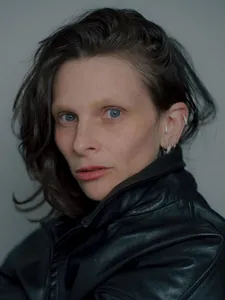 |
| Amanda Kramer Photo: Courtesy of Sundance Institute |
"This is like the section of the film where you're indoctrinated into a life that you wished you’d had if you got your wish. Then the turn comes. You miss your life, you miss your body. You miss the people you are surrounded by, you're learning gratitude. You're learning that the grass is not always greener, that everybody has their problems and suddenly you want the wish to return you. Then the wish does. You go back to yourself and you end the film proud to be you, with a bigger understanding of the world. Your perspective has widened and you've changed. I think that's all bullshit. Also, if you wanted to be somebody else, do you really think you would want to go back to yourself? And where are the films where the person does not want the wish to reverse them?
"That is what I'm always curious about. And I am also curious why we are transitioning into things that we could never be. And that, too, is a part of the fantasy. If we're doing the fantasy, why not do the fantasy in a properly fantastic way? Who hasn't wanted to be a dolphin or something? These are the things I'm trying to examine in the film by way of choosing a beautiful chair and a woman who wants to be that chair."
How did she choose that specific beautiful chair?
"It was so difficult because every chair has a thing about it. Even the chair that you're sitting on now – you probably feel like it's incredibly comfortable. It serves a lot of your needs and that's in and of itself a fetish. It's maybe leather I'm looking at. Maybe it's a black leather that also has a sex appeal to it. You know what I mean? So you can look at every chair and start to feel its personality and start to feel its character.
"We wanted a chair that had a simple, strong, sturdy, plain elegance. We didn't want something too avant garde, too wild. We definitely didn't want something that stood out immediately when you saw it. That's why it's such an analogue for Camille. Maybe you would pass right by that chair and not look at it. But then when you stopped, you would realise the gorgeousness, the stunning quality of its simplistic design. And that is how I viewed that character."
We talk about Juliette Lewis, the power that she has as an actor and how she has too often been overlooked.
"I absolutely love her," says Amanda. "I think that she will really try something she's never tried before. There's excitement in her to face that challenge and to contort herself in certain ways. She has a dancer's body, and so she was excited to be dancing in this film, and she was excited to be moving her body in strange ways. And to work with her is obviously one of the great moments of my life. I've been a fan of hers since I can remember being a fan of really anybody. If you're not a fan, I don't know why you would cast someone. If you don't have that obsession over them, how can you ask an audience to? So maybe my gaze adjusted. Juliette Lewis is coming out a little bit in this film as well.
"I think if you knew Juliette Lewis and you wanted to choose a chair that you felt like was a sort of physical approximation of her, she's a much wilder chair, and you would probably choose a chair that stands out immediately in a room. But in the playing of Camille, Juliette is accessing a different type of persona. I wanted more than anything for her to attempt a kind of earnestness and sincerity. And we talked about really believing what you're saying. And in that, you find such humour and irony, because most people are not that meaningful. They're not that earnest and sincere and we almost don't know what to do with sincerity. It's slightly off-putting.
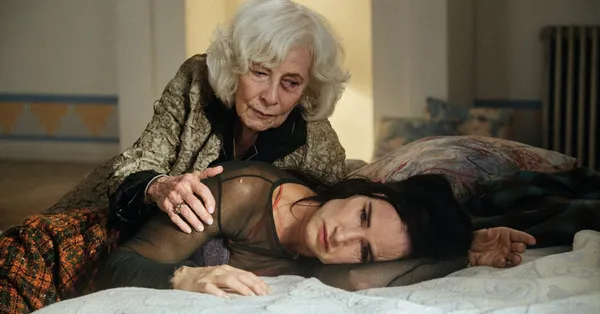 |
| Amanda Kramer on Juliette Lewis, who stars as Camille: 'I've been a fan of hers since I can remember being a fan of really anybody' |
"In contemporary life, everyone has a bit of wit, and everybody knows they have to slightly be a cad in order to have the combative conversation that modern people need to have. But what about somebody who just very earnestly loves their lunch and they just want to tell you how much they love eating their lunch? You almost wouldn't know what to do with yourself. So that's the kind of personality she's embodying. And this chair is kind of similar. Like, “You don't need to look at me, but if you'd like to look at me, I'm very honest, I'm just being myself. I don't even have a pillow, I don't have an upholstery. I am just myself”. These are all things I'm making up in my mind, of course, but they're things that are revealed to me when I'm staring at chairs for a very long time."
The chair also has to have sufficient potential for the choreography woven around it as Amanda uses dance to express people's feelings for it.
"It has arms, which we definitely wanted. We wanted a chair that looked like a woman's body, right? Like a lap with a back and arms and legs that sort of fold. To be able to immediately have that is a great visual connection. But the way that these arms curve, you can loop your body through them and around them. And the way that the back is also sort of curved and rounded is a way you can slide your hand or face around it. So, yeah, if you have to dance with the object, you want it to be a dancer's prop."
I tell her that I was interested in the general design of the spaces that people are using because we don't really see anything personal in the homes that we visit. There are a great many things, but there is nothing that really feels like somebody's stuff.
"It's interesting because I'm trying to choose every object so deliberately," she says. "And my production designer, Grace Surnow and I are thinking about each space and we're imagining a plant, and then we get the plant, and the plant goes just in the spot that it goes in, and we stand back from it and we say, “Yes, that's exactly right”. Which is not how we live as human beings. We don't have the time or even really the design and aesthetic, even if we're very aesthetic people, to stand back from a plant and really think about the exact place that it needs to go, and not an inch to the left or right.
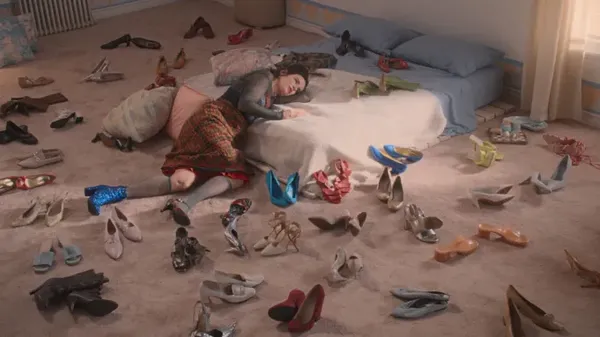 |
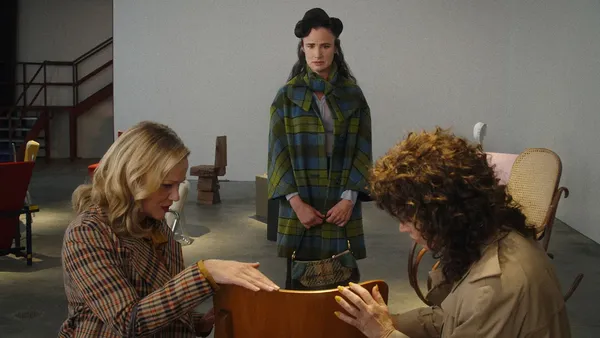
| Juliette Lewis in By Design. Amanda Kramer: 'The film is about a kind of deliberate touch and a lack of personal affect' |
"What you're feeling is that deliberate touch, which I think helps a film like this, because the film is about a kind of deliberate touch and a lack of personal affect. In order to fall in love with a chair, your life has to be not so filled with stuff because something has to speak to you. If your life is filled with a million things, then what's to say, one thing would speak to you more than the other. But in a spare world, a singular object might really beam out a light at you."
Was she trying to address a world that values objects more than people?
"I think we live in that world as well," she says. "I did not make that up. I see that so often. It's a cynical thing to discuss in art, but it is true. It's why so many people have started to turn themselves into unmovable objects as we see quite often. There is something going on there. That the movement of a face, that the movement of skin, which is natural and should be a natural beauty, is really no longer fetishised. Now we are fetishising an unmoving face and unmoving skin. I don't like it but I'm not making a film about the gruesomeness of plastic surgery, I'm trying to talk about it in a different way."
The costuming in her films is always spectacular, but here what stood out to me is that a lot of the clothing seems designed to be still in. It sits a certain way and catches the light a certain way and is not for moving in.
"Yes, they're very fussy and particular and layered in a way that would not be comfortable and layered in a way that would not be your first thought of how to dress yourself. I think in one scene, Juliette is wearing three skirts. She's wearing so many skirts. But the way that they look layered gives her an almost doll-like quality. They're very frigid and it's meant to be an undressing of that frigidity and a sort of becoming basic, of becoming essential and a sort of stripping off of a very strictness of frigidity."
Finally, we take a moment to talk about Udo Kier, who has a cameo as the chair's designer. It's one of the last roles people will see him in, and he is magnificent.
"Absolutely," she agrees. "He was the first person we thought of. When you think of an eccentric designer, you think of those piercing blue eyes. I drove to his home in Palm Springs to meet him. His home was a converted library, like a city library he had bought and turned into his living space. It was like a museum to himself and his beauty, which I thought was… I mean, I was overwhelmed. I walked in immediately to a Warhol of himself, given to him by Andy Warhol. A Maplethorpe of himself. Like these things that you would imagine would be in a museum, and I could just touch them. It was absolutely incredible.
"He was just such a fascinating character, immediately. I begged him, I said, “You come, you play for one day, you be the character that you want to be. You have the text, you have the scene. But of course I'm looking to collaborate with you”. And at that point, I think he's 79 years old and has been working since 20, maybe, has played obviously everything from a vampire to just a total [range of] other kinds of ghouls. And he is so electric. I felt very lucky to work with him before he passed."