





Eye For Film >> Movies >> In A Whisper (2026) Film Review


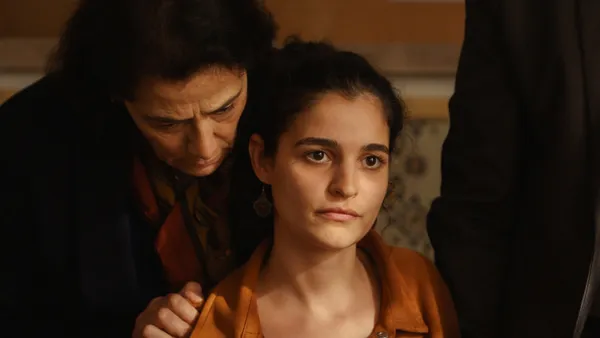

Leyla Bouzid’s third feature feels poured into a house. Not “set” in one, but steeped in the deeply personal architecture of a family home in Sousse, a place that holds summers, silences and the inherited choreography grief can suddenly activate. Lilia (Eya Bouteraa) returns from France to Tunisia for her uncle Daly’s (Karim Rmadi) funeral, after a death that arrives not only as shock but as exposure. He is found dead and naked on the street. The details land with a violence that is both physical and social, because a body can be mourned and still be judged, handled, managed.
Early on, Bouzid lets us infer Lilia’s secret without turning it into a twist. She is queer, and she has brought her French girlfriend, Alice (Marion Barbeau), on the trip. But the trip immediately becomes an exercise in compartmentalisation. Forced to uphold a ruse de famille, Alice is introduced as a roommate. Alice is sent to the hotel, Lilia to the childhood home. Their love is made logistical. Their days become a split-screen that never fully connects, an unbridgeable division from the start. One life can be spoken. The other must be parked elsewhere.
Then the mirror appears. Daly, too, was gay, and because homosexuality is criminalised in Tunisia, he wasn’t allowed to live the life he wanted or needed. That fact doesn’t sit in the background as “context”. It radiates backward through everything, because it turns grief into a second kind of closet. What does a family mourn, and what do they erase while they mourn?
What follows is not a simple coming-out narrative and not a whodunit either, but an internal struggle constantly externalised through ritual and space. Lilia is pulled between being true to herself and respecting the family’s grief. She begins a quasi-investigation into the circumstances of Daly’s death, but every question carries risk, because to pry open his hidden life is also to endanger her own.
Bouzid stages the religious proceedings around the funeral and post-funeral with deep respect. There is no cheap “clash” framing, no sense of looking down on belief. The rites are presented as lived practice, as structure, as something that holds a community together while leaving very little oxygen for deviation. And within that structure, the narrative does something quietly radical. It lets the past occupy the present as matter, not as a flashback you can neatly leave. At times Bouzid breaks the membrane separating space and time, and the result is a kind of magic realism in which adult Lilia’s memories take up room inside the house, as if to say this place has never stopped happening. It feels like the Tunisian filmmaker is communicating, without announcing it, that this is where she herself spent childhood summer vacations. Memory is not recalled here, it is revisited.
The score composed by the French musician Yom invokes mystical energy while the cinematography shows flashes of brilliance, especially in superimpositions where Lilia and Alice’s bodies become entangled, as though the image itself is trying to grant them the closeness the world keeps denying. That formal gesture also opens the conversation the story dares to name, the different perceptions of male and female sexuality. The line “female sexuality isn’t taken seriously” doesn’t play as a slogan so much as a diagnosis of how erasure operates, how a woman’s desire can be dismissed as phase, as joke, as non-event, until it becomes scandal.
Daly, crucially, is never seen alive. He is a looming presence that fills every emotional pause, and Bouzid makes that absence productive rather than merely mournful. We learn him through unsent letters, through lovers unable to love, through the negative space left by a life lived under threat. In a way, his sorrow gives him the highest character dimension here. There is even an homage to La Jetée, a reminder that a life can be reconstructed from fragments, from images that have survived the violence of time and repression. And there is the most piercing tactile metaphor, wallet-sized photos worn by time, cupped in the palm of one’s hand like a precious drop of water in the desert. That is not decoration. That is the whole emotional economy, what is small, secret, and nearly evaporated is treated as sacred.
Running alongside this is the simmering judgement Lilia feels for leaving Tunisia and making a life elsewhere, the resentment of diaspora, the sense that departure is both escape and betrayal. Bouzid doesn’t romanticise staying, but she doesn’t let leaving off the hook either. There are queer people in the present who are weighed down by wrong passports, dreaming of mobility and rights bestowed by something as arbitrary, and as decisive, as a French passport. The narrative understands how sexuality and citizenship rhyme. Both can be regulated. Both can be policed. Both can determine whether your life is private, public, or impossible.
Hiam Abbass, as Lilia’s mother Wahida, is remarkable, as always, turning maternal authority into something layered and alive, a performance that holds tenderness and enforcement in the same steady gaze.
And yes, In A Whisper can feel bogged down by the sheer amount it wants to do. It wants to investigate Daly’s death. It wants to comment on how families grieve and what they refuse to name. It wants the mother thread, with Lilia’s divorced parents and the particular way a mother can both protect and enforce. It wants the cultural difference and impatience between Lilia and Alice, the festering small frictions that come from asking a relationship to survive secrecy. It wants to speak about being gay in present-day Tunisia without collapsing into a single-issue statement. Sometimes the threads tug against each other. Sometimes the story risks overloading its own vessel.
But the ending idea makes everything cohere. Not everyone accepts, not everyone knows, yet lives still get built in the crevices of family complexity, in the silences between whispers. Contemporary feelings fit the mold of older family wounds, pre-felt, almost inherited, and still, strangely, capable of comfort. A chance for course correction, not through a clean rupture, but through the smallest reclaimed spaces of honesty.
And that final layer matters. Bouzid uses her actual family home in Sousse to shoot this, a home that will soon be sold and demolished. The narrative isn’t only about a life kept hidden, it is also about a place disappearing, the physical container of memory being taken apart. Which makes the gesture feel less like representation than like salvage. Before the walls come down, let the house speak.
Reviewed on: 13 Feb 2026


