





Eye For Film >> Movies >> Nuisance Bear (2026) Film Review


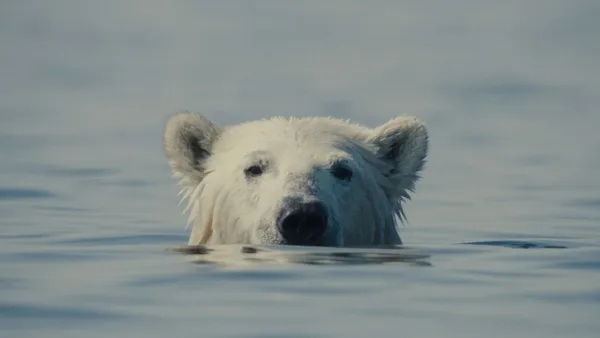

Questions of territory and takeover lie at the heart of Gabriela Osio Vanden and Jack Weisman’s documentary, which significantly expands on their 2021 short of the same name. “Inuit never say, ‘I want to see a bear.’” narrator, Inuit elder Mike Tunalaaq Gibbons observes near the start. It’s an attitude in sharp contrast to what happens in Churchill, Manitoba, where we see hordes of photographers on tours and otherwise snapping the animals in the self-proclaimed “polar bear capital of the world”.
For Churchill, bears bring tourism but as this Sundance US Grand Jury Prize-winning film illustrates, that is just the tip of a more complex iceberg. The bears are being squeezed both by human development and a loss of territory, both obvious from this film although not directly articulated. Meanwhile, specifically, in Churchill, the interaction with the animals encourages some of them to start to make forays into the town for food. This leads to the term “nuisance bear” – although the Inuit call them “avinnaarjuk”, which you suspect is a word that carries considerably more nuance.
The nature photography captured by the directors and their team of cinematographers is up close and stunning in the way of the best David Attenborough output. By viewing the situation, at least initially, mostly from the perspective of the bears, the directors ask us to consider who exactly is trespassing on whose turf. The bears don’t seem to be able to get a moment’s peace without a lens being pointed towards them.
While the bears may well have more right to be there than humans, the animals are the ones banged up in “bear jail” – pretty rudimentary looking traps that appear to be as adept at hurting the animals as catching them – or “transported” if they become too much of a pest. Initially, a little laboured in its depiction of Churchill, Nuisance Bear picks up the pace as we see one bear smeared with green and airlifted out of town in scenes that put me in mind of the transportation of the “cocaine hippos” in Nelson Carlo De Los Santos Arias’ Pepe, or the trees in Taming The Garden. While this removal may solve the problem for the residents of Churchill, in reality it merely nudges it north to the Inuit settlement of Arviat, Nunavut, where Gibbons lives.
Here, the film draws parallels between the white settlers’ attitude to the bears and the historic treatment of the indigenous populace, who have faced attacks on their language and culture. Today, as a lottery is conducted for the annual bear hunt, we see many in the community arguing against the notion that polar bear numbers are dwindling – an interesting theme that, unfortunately, the observational nature of this documentary does not offer much scope to dig into. Vanden and Weisman’s film does, however, join the dots between various issues, showing the interconnectedness not just between the actions in one place and effects in another but between the past, which Gibbons describes the bears as “visitors” from, and the “maze of the present”. In a film full of striking images, the sight of a bear being forced to uproot itself from slumber in the most pointless fashion, leaves the enduring sensation of the peace of one existence being shattered in the name of little more than a moment’s diversion for someone else.
Reviewed on: 05 Feb 2026