





Eye For Film >> Movies >> Home (2026) Film Review


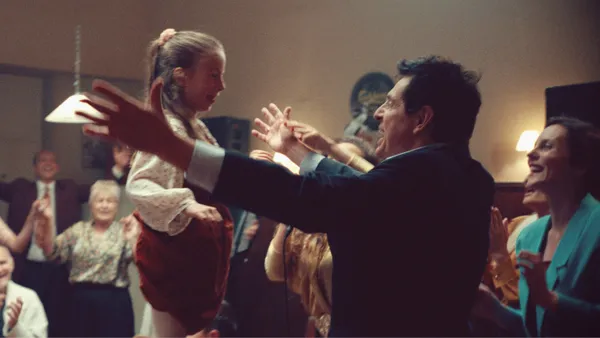

In a fictionalised return to Danish director Marijana Janković’s own uprooting from Yugoslavia to Denmark in 1991, we watch an autobiography unravel through the eyes of six-year-old Maja. Migration as rupture, childhood as sudden responsibility, language as both salvation and burden, these elements in Home accumulate less as shaped drama than as therapeutic reconstruction. It becomes compelling only when it stops reenacting the past and begins observing its aftermath.
In 1991, the Petrović family lives in what is today Montenegro as Yugoslavia begins to fragment, the same year Slovenia and Croatia declare independence. The economy is collapsing, and Marko (Dejan Čukić) is failing to provide, a pressure that quietly humiliates him. The shift comes when his uncle Jovan (Zlatko Burić) visits from Denmark and suggests they move. Marko, averse to the idea at first, ultimately resigns to it, but the decision fractures the family before they even leave. He travels with his wife Vera (Nada Sárgin) and daughter Maja, while two older sons remain with their grandmother until he can bring them over. By the time the boys reunite with them, the bitterness has already set in. Denmark offers refuge with conditions, from the limits of hospitality to the cost of a phone call back home.
Janković is sharpest when she focuses on the daily mechanics of integration. Denmark is not introduced as a haven but as a set of rules, work permits, phone bills, forms, the humiliations of hourly labour. The parents clean a school. Maja, attending that school, begins tidying classrooms during recess, not as a saintly gesture, but as an intuitive attempt to make her parents’ lives easier. She tries to pre-empt the shame she senses is waiting for them. This becomes the strongest throughline, the adult child as interpreter, protector, and emotional translator, the inversion where the child becomes the parents’ interface with the world.
In reaching for universality, Home also sands down the politics of its moment. Janković signals the Western Balkans fracture through background broadcasts and a single proxy, Yugoslavia’s removal from the European Championship and Denmark taking its place. The family watches the match Yugoslavia was meant to play while neighbours celebrate with Danish flags. Marko tells his sons the Danes would never have qualified if Yugoslavia had not been kicked out. It is a clean, cutting image of belonging as spectacle, exile measured in other people’s celebrations. Yet by relying on proxies, the drama registers consequences while leaving causes at a distance, and the historical frame turns abstract. UEFA’s decision followed United Nations' sanctions on the Federal Republic of Yugoslavia, Serbia and Montenegro, over aggression in Bosnia and Herzegovina.
Janković’s gaze toward Marko fosters generous complexity. He is proud, yes, but also persistent, animated by a traditional mandate to be the provider rather than by vanity alone. The camera seems to forgive him even as it registers the damage his pride produces, and that tenderness becomes one of the work’s redeeming qualities, a pocket of recognition that acknowledges sacrifice without excusing harm.
The bigger question Home never answers is why it needed to be told in this form, now. Ex-Yugoslav cinema has a recurring reflex to return to the 1990s, departure, war-as-background-noise, assimilation as ordeal, as if the region’s most legible export remains its trauma. That reflex can produce great work when it is paired with historical and social precision. Here, the past is tangentially invoked but not meaningfully examined, and Denmark functions as a generic West rather than a society with evolving politics of belonging. The result is a narrative that wants the moral clarity of a refugee fairy tale while sidestepping both the specificity of its own history and the harsher realities of migration in Europe today. By treating Denmark as a stable endpoint rather than a shifting political climate, the immigrant framework feels less like inquiry and more like a familiar template.
This tendency becomes clearest in the marriage for papers strand. Both Marko and Vera enter fake marriages, a scheme that brings them into contact with a Danish intermediary who demands more money as the stakes rise. The premise could have illuminated the brutal economics of legality, but the drama does not integrate the moral weight and systemic implications into its emotional logic. Staged with brisk pacing and thin aftermath, the coercion registers as escalation rather than a system closing in. Regional cinema has shown how much nuance this premise can carry when treated as a subject rather than a device, which makes its thin handling here all the more apparent.
When the story reaches the present day in the third act, Janković plays Maja herself, a choice that underscores how personal the material remains even as the tone finally shifts. With Marko now elderly and finally capable of naming his pride as a weapon, the picture finds a rough, documentary-like honesty. He regrets the move. He dreams of what was lost. He reaches toward forgiveness with late, faltering humility, texting an estranged son and trying to earn a sliver of grace before it is too late. The camera’s attention changes here. It becomes calmer, less eager to prove a point, more willing to sit with contradiction. This is where Home most convincingly becomes what it claims to be, a story about legacy, guilt, and the lifelong search for a place to belong, not just a chronicle of hardship, but an excavation of what hardship does to love.
Janković has described the project as a fairy tale told through a scream. Home certainly screams, sometimes with urgency, sometimes with the strain of a story still too close to its maker. The plain terror of responsibility placed on a child is bogged down by the familiar immigrant trauma tropes and a score that tells us what to feel.
The closing images hint at the sharper, stranger work buried inside it. We glimpse a gravestone in present day Montenegro, prepared in advance, a photograph already set, even the first digits of a future date carved into stone. An administrative gesture becomes existential. The detail lingers because it is not performed. It simply is, the future pre-written, the self-preserved in stone. It carries a blunt reminder that whatever one calls home in life, the resting place often returns to the land of birth. In that quiet chill, Home finally feels less like reenactment and more like truth.
Reviewed on: 05 Feb 2026