





Eye For Film >> Movies >> Yellow Cake (2026) Film Review


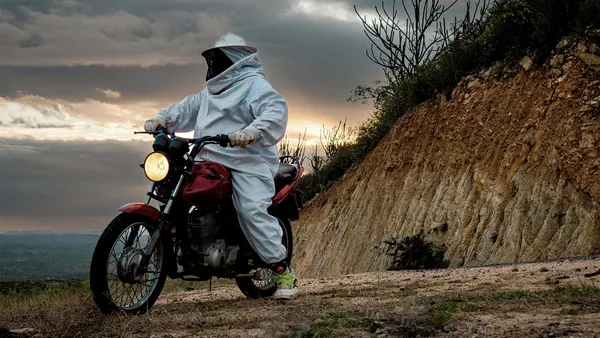

If cinema runs on light, science fiction runs on trust. You can ask an audience to accept almost anything, so long as the world feels internally engineered rather than casually asserted. Tiago Melo’s Yellow Cake wants the charge of a near-future warning tale, rooted in a very real place and history, but it keeps undercutting its own premise, swapping persuasion for hand-waving just when it needs precision.
Set in Picuí, Brazil, where dengue fever is no longer a seasonal nuisance but a public health emergency, a secret operation brings a team of foreign researchers to “solve” the problem by sterilising mosquitoes using uranium sourced from the region. The central conceit is so out of whack it keeps snapping you out of the story. A nuclear fuel-cycle material used as an insect-control tool is a leap the script never earns. The screenplay wants the authority of scientific jargon, but the more it leans on terms like “yellowcake” and “enrichment,” the less credible the plan feels.

Melo tries satirising Brazil’s dependence on world powers that arrive under the banner of help and turn peripheral territories into testing grounds. The result is a story split between satire and science fiction. While translating the present-day world order verbiage onto a near-future frame makes sense conceptually, it sacrifices the remoteness sci-fi offers, even in a close-term scenario, so much that it is hard to infer we are in the future at all.
Rúbia Ribeiro (Rejane Faria), the Brazilian nuclear physicist, is positioned as the connective tissue between the Brazilian military interests and the visiting researchers, a liaison who should give the story both ethical friction and human stakes. Instead, she is too often reduced to a functional go-between, caught in scenes that explain the project rather than dramatise its pressure. This exposes Yellow Cake’s clunkiest habit, exposition as explanation rather than drama. Characters, or the voices coming through their machines, spell out what is happening instead of letting urgency emerge from behaviour. You feel the mechanism of the plot working, but not the pressure of people thinking, fearing, and improvising under it.
Even Bill Raymond’s (Spencer Callahan) recklessness as the project’s lead scientist, which should be terrifying in its specificity, lands as a broad trait, especially once his illness and self-medication enter the mix. The locals exist in the shadow of this imported experiment, treated less like participants than collateral, as if their role was always to absorb the consequences and be left behind.
What does work is atmosphere. The buzzing mosquito motif, used as a sonic irritant that escalates into panic, is smart and physical. Picuí itself also carries the film’s best idea, a landscape that remembers Americans arriving during the Second World War to extract uranium for the Manhattan Project, and the way uranium becomes both promise and threat. That historical echo gives the narrative a spine it sometimes lacks elsewhere.
Where Yellow Cake loses coherence is in its competing registers. Local mysticism, dream imagery, crystal healing motifs and symbolic carvings all drift in and out, but they do not complicate the science so much as blur it. Dona Rita, the mystic grandmother played by Tânia Maria, so compelling in Kleber Mendonça Filho’s The Secret Agent, brings welcome texture and presence, but Melo never finds a function for her beyond atmosphere, unable to decide whether she is a rebuttal to scientific arrogance or merely another layer of mood. The “disaster” arrives too late to deepen character, and too early to feel earned. By the end, the outsiders disappear and the locals are left to pick up the pieces. It is an indictment by design, but one the film arrives at through muddle rather than drama.
Yellow Cake is topical, and its target is valid. As a piece of genre storytelling, it needs a harder commitment to causality, procedure, and consequence. Without that, its warning becomes another kind of contamination, a cloud of urgent themes without the discipline to make them stick.
Reviewed on: 07 Feb 2026


