





 |
| Whistle |
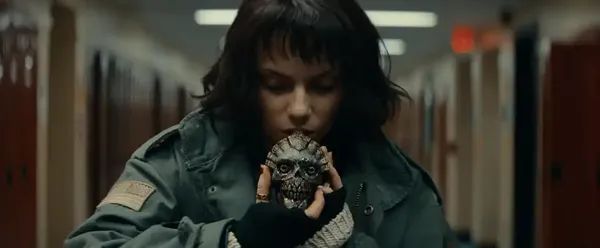
In director Corin Hardy's supernatural horror Whistle, a socially mismatched group of high school students happen upon an ancient Aztec Death Whistle. Chrys (Dafne Keen), a recovering addict, who after her father's death has moved in with her comic book nerd cousin Rel (Sky Yang), is the emotional heart of the story.
An outsider, Chrys finds herself pulled into a social circle that includes popular girl Grace (Alissa Skovbye), who knows Rel has a crush on her, as does everyone else, including her jock boyfriend Dean (Jhaleil Swaby) and his basketball teammate Noah (Percy Hines White). Then there's the sexual tension between Chrys and Ellie (Sophie Nélisse).
When Grace, egged on by Dean, foolishly blows the whistle, they discover that they have summoned their future deaths. They desperately try to learn of the artefact’s origins to save themselves, but already, the body count is rising.
Hardy has previously directed The Hallow, about a family who discover their new home is possessed by a demonic force, and The Conjuring 2 spin-off, The Nun. Whistle is his third feature.
In conversation with Eye For Film, Hardy discussed the filmmaking process, his attempt to subvert audience expectations of the high school horror movie and embedding the story with a personal connection.
The following has been edited for clarity.
Paul Risker: Why filmmaking as a means of creative expression. Was there an inspirational or defining moment for you personally?
Corin Hardy: I guess my journey was being captivated by movies like King Kong at age six, and being drawn into the illusion that it was real. And then watching Ray Harryhausen and stop-motion adventure movies. Later, I got into fantasy and [Steven] Spielberg, and then horror movies like Evil Dead 2, Alien and The Thing. But I predominantly wanted to create the monsters on the art side, and so I studied art and theatre design.
I sculpted and did animatronics and prosthetics, and me and my friends did our own Super 8 movies to imitate the films that we loved watching, like Friday The 13th and other slashers or [George] Romero's zombie movies. And so, I didn't consciously want to be a filmmaker. It was more about how we could create outrageous monsters and gore effects, because you got a reaction out of people when you showed them that.
While I wasn't a magician, it felt a bit like being a magician, because you could create an illusion. So, it was the illusion combined with stop-motion, and I made a stop-motion film that took five years to make.
At Wimbledon School of Art, I'd been making some of my own short films and music videos, and my teacher at the time collared me on my last day and said, "What are you gonna do?" I said, "Oh, I'm going to go to a special effects department at Pinewood or Shepperton and try and get a job in a workshop." And she said, "No Corin. You want to make your own films, don't you?" At that point I did, but I had imposter syndrome. I didn't know how, I hadn't studied it and no one had told me that I could do that yet. But she just had, and it set me off on a course. I did ten years of music videos, experimenting with storytelling and special effects to get to eventually do The Hallow.
PR: You wrote the screenplay for The Hallow, but on The Nun and now with Whistle, you're working from someone else's screenplay. How does that change the dynamic as a director?
CH: I tend to just go in the direction of whatever's best for the project or story, whether I've conceived it from the start, writing the outline and the script, or whether I'm coming on to someone else's, like Gary Dauberman's The Nun. I had an opportunity to help feed into that before we shot it, as I did with Whistle. Ultimately, you're trying to find a balance between the vision that you have when you read the script and what excites you. And it's a flexible thing, because writing on your own, you're trying to put down exactly what you want, but it might not always be the best version of the story. When you read someone else's script, it's about how close it is to how you perceive it creatively. Hopefully, there's flexibility to work with the writer or work in ideas that make it yours, so you feel confident in everything you're trying to pull off. I'm quite collaborative and flexible, but I also have an instant strong feeling about how the story, the effects, and the dialogue should go.
PR: What were the ideas you developed?
CH: It was mainly just solidifying thoughts on mythology, the death sequences, and character continuity. With Chrys, for instance, I was keen to show and not tell when we could. Knowing that she's grieving, and she feels a guilt and responsibility for what happened to her father as a result of her drug addiction, I had this idea that she would be given a small amount of things of his that she would treasure. One is the John Rambo military jacket that's like her armour that she hides inside for most of the movie. And the other would be her father's record collection, which would help us inform her world, her moods as well as the movie itself, by trying to create a timeless soundtrack that was contemporary but also harks back to the retro period of the Eighties and Nineties. That was something I brought into it to help to show and not tell, because when she talks to Ellie, she doesn't mention her father and inheriting his record collection. And it was also a way to get some of the bands in that I put together in a playlist.
Another example would be Rel's character, who was a comic book nerd who idolises a certain character. It was originally written as Green Lantern, and it's funny, because I love a lot of comics, but I wasn't a big Green Lantern fan. I really identified with Rel through my own 14-year-old to 17-year-old self. But knowing through the events in the film that he was visually going to take on traits of the character that he idolises, it made more sense that he would be a darker character in keeping with The Punisher or The Crow.
We weren't able to clear a known character like that, and so, it was a nice opportunity to design a character called The Revenger that was inspired by some of those darker characters. That also fed into Rel's arc and the look of his character, especially what he dresses up as for Halloween at the Harvest Fair.
These all add up to smaller things, but to me, they're significant for building the characters. Then there's the death whistle itself and what you learn about its mythology, or don't.
PR: We often contextualise world building as the concrete or physical parts of the story, but it's also emotional, which is what you're alluding to here.
CH: I think because of the words "world building", you probably visualise a Minecraft situation, and that comes into it in the production design. The whole Harvest Festival sequence was music to my ears because I love that environment. That kind of look and feel taps into [memories of] my 14-year-old self on Bonfire Night in England and trying to have a conversation with a girl I fancied from school. And so, that's also world building in a sense, but it is the character's character-building, and then you also have the sound design, music and mythology. It's trying to make it all feel part of the experience, because it's the suspension of disbelief in a horror movie that leads to you being scared or moved or thrilled.
PR: The horror genre has rightly been criticised for its tendency to objectify the female body. There's a pool scene in Whistle that appears to refrain from the typical levels of objectification that we're used to seeing.
CH: When I did Gangs Of London, we were dealing with lots of characters of different sexes and from different cultures. What they all had in common was that they were all criminals. They are all in this specific world that they've signed up to. They are all doing terrible things, and they're all betraying each other. To be able to treat them all equally and show them as authentically as possible, was really important, as well as then introducing them in their own kind of nightmarish sequences or scenes of action, tension or torment. So, I can only say that I tried to do the same thing here, where I didn't want to exploit the characters.
They're a bit like The Breakfast Club in that they come together because the teacher has collared them in the corridor fighting. So, these different cliques all being brought together in detention is our nod to The Breakfast Club. I like that those disparate characters then spend time together and actually get on in different ways. But it was written that they hang out at Grace's house, and she's a wealthy character who has a hot tub and a pool. Now, apart from the challenges, because this was Toronto in November, and it was minus 15 on our first night shooting it, naturally, the production and costume departments logistically asked, "Can we have them all in clothes?" I said, "But they are gonna be in the swimming pool, so how are we gonna do that?"
I wanted them to be natural in the scene, but it was important for Grace to be vulnerable in a way that would make it scarier, because whilst she isn't unclothed, she's still wrapped in a towel. To see bare shoulders and skin in a sequence like that is important because it makes you feel scared for that character compared to if she's in a big puffer jacket and jeans. There is a visual thing that humans identify with, because when you've got bare feet and bare shoulders, and you're hearing some noise in the darkness that you're checking out, it's going to make you more scared than if you're all equipped and ready. So, it was something that I was very conscious of, but the idea of exploiting that to the max and having her wearing barely anything wasn't a thought. But it was important to also preserve that aesthetic.
PR: Something that struck me about Whistle was that the hostility of the school cliques, the female characters more so than the jocks, gave way to a warmer and more inclusive vibe. This lends the film a subversive edge, but was it intentional?
CH: I'm glad you noticed and yes, it's 100% intentional. I'm well aware that we're making a high school horror movie, and it's going to have cliques and tropes. And I call those five characters 'The Breakfast Club' because you have got a jock, a nerd, an outsider, a popular girl, and then there's the strange one. But I didn't want it to be like a real big part of the concept of it that it's in your face. I do get tired of these bitchy, snarky, and hateful characters that you get a lot in horror movies, because they're just there so that you can enjoy watching them die. I get it, but I wanted to work with these characters, not to make them all likeable but to give them angles so they would surprise you, and you would care for them.
This was something Owen [Egerton] had written into the script, but as you edit a movie like this, you sometimes have to lose those parts in favour of pacing and thrills, which is always difficult. So, they might have had even more angles to them, but I'm glad you noticed. They do all subvert in different ways and some more subtly than you might expect.
PR: How do you look back on the experience of making the film?
CH: Well, it was an invigorating experience to be able to make a movie like Whistle with its sharp and simple mythology of the Aztec Death Whistle. I wanted to immerse people and take them on a roller coaster ride — horror with heart.
Whistle is released in the UK and Ireland from Friday 13 February. It was released in US theatres on Friday 6 February.