 |
| H Is For Hawk |
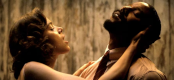
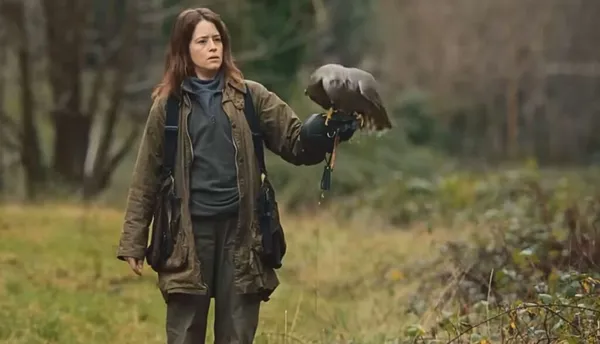
H Is For Hawk, directed by Philippa Lowthorpe, is an adaptation of the 2014 memoir about grief by British author Helen Macdonald, who co-wrote the screenplay. Cambridge academic Helen (Claire Foy) is sent spiralling after the sudden death of her father, Alisdair (Brendan Gleeson), a photography journalist with an interest in ornithology. Helen hastily decides to resign from her fellow teaching position, giving little thought to practicalities like what she'll do next and where she'll live. To cope with her grief, she buys a fierce Goshawk to train, that she names Mabel.
Lowthorpe's previous credits include the BAFTA TV Award-winning true crime miniseries Three Girls, an adaptation of Daphne Du Maurier's Jamaica Inn for the BBC, the historical feature film The Other Boleyn Girl, and Swallows And Amazons. She has also directed Foy as Queen Elizabeth II in two episodes of the Netflix series The Crown. Macdonald is a writer and naturalist whose published work includes Shaler's Fish: Poems and the collection of essays, Vesper Flights.
In conversation with Eye For Film, Lowthorpe and Macdonald discussed the importance of texture and light, and the film's exquisite soundtrack. They also spoke about liberating the film from traditional narrative tropes and its spiritual and philosophical nature.
The following has been lightly edited.
Paul Risker: How did H Is For Hawk journey from memoir to film?
Helen MacDonald: I'm thinking back because it was quite soon after the book came out, and I was in this bizarre numb state, because I had no clue the book would take off the way it did. It is a book about this miserable person, a dead author and a bird — who's reading this? And it turned out everyone wanted to read it. So, I was kind of in this wilderness state, and I got a phone call from the actor Lena Headey, who purchased the rights and was working then with this extraordinary producer, Dede Gardner from Plan B.
For various reasons, Lena had to drop out of the project and Dede continued. She brought on board Philippa, whose work she had seen, including this astonishing series Philippa had made for the BBC called Three Girls. Much of Philippa's work was deeply thought through and emotional and based on difficult real-life situations. And Dede just knew that Philippa was the person.
I'm really glad that they both made that decision to come on, because I can't imagine anyone else making the movie the way it has turned out. It's extraordinary.
PL: When I was asked to come on this journey with this incredible team, my dad had not long died. And when I read Helen's memoir, I was so moved, I felt it really spoke to me, and I just felt like it had to be made.
I knew Helen’s memoir was very popular, and it would bring it to an even wider audience because of its relatability. It’s all right to go a bit mad when you go into dark places — you can come out the other end.
I was aware it would be a big challenge filming a hawk, and it was a challenge because you can only really film these hunting scenes once a year in the autumn and winter. So, it was quite a challenge to make it about a woman suffering with grief and with a Goshawk, but we did it.
HM: My go-to analogy for this is that asking an actor to suddenly handle a Goshawk is a bit like saying, “Do you want to learn to drive? Well, hop in this McLaren” or, if you want to learn to fly, then hop in an F16. These are not beginner birds, and I always assumed early on that they were going to use something easy like a Harris Hawk, which are much easier birds to fly, and they don't mind crowds of people. It wouldn't be the same film, but I just assumed that was what was going to happen. But, oh, no, they were real Goshawks, and it turns out that Claire Foy is one of the most naturally gifted and intuitive falconers I've ever met — thank goodness. She's extraordinary with the birds and some of the shots in the film of her playing with Goshawks are unheard of. It is a testament to the bond that she developed with these birds when she was filming.
PR There's a texture to the film that you can feel not only in the world itself, but in the character's physicality — movement and voice. Today, visuals are so clean and sharp, with the grainy image seen as a detraction. However, the texture that imbued the cinematic image throughout its history, in spite of its imperfections, is something we should safeguard.
PL: It was a deliberate choice to make it feel real and authentic, and we wanted to give it a kind of celluloid look. The DOP, Charlotte Bruus Christensen, did a beautiful job, and neither of us wanted it to feel clean. We wanted it to be so you could smell the earth, feel the wind in your hair and for it to have that texture. So, we spent a lot of time choosing what lenses to shoot with. We spent a lot of time studying Tarkovsky polaroids of nature and landscapes, which have this incredible ephemeral feel. They're like little fragments of memory, and they’re slightly dreamlike, and they’re very raw as well as being very beautiful. We wanted to give our film that feel.
And even the texture of the curtains in Helen's home, in the scene when she brings Mabel home and shuts out the daylight. It's the first time she unhoods Mabel, and Charlotte, the [production] designer Sarah Findlay and I spent ages choosing exactly the right texture of the curtains to let in the right amount of light. This was so that the scene would have a tense but magical quality — that amber colour behind it and the brown tinged feathers of the hawk and Helen’s cardi that she was wearing. We thought about all those tones and those palettes.
HM: [...] My family was welcome with open arms on the set, which didn't need to happen. The filmmakers had the rights to the book, and they could have made whatever they wanted. But we were welcomed with so much love and generosity.
We came up to the set in Wales to the messy house that Helen was living in, which felt exactly like a Macdonald House. In fact, my mum was like, “This is weird.” We were watching a scene on a monitor that was being shot in the kitchen of the house. The shot was of a dead pheasant that Mabel had caught, and I don't want to use the term “religious”, but the way that the light works in the film, there are so many tiny revelations that unpeel. It reminded me so forcibly of how grief takes you through almost these stations of the cross. You move, and you change, and then there are these moments of extreme beauty, and then humour and then darkness, and the film faultlessly captures all of those. So, I was surprised how well it conjured the immediacy, the darkness and the beauty of those days.
PR: An early piece of composer Emilie Levienaise-Farrouch's score profoundly conveys the dance between beauty and sadness or beauty and pain. She anticipates the interaction of humour and sadness throughout the film.
PL: It is like a dance, and it's in three time, which is a waltz rhythm. But it has a melancholy to it, even though it has that amazing energy. And it soars with the hawks, which were filmed for real in secret by our lovely natural wildlife cameraman. But you're exactly right, it gives you this incredible lift, but it has this tinge of sadness in it.
HM: What I love about that soundtrack too, is not only that it's exquisitely beautiful, but it never tells you how to feel. It buoys you along with the film, and it makes the film sharper and more emotional in so many ways. But it never says, "Now you're feeling sad, have a cry." There's a generosity to that which is really beautiful. This is a film that never speaks down to its audience. Instead, it carries the audience with it.
PR: In the way the film doesn't speak down to its audience, nor does it speak down to the subject of grief, loss and depression. It doesn't suggest grief is a self-contained narrative with a beginning, a middle and an end.
PL: Well, obviously, everything comes from Helen's memoir, but it was nice to have the freedom to not make a deeply conventional film with beats and then counter beats, where you have to pay off those beats. For example, in the brief moment when Helen may or may not go to Germany, we never have to pay it off once it has gone. Not having to observe those script editing tropes really liberates the film. And I'll tell you what I said to the editor when we sat down and looked at the rushes: "I want this to be a poem and not a novel." A film should be a poem, and that's liberating because you don't have to have a specific beginning, middle and end. Instead, you can have verses.
HM: And of course, what grief does is it just breaks apart all of those familiar tropes and narratives that life gives you and makes them not work in the way that you expect them to. So, one of the reasons that the book was called Ages for Hawk, is the title refers to learning to read the world again after losing a father has made it unintelligible. In that way, the book and the film are a kind of primer for how to find your way back into the world after things are lost. That's never a linear process, and it's such a sophisticated way of thinking about film and narrative.
PR: H Is For Hawk takes something personal, and yet, communicates about universal and philosophical subjects. It's a film that will speak to you differently in different chapters of your life. Perhaps that is its beauty.
PL: […] I hate to use the word spiritual too, but it does ask philosophical questions, even at the end of the film where we have our Julian of Norwich quote, and you think, what does that mean…really? Somebody said something lovely to me the other day. In the last scene when Helen's dad takes her to look for the source of the River Thames, they saw a beautiful metaphor in that. The River Thames was actually buried and unseen, and that little river that was underneath the earth, that was so exciting to her dad, was the river in all of us — the unseen feelings that are going to happen, and the things that are going to become part of a fluid life. And I thought that was so beautiful.
HM: There's something special about falconry, in the sense that you have a truly wild creature, which every time you let it loose, there's the possibility it might just decide not to come back. So, it's a wonderful kind of way that you have your soul stretched and then it returns. And you've got that happening at the same time that these Goshawks have never been domesticated. The hawk that Claire flies in the film would have been trained the same way and would have looked and behaved exactly the same as two, three, four, five thousand years ago. So, there's a sense that it's a film largely about human universals. I hate the term, but they are human universals that happen to us all. And in the backdrop, there's this unchanging natural world that's fixing us all with an orange eye as we go about our days. So, I do think it's a very spiritual film.
H is for Hawk was released theatrically in the US by Roadside Attractions on 23 January. It was also released theatrically in the UK on the same date.