 |
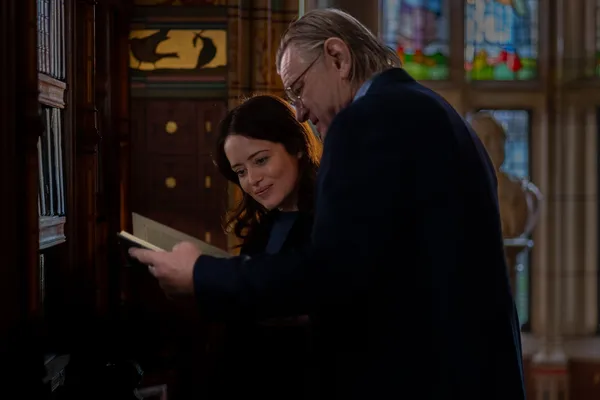
| Claire Foy and Brendan Gleeson in H Is For Hawk |
H Is For Hawk, directed by Philippa Lowthorpe, is an adaptation of British author Emma Macdonald's 2014 memoir about grief. Actress Claire Foy plays Cambridge academic Helen, who is sent spiralling after the sudden death of her father, Alisdair (Brendan Gleeson), a photojournalist with an interest in ornithology. Helen hastily decides to resign from her fellow teaching position, giving little thought to practicalities like what she'll do next and where she'll live. To cope with her grief, she buys a fierce goshawk to train, that she names Mabel.
Foy and Lowthorpe previously worked together on the Netflix series The Crown, in which Foy played Queen Elizabeth II. She has also played the ill-fated Anne Boleyn in the BBC series Wolf Hall, adapted from Hilary Mantel's novel. Her film work has seen her work with notable directors, including Sarah Polley on Women Talking, Andrew Haigh on All Of Us Strangers, Stephen Soderbergh on Unsane, and Nicholas Hytner on The Lady In The Van.
In conversation with Eye For Film, Foy discussed the importance of emotional connection, her search for truth, and why she values space and silence.
The following has been lightly edited.
Paul Risker: What was it about the project that compelled you to play this character and to tell this story?
Claire Foy: It's a weird one, actually. And this happens quite often, in that I don't necessarily want to do something. It's not like in my dream life I'm wearing a sparkly leotard and doing show tunes [laughs], so, that's where I want to be. It's more like it's an internal drive that I'm already doing. The decisions have already been made, and this is what's happening. I think it's that I'm drawn to scripts, stories and characters that feel as close to real life or what I think is real — emotion and truth and all those sorts of things. But it feels like a necessity as opposed to a want, I suppose.
PR: Cinema is commonly described as escapist entertainment. However, if a film starts off being about the characters onscreen and ends up being about the viewer, this speaks about how reality and realism bear down on the filmgoing experience, even if the film leans into dramatisation and escapism.
CF: The things we respond to, even if it's not necessarily emotions like loss or romance or any of those things, but if it's humour, then that's still real. It's something that we experience all the time, and it drives everyday life. So, even when it's something to do with fantasy or sci-fi or anything like that, what I find in my experience of talking to people is that ultimately, it's the human connection within that framework that is the thing that people find most enjoyable.
I totally get that people don't want to go to the cinema and be beaten around the head with a moral or a message. But I also don't think there's anything better as a cinema goer, and I'm an avid film watcher, than going into something and not knowing what it's about, not knowing what I'm going to be given, and not knowing where it's going to take me, because that's what film and theatre do. They take you on a journey, and you ultimately end up back at yourself. The person who's going to be moved at the end isn't going to be a fantasy person. It's going to be you, the human being who's watching the film. And it's the best feeling ever if you can make something that has that effect.
PR: One of the things I appreciated about H is for Hawk is that it humanised rather than dramatised grief and loss.
CF: As an actor, that's my approach, which is possibly why they chose me and also why I ended up doing the film.
Philippa Lowthorpe, who directed it, grew up in documentary. I love working with documentary filmmakers who then go into narrative, because they are looking for a reaction; they are looking for humanity. They are not trying to portray anything; they are only trying to capture. And for me, I find that really exciting — I find it as close to the truth as you can possibly get. And I don't mean as in like method acting or anything like that, but the truth of what it is that we do to each other, how we do those things to each other, what we do to ourselves in the process and how we try to recover. That's basically the whole thing for me, and I knew in making the film that I couldn't be performative as Helen. She is suffering with the unimaginable grief of her father dying suddenly, but she's also suffering with depression. It would have been a disservice to those people who have depression to try and make it dramatic, because it's such an internal condition.
PR: As someone who is all too familiar with depression, the way you carry Helen's pain in her bones and soul struck me as being genuine. Whether still or in motion, her body and eyes, her gestures and expressions capture what it is to carry this weight.
CF: Helen spoke a lot about something that was very important to me in the memoir, which was the physicality of grief. It's that feeling within your brain and your body, that disassociation of sometimes feeling like you're underwater, or you were in a different dimension to everyone else, where everything was in slow motion and you couldn't reach anyone. And I felt strongly that I wanted to, in whatever way I could, [express this], whether that was physical or in the way that questions are asked and not necessarily responded to, or things happen, and you're a beat behind, or things are hyper-real and hyper-focused. Even if it didn't come across in the film, for myself as a performer, I had to go through that whole experience internally, and hope that some things stuck even if other things didn't. But I felt I had to honour the interior world of what this person was experiencing, because I couldn't articulate it, and often, you can't anyway.
PR: One of the things I appreciate in performances is when silence is allowed to exist by allowing the characters to breathe and communicate non-verbally through gestures, a look or a glance. It's one example of how silent cinema has endured, transforming, and is an invaluable tool.
CF: There's no sort of cue cards in the middle going da, da, and there's danger or something like that, which I'm grateful for. But yeah, there's a real fear now in filmmaking because of the way cinema has gone. People aren't going to the cinema as much, and streamers have become so huge, and with social media, TikTok and stuff like that, we're not used to long form. We're not really trained to sit through something, and I feel there's a real nervousness around space and silence. And that's unfortunate for me because they're two of my favourite things when I'm acting — I just love being in those moments.
I think you learn a lot about the dynamics of relationships, of what's not said instead of what's said, and how space works between characters. And if you leave enough space and enough silence, the audience can have a three-act [story] play in their head about what's happening and what these people are thinking. It's a really valuable tool, but I don't think it's necessary for an actor to engage with — it's for the director and the editor to use to their advantage. But I do think there's a fear of it.
This film is very silent because in a lot of the scenes, I'm with a non-communicating species. So, it's just me who's able to articulate, and that was one of my fears. I said to Philippa, "I'm not going to be talking to Mabel all the time, am I?" And it takes a really confident director to do what she did. So, I couldn't agree with you more. Let's have more silence, please.
H Is For Hawk was released theatrically in the US by Roadside Attractions on January 23rd. It was also released theatrically in the UK on the same date.