 |
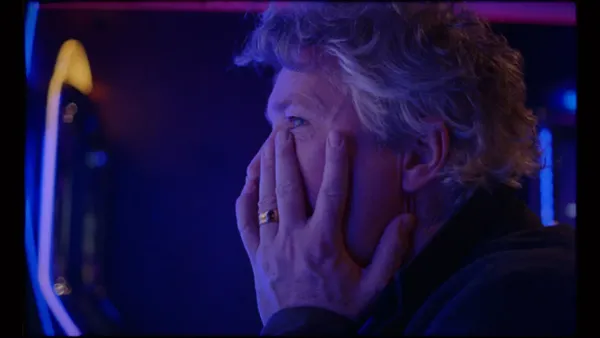
| Aidan Gillen in Nostalgie |
“That's really positive to hear,” says Kathryn Ferguson, when I tell her that her new short film, Nostalgie, really hit home for me. “It's only just been out a few months, so we're just catching our breath a wee bit with this BAFTA stuff. Last week, we absolutely, genuinely in no world believed it was going to get in. So we're kind of going from just tootling along to now, all of this. I'm trying to catch my breath. But that means a lot to hear that you liked it.”
It’s the story of a retired musician, Drew Lord Haig (played by Aidan Gillen), who is excited by the opportunity to recall the success of his youth when he’s invited to Northern Ireland to perform for a private club. The problem is that he knows nothing about what that club is, why the song means so much to its members, or what their bloody history involved. Adapted from a short story by Wendy Erskine, it has now made its way onto the BAFTA longlist.
“We just thought we'd just do some nice festivals. We're like, what is this? And it's just so nice that it's been received and people are enjoying watching it. It was a passion project. It really was. And it was a passion project, about my hometown.”
We discuss what it’s like to watch the film as Celts; how that background changes the perception of it. There are details as the story develops that Drew, as an Englishman, just doesn’t see, or fails to interpret as the warning signs they are. When I see things like that, I admit, I want to get out of there as quickly as possible, but Drew just isn’t aware of the threat.
“He’s not aware. And I hate to say it, but there is an apathy about the situation in the North, and there always has been. That's what drew me into the story so deeply. It's very close to Wendy's original story, obviously adapted brilliantly by Stacey Gregg. But it's this: how to make a nod towards the empathy that we all feel in a more nuanced way. Like a bit of a sideswipe, you know, in the writing itself, because it's what we feel and have felt as people growing up in the North. That lack of understanding or interest potentially in our situation and the politics of it all is something that we're deeply aware of.
“So I loved that it was done through this aging Eighties pop star trying to reclaim this potent part of himself where life was in full tilt. He's trying to get back there, but he's doing it in such a dubious way and certainly isn't spending his time on the boat, or prior to that, googling where he's going and who he's going to be working with. He's enjoying his nostalgia trip. And I think it's just that combination I find very powerful.”
I suggest that he's looking for a way to recapture his passion, to feel really emotionally intense about something, but he hasn't thought about what that sometimes means, that you get that intensity in dangerous situations.
“Very well put,” she says. “Absolutely, deeply. And that's what I mean. He's choosing to have a Guinness and to try and connect with a young female musician on the boat and enjoying the chat. I love her retorts, but he's doing that instead of spending his trip maybe googling and thinking ‘I might need to think a bit more about what I'm about to do here, who I'm playing for.’
He’s also reading Anna Burns’ book Milkman, I note, and she tells me that’s so in the original story.
“I think Wendy does that beautifully as a novelist nods to other writers from the North. But no, it's just that's the height of his research, thinking ‘I'll read this very well known book about the North and I'll get all the information I need prior to going,’ instead of actually spending the time really thinking about or looking into where he's going. I do think it's interesting, just culturally at the minute, you know, that Ireland's got a lot of cultural cachet in the last year two years, with all of the art and music and writing that's pouring out of the country at the minute. That it's so appreciated by the English. It's this sense that maybe Ireland is cool these days, but no one's really thinking about what's generated all this work, all of this creativity, the years of oppression and everything that we've been through as a people, you know, so it's interesting to me.”
He's an innocent character in that it doesn't occur to him that this could possibly exist, I venture. But at the same time, being English, he's benefited from it in his own way, and he should have been more aware.
“He should have been more aware. Read the news more often. It was a perfectly formed story by Wendy. Truly, it really was. It was after my feature documentary about Sinead [O’Connor], I think.”
She recalls speaking with Eye For Film’s Amber Wilkinson about that film, Nothing Compares.
“It was kind of on the back end of that release. I suddenly had a couple of drama producers get in touch, being like, ‘Have you thought about drama all?’ Honestly, I hadn't thought about anything, remotely, in my life, past Nothing Compares, because it had taken up all my time and energy. But then this particular producer said ‘Have you read the work of Wendy Erskine?’ And I had read her first book of short stories, Sweet Home, but I hadn't read the new one that had come out. It was 2023. So I was sent a manuscript of the book and all the stories, and there were 12 stories and I read them all, loved them all. Amazing, wry, sharp, observational, contemporary Belfast stories, which I love. But it was Nostalgie that just jumped out for me.
“Wendy writes very cinematically, so I could see it very clearly. But it was also this, I think: off the back of doing a Sinead film, like what happens to an artist's art when it goes out in the world and they lose control of this thing that's been put out there? And loss of autonomy and it going out of their hands. And I think there’s nothing that you can do about it. You have to accept that once art's out there, it's gone, you're handing it over. I guess that was something that's really resonated with me after working with Sinead for all those years. And then, as I said, this cultural cachet side of things. And also just the fact, you know, I've been in England now 25 years.
“I'm born and bred Belfast. Hopefully going home soon, thankfully. But I've been over here and just this idea of looking at Belfast from over here, even myself, and what the perception of the North and our history and our politics and our trauma, all of it, how it's viewed from over here, it's just very interesting to me to see it through this character as well, through Lord Haig.”
So how did she end up casting an Irish actor in such an English role?
“Well, we wanted somebody who could sing, or who was up for singing. And they had to be the right age. They had to believable, having like a louche thing, could have been a rock star or a pop star at least, or a wannabe rock star in 1986. So it was really trying to find an actor who had that: was of the right age, could sing and also just had that loucheness and could be somewhat believable in this role. And Aidan just fit the bill perfectly. We hadn't consciously decided to find an Irish actor to play an English person, but when we finally spoke to him, we got to chat to him and he agreed to do it, it made even more sense. I love his work and always have. And Wendy even, you know, when I told her, she's like, ‘Oh my God, he's exactly Drew to me. Perfect.’
“We were delighted that he came on board. And then Stacey Gregg adapted the story into this brilliant script. So once we had our script – it was a good few years ago, I mean, it took us two years to try and get the funding for it. I had realized it's hard to get anything funded, but even with a short, trying just to get it up and off the ground, it did take us about two years to actually pull it all together in the end, and go out to various partners and ask for money and try and get it made.
“It just kind of rolled on for a year and a half while we tried to just bring it to life and get people to believe in it and make it with us. And then quite suddenly we did do that and we did manage to get people to come on board and help us fund it. And we quite boldly asked. I'd met [cinematographer] Robbie Ryan at a Film4 event, and we just cheekily asked him or his agent would he be free to potentially shoot this? Expecting a polite no. And his lovely agent came back saying he really loved the script and he would be interested, but he only had four days that year. ‘Okay, and when are they?’And they were in a month's time.
“So we'd havd this long period of nothing really happening, and then suddenly it was like, ‘Right, Robbie can only do these days. Let's make this thing happen.’ It was a wild four weeks and it all came together, even like the songs. We were so fortunate to have Dan [Smith] from Bastille write the music for it. The songs had to be written from scratch.”
They're just perfect for the time period, I say. Really well done.
“There were a lot of references being fired everywhere,” she responds. “It needed to also have a hook and be believable as an anthemic type of song, you know, because it's based on this idea of these artists who've had their work co-opted like Sinead’s was by Trump or Bruce Springsteen with Reagan. And even in our own country, paramilitary groups – I think it was the UFF had Simply The Best by Tina Turner as their theme tune for 30 years. But you can't stop it. Once it's out, you can't stop it.
“So we had to write this music and we just had the one line of the song from Wendy's Story. That was a really collaborative, really quite fun few weeks – kind of a panicky few weeks, because we were trying to come up with two 1986 bangers in a matter of weeks and then record them. So it was a lot of hijinks trying to get it done. But really, I would say the film really benefited from the Robbie Ryan effect. Obviously, the story’s number one, and Stacey's amazing script. But then when Robbie came on board, that's when really all of this exceptional talent started to pile on to the project. It wasn't a given in any way. It was very much like we just asked and hoped for the best. And I just think people could see this was an interesting take on Northern Ireland. I had a lot of ‘pinch me’ moments when I walked on set for the first time, looking at the room being like, ‘How is this happening? All these people have come on board.’ So it was really fabulous.”
Then there are the extras, who look just perfect for it. How much was that makeup and so on, and how much was it just finding the right people?
“We worked with a brilliant casting director called Mary Ellen O'Hara. She's actually Seamus O'Hara's partner and she is a Northern Irish casting agent,” she says. “She just found all of them, everybody. It's a lot of actors from the local theatre, the Lyric, and they were the sweetest bunch of men. They were so fabulous and they came and they knew every word of the song. They practiced it, they knew exactly what they were coming in for. And they just brought their wild energy. It was kind of startling just to be behind the camera watching it all happen and how authentic it actually did feel. And I guess growing up with the news every day of my childhood and my teens, seeing what these actual men looked like, you know – we were inundated, obviously, with the imagery of it every day of our lives growing up. So it felt extremely authentic.”
Speaking of appearances, I mention Drew’s mascara and how that's something that would have made him unsafe around them if he hadn't been there for something they wanted.
“Yeah, totally. And Aidan very much brought that as an idea to the film. He's like, ‘I’m just going to put some mascara on. This is what we would have done. In the Eighties it's what we did.’ So it was great. And yeah, I mean Drew just has no idea what he’s walking into in any shape or form. He thinks it's going to be a nice fun night, and there’s the dawning realisation as he's driving [that he’s getting] further and further out of the city into the sticks, which makes him extremely isolated for what then unfolds. And then he's peacocking around his hotel room to his own song, and he's still determined that it's still going to be a good night for him.”
They shot the whole thing in those four days, she says, with no additional time for pick-ups.
“We shot it last December and then we were just trying to edit it at weekends and when we could, in amongst the other work that we were doing and. Even with the editing process, it was quite drawn out. I was on another project, but. And then it just suddenly all did start to come together, even with that, and it was such a joy for it to launch. I think it was actually really good that it launched in London in a sense. It felt like appropriate that it launched at BFI LFF. I thought that was a really good launch pad for it.
“We're genuinely just shocked and delighted that it's got in at all as a long lister. So whatever happens next, the fact that it's been long listed is such a nice trajectory for the project. Whatever happens, hopefully it's going to have a nice life at festivals.”
She’s now working on a feature documentary and a feature drama, she says.
“I can't say what it is yet, but we’ve just optioned a beautiful book by a Southern Irish writer, a story that's based in the West of Ireland and it's a very beautiful story that I'm very excited about. So we're in the early development stages of that, working on scripts and getting that up and running. But I guess what, I set up a small production company with Eleanor Emptage, who produced Nothing Compares and was an executive producer on Nostalgie. We've worked together for the last seven years and we just have a slate of lots of bits that we're trying to get up, but a lot of it's about Ireland. A lot of it's very clearly drawn to our stories and trying to get them out there.
“It feels like a really good time to try and share them. There's an appetite for it. It feels like the time is now. Let's get these out when people are interested in hearing about who we are and what we've gone through. So, yeah, I’m excited about that.”