 |
| Michaela Madden in Bad Hostage |
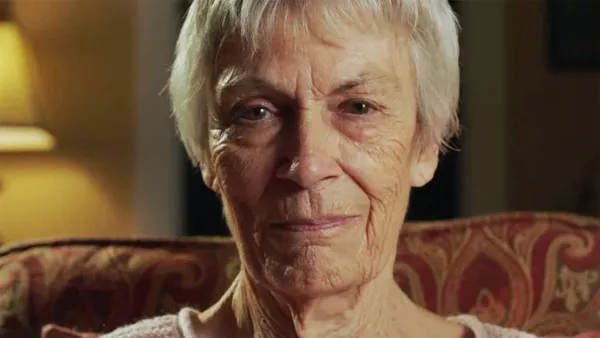
In 1973, Michaela Madden, a widow and mother of five who lived in a quiet rural area of Sebastopol, California, was held hostage in her home by fugitives from an earlier crime scene. Keeping her head, she handled the situation superbly, but this angered the police officers at the scene, who wanted to do things their way and have her be a compliant damsel in distress. Now her granddaughter, Mimi Wilcox, has made a short documentary inspired by that experience. Bad Hostage compares the incident with two other high profile cases, examining the difference between what’s expected of women in such situations and what they need to do to survive.
Bad Hostage has now been shortlisted for an Oscar. I met with Mimi and asked her if Michaela’s story was one she had grown up with.
“Yeah, absolutely,” she says. “It was a story I had never really heard from my grandmother, but I had heard it from my mom all the time. It was sort of her favourite family story to tell me. I always thought it was so interesting, so captivating. It had all this drama, but then it also had a punchline, you know, and so I was just really super invested in it and always loved it.
“It wasn't until I became an adult and became a filmmaker that I started wondering whether the story had gotten a bit mythologised – you know how family stories, over the years, can get a bit embellished. And so I started to look into it and found newspaper coverage, found archival footage, and found that actually the story really was true, as my mom had told it to me, and actually was even more dramatic than I realised.”
That must have involved some surprising discovering about how the press treated her grandmother, i suggest.
“Exactly,” she says. “I mean, it was really fascinating to see both ends of how it was covered in the press. On the one hand, there was this incredible article written by the journalist Boniface Saludes, who was held hostage in the house with my grandmother. It was this brilliantly written and really thoughtful piece about the experience that really echoed what my grandmother had said; but in other ways, it was really surprising to see her described as a ‘small, attractive woman’, really fixated on the fact that she was this single mom, this widow with five kids. She was so flattened in the press. And then incredibly, I learned that there was so much backlash against her in the community because she stood up to the police and didn't play this damsel in distress role.”
Did that give her problems in the rest of her life?
“I don't think she would say so. I think that it was a difficult couple of years, but that things fade. She was really very focused on providing a sense of normalcy for her kids and for herself. And so I think that was really her focus, just on creating as much a sense of normalcy as possible and really continuing on with their lives in spite of whatever barriers they might have been facing.”
Before the incident, Michaela had been worried about her ability to look after her children in the absence of a husband. Getting through it the way that she did must have boosted her confidence.
“Absolutely. They had already navigated this incredibly devastating experience of losing her husband and their father, and then came into this experience and were able to handle what might have been also a really traumatic, devastating experience, and come at it with so much calm and bravery. I think that really speaks volumes to who she is.”
The film also looks at the bank robbery which gave Stockholm syndrome its name, also in 1973, and at the kidnapping and ‘brainwashing’ of Patty Hearst in the following year.
“Well, you know, there was a really funny connection organically between my grandmother's story and the Patty Hearst case, which is that after this hostage situation, as I said, there was all this backlash against my grandmother in the community, and someone, to harass her, had called the FBI, and the FBI showed up at her door and said that they'd received a tip that she was harbouring Patti Hirst, which is just ludicrous. It was always kind of a punchline in the story that my mom would tell me.
“What solidified bringing in Stockholm syndrome as an idea in the film was I was looking into the case in Stockholm, this original bank heist that led to the coining of the term. I was really struck by looking at interviews with Kristin Enmark, one of the women held hostage, and what she said, which is that she felt more threatened by the police than she did by the men holding her hostage. It just so echoed what my grandmother had said. What I was really struck by in these cases is how similarly they spoke about it. And that's when we realised that we really wanted to look at all these three stories in conversation with each other.
Both those incidents concerned women who actually had time to get to know the people involved. So they were thinking of them as people, and the police and the press weren't really thinking of them as human at all.
“Exactly, yeah. And my grandmother, to this day, just really engages with people as individuals. And I think that's really what she was doing then, even though of course she was upset about the circumstances and was not pleased with the actions these men were taking. But she wasn't just looking at them as criminals or as dangerous men or as hippies or whatever it might have been. She was just looking at them as individual people. Whereas I think on the flip side, she really wasn't being looked at as an individual by the authorities. She was being looked at as a damsel in distress who wouldn't play her role.”
I venture that, to me, recognising the hostage takers as human really seems like a survival thing for hostages, both to understand them as well as possible in that situation, and to make sure one is recognised as human oneself so that there's less chance of being killed.
“I think that's exactly right. And I think that's what really strikes me about all three of these women: their incredible survival abilities. They were all in situations where the authorities were actually increasing the amount of danger they were in, but the tools that they had at their disposal to keep themselves safe is really amazing, and they should be commended for making it through those situations and surviving, and not be punished for surviving.”
The police seem to have been interested in winning than in actually keeping the hostages alive. They just had different goals.
“Exactly. To me, it's a huge theme to me of the film. I think in all of these situations and in so many situations that we see in life, in the world, they're trying to win, they're not really trying to find a solution. They're not in these situations. They're not really focused on keeping people safe. They said that explicitly to my grandmother: ‘Whether or not you're in danger, we're going to get those guys.’ I think that really highlights the danger in people trying to get a win at all costs and not actually listening to the voices of the people who are most directly impacted.”
There’s some amazing material from Truman Capote in the film, where he insists that women fall in love with their abductors, in a way that really seems like projection. Because he fell in love with a murderer, he thinks everyone else is going to as well.
“It's fascinating, isn't it? When were trying to find the earliest mentions of Stockholm syndrome, that was one of the earliest that we could find, Truman Capote talking about it. And that was such an incredible archival find that Max Asof, our producer, made. We had to include it. It was really fascinating to realise how that was connected.”
It brings a bit of humour to the film as well, which, I suggest, gives authority to Mimi’s position and to the voices of the women in the film, because if they were actually brainwashed or didn’t understanding themselves, they wouldn't have room to have that humour.
“Absolutely. I think that's really astute and it's so true. Humour was always going to be really important in this film, even though, of course, it's quite a drama because, as I said, that's kind of what it was for us as a family. Initially it was a funny story with a punchline at the end, even though, of course, it's a terrible thing that happened. So much of how my own family navigates life in general, but certainly the more difficult parts of life, is with humor. And that's something that I always really appreciate as a filmmaker, is bringing humour, even in our darkest areas that we might explore. I'm really glad that came through in the film.”
So what does her family think about the film now that it's finished?
“I was so nervous to show them,” she says. “But you know, the film took six years. So when you do an interview and five years later, there's no film, I think that could be confusing. But when the film was at a late stage, I sat down with my whole family and showed it to them. I wanted to make sure they felt they were being represented accurately. That was something that I was uncomfortable with and it turned out to be really wonderful. They responded so generously and wonderfully to the film.
“My grandmother had initially been very skeptical about why I wanted to interview her and why I was interested in this. She just sort of felt like ‘Oh, who cares about this little family anecdote?’ But I think it was really cool for her to see it kind of in a new light, to see her story alongside these two other stories. So that was really wonderful, and it was really nice for me to kind of connect with my family in a different way through working on this project with them.”
Her grandmother is now a strong supporter of the film, she says.
“She's amazing, of course, and she was doing the Q&A for us with us at a screening the other night, and moderator asked her ‘So what do you think of Stockholm syndrome?’ And she said ‘You know, I think it's a total fallacy.’ And then she kind of spoke on it more eloquently than I could. So I think she definitely feels the connection now, even though, of course, she wouldn't have used those words to describe it at the time.”
She’s thrilled by the film’s unexpected success.
“It's been really amazing, you know? Beyond my wildest dreams for it. Again, it's been such a long journey to get here. I first started making the film at such a different stage of life. And to be here now six years later, to have been able to share it with people, you know, it's so powerful to work on something where I'm in relative isolation for so long and then see how different people react to it, what people see in it. It's such an amazing process. It's been really special, and I feel really honoured that we're now in this position with the shortlist.”
Does she hope that the film can kick off new conversations about this now that it's so visible to people?
“Certainly. I hope not only that we have a greater cultural reckoning with this concept of Stockholm syndrome, which I think really needs to be understood differently, but also with other commonly held knowledge that we just take for granted and don't interrogate more closely. I think that there's probably a lot of other things like that in our society that we might find just become a part of the normal conversation, that actually exist to prop up patriarchy and prop up institutional power. So I hope that it has people thinking differently about all those things.”