 |
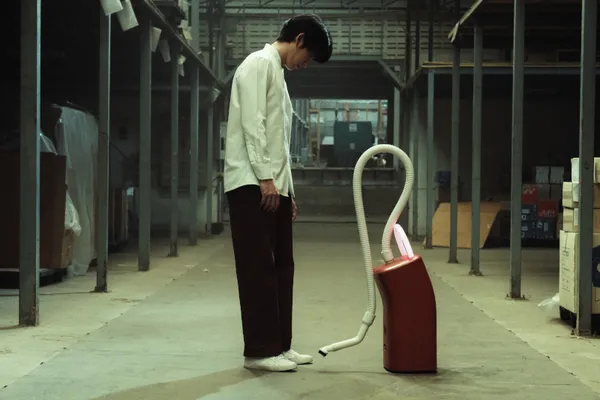
| March (Wisarut Himmarat) in A Useful Ghost with his haunted vacuum. Ratchapoom Boonbunchachoke: 'She’s a useful ghost so she’s a people-pleaser' |
In A Useful Ghost you combine real world issues, such as the environmental problems in Thailand with dust, with more fantastical elements. Tell me about that?
 |
| Ratchapoom Boonbunchachoke: 'I want to have a fantastical element and humour and silliness in a film and then talk about some serious issues' |
I'm happy every time I see comments or reviews, saying, “Who would have thought that a film about a haunted vacuum cleaner could also be about that?”
You seem to love to add layers in your films, you did that in your short film Red Aninsri; Or, Tiptoeing On The Still Trembling Berlin Wall as well and the feature is eleven more ambitious.
RB: With the short film, it could be gimmicky. There’s a lot of short films that use a dubbing technique but which don’t convey a historical layer. I like putting incompatible stuff together and seeing how it works. I want to see things that are not supposed to be together but they end up together.
This film revolves a lot around memory and forgetfulness, some of which is forced and some of which isn’t, it’s almost Orwellian in places. Was that a response from you to the political situation in Thailand in recent years?
RB:Yes. One of the things that triggered me a lot is the demolition of some architecture and monuments across the country because Thailand was changed from absolute monarchy to a constitutional monarchy in 1932. After that, the People's Party became the government for a few years and they built a lot of stuff across the country but nowadays like I think like the current government or ruling class, they secretly, discreetly dismantle or destroy this architecture and replace it with something else. It’s like they’re trying to erase the legacy of the revolutionary era.
Also, in 2020, the Covid year, there were a lot of young protests against the military regime that we were living under. They weaponised the past, using figures from the revolutionary era as a kind of example that there was a generation before us that tried to fight against the establishment in 1930. So they tried to weaponise this part of the past against the current regime and I found it heartening, in a way, to see them doing that. So I think the past could help us in a way, when we look at it and see there’s some people who tried to fight before us and we can just continue fighting the same battle. So, I was inspired by this but now I feel people have started to forget again. I think in the Covid year people had more free time so they fought against the regime but now they need to resume those other things so they don’t.
Can we talk about the design of the vacuum cleaner that your ghost inhabits and how you incorporated it into the film?
RB:The Singaporean designer is an actual industrial designer. He designed vacuum cleaners for real that would go to market. Initially I thought we were going to work with an artist to design it but then my Singaporean co-producer knew someone, who knew someone on the team of the industrial designer, so she introduced us to Sim Hao Jie. I was worried that he might not get it because he’s from the industrial world and didn’t watch many films. So I had a chat with him and gave him some of my ideas and a few weeks later he came back with six options and they were all wonderful. I finally chose the one that we see in the film. It also has a nickname – “soft obedience” because it looks like she’s always moving or bending. She’s a useful ghost so she’s a people-pleaser.
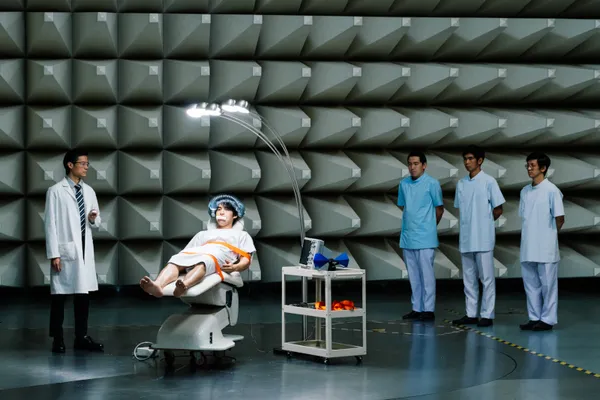 |
| Ratchapoom Boonbunchachoke on the electroshock room: 'My location team discovered it and I was really impressed because you can’t think of this room when you’re writing the screenplay if you never saw it' |
The costuming is also distinctive, the family is often colour-coded and Nat’s outfit is also very unusual.
RB:We had two teams of costume designers. One looked after Nat’s costume and the other characters were being taken care of by another team. With the family, they always appear with the same colour scheme and I think it’s so funny. I tried to create a specific universe in the film, not just in terms of how it looks but how people behave. They have deadpan or understated expressions through the film. I like artificiality. I like reminding you that you’re watching a film, you are watching a construction in a way.
One of the more distinctive pieces of production design is the room where electroshocks are given. Is it right that it’s a real room that exists and you found it?
Yes, it really exists in Thailand. It’s located in a university just an hour’s drive from Bangkok. It’s a room to test electric cars. My location team discovered it and I was really impressed because you can’t think of this room when you’re writing the screenplay if you never saw it. So when I saw it, I was like, “Oh my God!”. It really helped the film and is a kind of character.
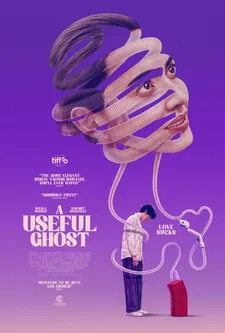 |
| A Useful Ghost poster |
RB:I’m developing something in my head now and have been for a few months already. I used to ask my Singaporean producer Tan Si En – because she produced a lot of films and she also produced second and third features as well – if it's going to be easier and she said, “No, it’s not going to be easier because for the new film you’re going to be more ambitious, you’ll want to try something more challenging and you don’t want to repeat something that you’ve already done.2
So, okay… the first one was already difficult for me, so I thought it was going to get easier for the second one. But no. I hope I can finish the screenplay this year and that it will take less time than A Useful Ghost to make. I think it will be in a similar style. It is an adventure film that also draws on some fantastical elements and, of course, humour as well but I’m still not sure what it’s going to look like.
A Useful Ghost is released in US cinemas on January 16. Watch the trailer below