 |
| Playing God |
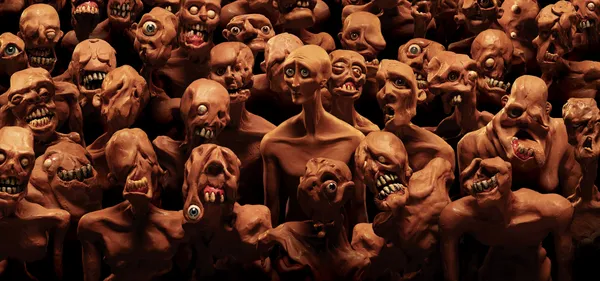
A dialogue-free short about clay figurines, Playing God might not sound like the most gripping material, but you’d be surprised. It packs in some intense ideas and strong emotion as it explores the relationship between a newly built creatures and the monstrous forms he sees to either side of him. It was directed by Matteo Burani, with the creatures sculpted – and resculpted for every individual frame – by Arianna Gheller. I met the two of them to talk about their ideas, their creative techniques, and how they feel now that their work has been shortlisted for an Oscar.
“Playing God started seven years ago,” says Matteo. “It's a long time ago, actually. And it starts from a personal burnout from the work. Because I was never satisfied about my career and my work itself, like I could never be enough in what I'm doing. And so the idea started in this way: imagine a creator, like an artist – a sculptor, in this case – that creates a lot of sculptures without perfection. This was the main idea at the beginning, but at the end, the idea developed into something more, because at the end we focused not even more on the relationship between the main characters, the creator and the sculpture, but we focused more on the relationship between the sculpture and the other figures like him. We focused on the people that feel this kind of abandonment”
“Me and Matteo, we met in 2017,” says Arianna. “We decided immediately we had this need to create something special, something deep, and with this kind of technique, with a high quality of the visual aspect. But at the beginning, I wasn't able to animate like that. Animating with clay, for me it was impossible. And when Matteo asked me ‘Okay, Arianna, let's do clay animation, puppet animation and pixellation together,’ I was crumbling inside. But you know, I always loved so much animate, I decided to come on board. It was fantastic for me to have all the time needed to experiment a lot and to, grow inside the group, inside our company. With the project we grew as people and perfectionists in this world. And I'm super happy with the journey that we had.”
“Yeah, we grew with the project and the project grew with us in some ways,” says Matteo. “We followed this path together and it was really nice. And I think that it was the first time there was the ambition to dream about making such an Intense project in stop motion. At the beginning it was so exciting that I remember it was so impossible to think, when we met. But eventually now it's come true.”
“Can you imagine?” asks Arianna. “We started in a basement without nothing, without money, without equipment. So really, when I say that we grew as people and professionals, it is truly like that. We didn't have nothing. And now the film is done, and after almost one year and a half of distribution, we achieved a lot of awards. And now this situation in the Academy Awards, in the show - we can be proud about the result.”
It wasn’t easy to finance something so uncertain, she says.
“It took five years to understand how to finance it,” Matteo explains. “It was a like the other side of the work. Because at the beginning we had zero knowledge about that. So we started just with the technique. How we could try to achieve this pixellation, let's try the animation, and blah. But we noticed that the time was passing and we needed money.
“We were trying at the beginning to pitch the project around Europe, around the festivals, without knowing the language, the English. So we tried the first time to speak with the others with zero success. We achieved nothing. This was the biggest problem. The beginning in our mind was clear in some ways, but was so difficult to explain to other people – also because we weren't ready to speak about the story. Everything was so confused. The people were like, ‘Okay, so is the film is talking about God or about something else?’
“It was so difficult and it took time to realise and to understand how we could communicate this kind of story. We tried a lot of producers, and in the end, after the pandemic, in 2021 we decided to build a company.”
“We decided that the best producer was already here – like, we had to produce the project ourselves,” says Arianna. “We had to stop the production in the pandemic year, because here in Italy there were very strict quarantine rules, so we took the time to understand how to build the company and to produce it ourselves. And then we launched the Kickstarter campaign in 2021, and we achieved the goal.
“It was a small budget at the beginning, like €10,000, something like that, but we were super happy. But of course, it wasn't enough for all of the short. But then luckily here in Italy we have some public grants, to obtain public funds. We applied to the regional fund, and we achieved that. And then we applied also to the national grants and we achieved also that. So at the end we obtained the total sum.”
“It was like an avalanche effect,” says Matteo. “We started with the Kickstarter, and then we obtained the grants and the money from our Italian and regional funds. But also we met our international distributor, and a lot of people started to step into the team, and it was great. It become something more, and we just followed the wave.”
I tell them that I heard that all of the individual puppets have their own individual stories.
“We started to think [of them] one by one and giving maybe one by one a name, not just the number, because actually the name of these creatures is just a number,” Matteo says, referring to the way their fictional creator catalogues the. “But we give a name and we imagine every creature. At the end of the film, the main character is falling down, crashing on the table, so we have imagined the other creatures, feeling this kind of stuff, falling, maybe, at the side.”
“Like they have experienced the same ending,” Arianna adds, and Matteo nods.
“Yes, the same ending, but in a different way. And maybe some are much older, some are younger. So with all this reference, we started to design the puppets step by step, one by one. But the magic came when Arianna went to the set to animate each one. That gives specific personality to each one, right?”
“Yeah, I animated each of them,” says Arianna. “Like if all of them have different characters, looking at their bodies, their faces, their characters, their design, and all of them have different souls.”
The main character is afraid of the others to begin with, perceiving them as monsters, but viewers will come see other qualities in them.
“We always see the humanity inside these kind of puppets,” says Matteo. “Of course, we are always feeling for the main character. It's interesting because there is this kind of dualism. Sometimes I feel much more the villain – let's call the sculptor the villain. And sometimes I feel much more the main characters. But the main character, it's alive from our soul in some ways, from our way to see the world, you know? And the other creatures in some ways are all human beings. So this was the main focus for everyone. We see at the beginning when the main character is alive and recognizes everyone around him like monsters, but there is a kind of movement in the film, and at the end he recognizes them like friends.”
“They become humans during the story,” says Arianna.
“They become humans in some way. This was our goal, to put soul and humanity inside these kind of monsters. We feel comfortable to play in the film in this way.”
I tell them it seems to me that the sculptor is trying to create perfection and he can never do it, because as soon as they have any life in them, they become imperfect. Was that one of the ideas?
“In some ways, yes,” says Matteo. “The sculptor is blind, not only metaphorically, but physically. So the question is, how a blind sculptor can recognise perfection in his work. And this is interesting because this is about a subjective judgment. So the main character is suffering. Everyone is suffering from this kind of judgment from a blind sculptor. It's crazy if you think. But it's a metaphor also. We were inspired a lot by the character of Alberto Giacometti, who is a really famous sculptor from the Sixties. There is this really famous interview from Swiss television that he talks [in] about his way of working. He never recognised perfection in his work because he felt like a failed sculptor, you know? And the interviewer tried every time to ask ‘Maybe this is because you are an artist in some ways?’ He said ‘No, no. I'm just a failed sculpture and this work is just a failed experiment.’”
“He keeps saying ‘I would like to sculpt for one time, a normal face, like a normal head, but I can't. I'm not able to,’ adds Arianna.
“So this is the point, and this is our character,” Matteo concludes.
Creating these creatures put them in a similar position to the sculptor themselves. Did they find that their relationship to them changed over the course of making the film?
“I think in some ways, yes,” says Matteo. “Maybe it changed the perspective. I speak for myself. Maybe I changed the perspective to see my work in general. At the beginning, I was entering this really strange loop in my mind, like I never was good enough. I was like 20, 27 years old or something. We made Playing God for that reason, to try to exorcise this feeling. Because if you work in animation, also, maybe you have to commit to a project that you don't like it or something.
“Making Playing God, I found another kind of happiness to making the things. This kind of puppets, this kind of sculpture, this kind of darkness that maybe came out. This was the point. Entering in the shooting room every day without knowing about the future, without knowing if you are able to succeed with the project was a really emotive event. We became friends in some ways with the puppets, with ourselves together and with the team. So we became like one thing. The monsters and the team became one in some ways through this process. So at the end, yes, the answer is yes. And we are happy for that.”
“I passed so much time with them that I always feel them like daughters,” says Arianna. “It's not the correct word, but I really felt always connected with them, and it's funny because, for example, with the main character, I don't know if, when I see him, I perfectly recognise some movement of myself inside him. It's because I pass a lot of time with him and with other creatures.
“Another funny story is that during the animation, I used to put like a mirror in front of me to act before sculpting all the emotions or the expressions on his face. I used to act the emotions first, and then I put all the little details on his face to create the emotion. So yeah, if the audience see his emotion, his movement, they can recognise me inside him.”
All of the puppets are still in the studio, they tell me.
“When you enter in our studio, there is a specific space with all these monsters, with all these puppets to scare everyone,” Matteo laughs.
“Some people asked us if we can sell some of them, but we replied ‘No.’” says Arianna firmly.”
I ask if they’ll take one along if they get to go to the Oscar.
“They are so big actually,” says Matteo. “Like in character, it's 60 centimetres. It's more or less like this.” He holds out his arms to suggest something closer to a metre in height. “It’s too heavy and huge, so we need a specific case to move it. But of course, if we are nominated, we’ll try to find a way to put it, maybe, on the plane with us, with a specific seat.”
“It could be a nice adventure for him,” says Arianna.
This was a huge project. It's taken such a long time. How will they cope with finishing something like that? What will they do with their lives afterwards?
“When we did like the last frame, like the last picture, we called all our team into the studio because they weren't here in that moment, I was just alone,” she explains. “We called them and we did the last frame together, pressing the button on the keypad, just to celebrate all together this long journey that was finished. And then we organised a big party inside the studio, because it was a milestone.”
“Afterwards, when we closed the project, our thought was ‘Okay, so the project is closed and that's it,’” says Matteo. “But there is the other side, the distribution part, that is important. So we followed after that. We made the film première in Venice in 2024, and from that we followed the project behind the scenes, and the communication on social media and everything.
“In some ways, of course, it was not a project, it was not a specific target, but it's happened, you know, and everything I think is because we love this film, we love our journey with this film, and we want to try to make as much as possible to spread this film and to enjoy this moment. And maybe it's something regarding dopamine some ways. I don't know what will happen at the end when everything is over. You know, turn the light off, everything disappears – or maybe not, I don't know. But we are already working with other ideas.
“Also during this time we worked on some co-production with Lisbon. Now we have another co-production for a short film with Greece. We worked on several commercials during this time. We keep working in some ways to never stay still, never have our minds only on that. Except in this month, because it's very intense this moment. But yes, at the end our dream will be making a feature film that will be completely different from Playing God. Another aesthetic, another message, something more mature in some ways that speaks more about this moment of the life of the world. So our dream is to continue in this field, making stop motion.”