 |
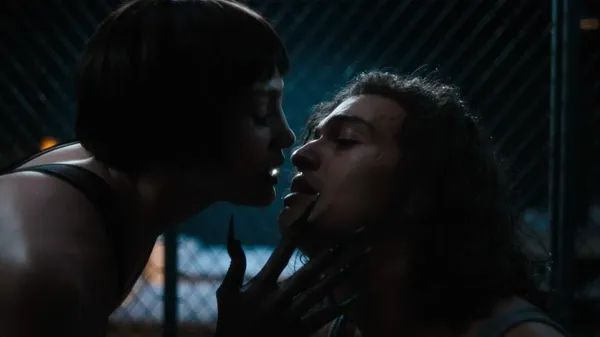
| Jennifer Lopez and Tonatiuh in Kiss Of The Spider Woman. Bill Condon: 'It felt as if it was a movie musical that was dying to be made' Photo: © 2025 AE OPS, LLC D/B/A ARTISTS EQUITY AND MOHARI MEDIA US LLC. ALL RIGHTS RESERVED |
Why did you think it was the right time to rethink this classic?
Bill Condon: Well, a few reasons. One of them was I had written a film version of Chicago and all those years back, I thought this was part of a trilogy in my mind of Kander and Ebb shows that should be movies – Cabaret, Chicago and Kiss Of The Spider-Woman. Mainly because the lead character of each, Sally Bowles in Cabaret, Roxie Hart in Chicago and Molina in this movie, have difficult lives and they escape from those lives through showbusiness – in Molina’s case it’s movie musicals. So it felt as if it was a movie musical that was dying to be made. But even more than that was the novel, which was now written 49 years ago, it’s taken the world all this time to catch up with what Puig was writing, specifically in the relationship between the two men, which is a genuine love story.
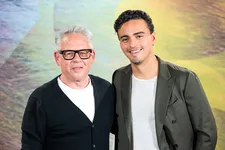 |
| Bill Condon and Tonatiuh in Locarno Photo: Locarno Film Festival/Ti-Press |
How did you choose the actors?
BC: Jennifer Lopez and Diego Luna were the one and only actors I offered those roles to so it was a dream situation where you do that and they say yet. [Laughing jokingly with Tona] Tona was my 800th choice. We were making this independently and we had two actors who were well known so I had the freedom to just cast the best person. We did casting sessions in South America, Central America, Spain, London, Los Angeles, New York and other places. So literally there were 800 people who were submitted and Tona sent in the most beautiful self-tape and I loved it. Then we had a meeting on Zoom and then he came to New York and it became clear it was most likely going to be him but the thing that makes this different from the other film is that he’s not just playing Molina. He’s playing a character called Kendall Nesbit in a Hollywood musical, so in addition to everything else he had to be able to dance with Jennifer Lopez and to sing these beautiful classic songs. So Tona came through this musical bootcamp.
Tonatiuh: I think I was like the midnight horse because I got the self-tape request on December 18 and I submitted it on December 21 so the industry is basically shut down for the holidays. But as soon as we got back on January 2 at 9am, they were like, “Don’t move, we’re taking you to New York”. So I think I came in and shook things up. We did very intense training, like a Broadway bootcamp just getting ready, it was a lot of fun.
How was it to work with the other actors?
T:It was incredible. Seeing Jennifer Lopez doing what she does best in a role that she was dying to play, was fantastic. It was a really great opportunity to play the entire spectrum, and get to play different characters who are the same spirit but they embody two different parts of the gender spectrum.
BC: We shot two entirely different movies. In New York, we made the music, Hollywood film, that was intense rehearsal – we could have put that on a stage – we shot that in four weeks. Then, Diego, Tona and I went down to Montevideo, in Uruguay, just across the across the water from Argentina, we made the prison movie. That was really a two-man play, we spent almost three weeks on the prison set. That was its own other play but that was a very different experience.
Could you comment about the differences between this and the original film?
BC: That was set in Brazil and Hector Babenco made it more about that experience. It’s actually faithful to the novel. One of the bigger inventions is in that film, he uses mostly a Nazi movie that he narrates and here it’s a Hollywood musical. We tried hard to make the film-within-a-film reflect what was going on between the two men in the present.
Can you talk about setting it in 1983?
BC: The reason it’s set in 1983 is because that’s when Leopoldo Galtieri’s regime fell so it was a sense that, and maybe this is the American in me, it was not all for nought.
The novel has been cited as a queer classic but it’s also received a lot of criticism, especially within the queer community, for its stereotypical portrayal and for the ending, especially. So how do you feel about the novel?
BC: I love it. I think those criticisms were so much of their time. John Kander spent a lot of time with Puig and I have another friend who actually spent a lot of time with him and he was a hugely flamboyant queer man. People can say that’s a stereotype but Molina is Puig. So I always thought that was unfair and it reflects a kind of, for me, a sense of queasiness over a certain flamboyance not being genuine. It is genuine, there are hugely ‘femmy’ queer men so I really take exception to that. [In terms of] the queer man dying, we tried to shine a light on that. He dies also in the movie within the movie and there’s a great book by Vito Russo called The Celluloid Closet about the necrology of queer men in Hollywood, specifically, but also in literature. We point out that it’s true but also near the end of the film Valentin says he dies for a bigger cause but Molina says, “No, he died for love”, so again I feel that transcends the label.
I made this movie about Alfred Kinsey and I spent a year living in his brain and all of his research, he always said that the real revelation was that sexuality is as individual as a fingerprint – there are eight billion sexualities. To me, that was an idea that we talked about a lot when we were making this movie. If you put someone together in this extreme situation and you start to strip away class and education and background and political beliefs and they start to just see themselves as the individual that they then connect to. That’s my hope, that ultimately it’s about this transcendence of label.