





Eye For Film >> Movies >> Faces Of Death (2026) Film Review



It’s a natural instinct in most animals to want to pay attention to things that are disturbing or horrific, even if doing so is distressing. We need understanding in order to protect ourselves. These days there are always people looking to exploit that, whether it’s to sell a product or a political ideology, or just to boost their own ego. It is perhaps difficult for those born after the mid-Eighties to imagine a time before the internet, when certain kinds of knowledge were very difficult to get. In mainstream UK and US society, a strong taboo about death meant that dead bodies were rarely seen. Furthermore, though one could see people being shot at in war footage on the news or in documentaries, editors carefully avoided presenting, with any clarity, the moment of death itself.
Into this space came 1978 film Faces Of Death. Mixing staged scenes with editorial outtakes, it consisted of themed collections of death scenes, part real, part re-enacted. Censors and columnists reacted with outrage, which of course made its allure even stronger to those who had been curious to begin with, and it became one of those films that got passed around on decaying tapes for secret party screenings. Unlike others of that ilk, however, it really only had novelty value with which to impress, and that quality is meaningless today. So what does it mean for the title to turn up again? How might it be revisited in any interesting or meaningful way?
The secret lies in the manner of director Daniel Goldhaber’s engagement. Best known for Cam and How To Blow Up A Pipeline, both of which engage unabashedly with the big conversations of our age, he uses the original as a jumping-off point for what is simultaneously a satisfying slasher movie thriller and an exploration of the present day media and social media relationship with violence. This is more successful than you might expect, thanks in part to a charismatic leading performance by Barbie Ferreira.
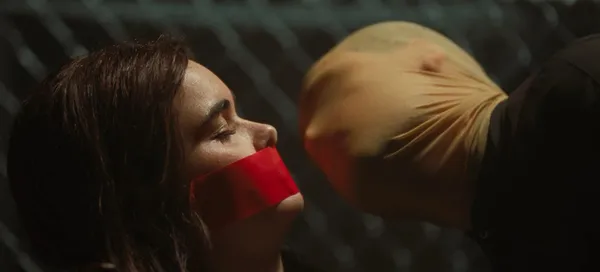
Ferreira plays Margot – or, as she is better known, ‘the girl from that train video’. That’s why she doesn’t like to go out. Having lost her sister Sophie in livestreamed stunt gone wrong, she now works in content moderation at social media company Kino. She’s seeking to atone, and, in her desensitised state, she’s better suited to the job than most people; but we meet her at a point in her life when she’s beginning to recover her emotional balance, and that’s making it harder for her to maintain her boundaries. When she begins to suspect that a series of grisly videos features real murders dressed up as fakes, and her supervisor says dismissively “DIY horror is trafficking right now. Give the people what they want,” she feels compelled to break the rules and investigate on her own.
What emerges is that a serial killer is taking inspiration from the original Faces Of Death and reconstructing its killings. Why? Here Goldhaber is able to hide behind a line from the original, which asserts that there is a certain breed to murderer “who kills for no apparent reason.” A handful of short clips from the original are used, including a monkey torture scene now known to be fake (there was real doubt about this, and about what were alleged to be human snuff scenes, when the film was released). Goldhaber avoids showing the most distressing parts; he’s also careful about what he shows during scenes where Margot is at work. This prevents these lower key scenes from diminishing the impact of the killer’s actions. It’s also congruent with the concern the film raises: that desensitisation to violence, and its increasing consumption as entertainment, is damaging people’s ability to empathise and thus fraying the fabric of society.
There are light touches along the way to keep all this from getting too heavy. Margot eats her lunch in the stairwell where there is a poster saying ‘no fucking in the stairwell’ but she is interrupted by people fucking – another common way of responding to an overdose of horror. Elsewhere, dark humour slips in. Looking online to try to find out more about a video, Margot finds people saying “If it was real, it would have been taken down,” and describing the original Faces Of Death as ‘like this super cursed tape’.
There’s a sweetness to Margot as a character, particularly apparent in her relationship with flatmate Ryan (Aaron Holliday). Both characters are gay, which is pleasingly incidental to the plot. Her naivety is charming even as we see it getting her into trouble. In scenes reminiscent of Red Rooms, and providing a similar warning to viewers, Goldhaber uses split screen to contrast her online detective with that of the killer, for whom it is light work to follow her online trail.
Adjacent to that sweetness is the lingering damage that losing her sister has done. Margot is a terrible witness. There’s no need to find excuses for her not getting help from the authorities when we can see how bad she is at communicating with them. Panic and anger take over in situations where she really needs to keep a cool head. Ferreira’s performance is convincing throughout and it’s easy to feel for her even when frustrated – or darkly amused – by her self-sabotage.
It’s rare to find a character this well developed in a slasher film, but Goldhaber pays equal attention to the smaller roles. A pair of influencers are introduced in a scene which swiftly establishes the difference between their online personas and who they are as people, at work, displeased by interruptions. This neatly points up the difference between the stock character of the airheaded blonde, there merely to titillate audiences and killers, and any actual human being. It’s a reminder that other forms of image-based desensitisation have been at work for a long time.
Goldhaber’s cleverly constructed action sequences and dynamic framing mean that viewers who are there purely for scares won’t be disappointed, but this is a horror vehicle with a lot more going on under the hood. Its ending will satisfy genre fans looking for traditional release but, upon reflection, invite us all to take a second look at our own attitudes.
Reviewed on: 04 Sep 2026


Director: Daniel Goldhaber
Starring: Barbie Ferreira, Dacre Montgomery, Josie Totah, Aaron Holliday, Jermaine Fowler, Charli XCX
Year: 2026
Runtime: 108 minutes
Country: US
Search database: