





Eye For Film >> Movies >> The Drive (2025) Film Review



There are moments in history that bind us, moments when news breaks and we are instantly aware that it will have massive cultural impact. Looking back at them, even decades later, we remember where we were and what we felt. We remember all sorts of odd little details of what we were doing at the time. What’s easy to forget is that we likely didn’t hear the news all at once. Events which, in retrospect, have a clear, established timeline and set of facts (at least outside the realm of conspiracy theorists), often filtered through in the moment as fragments and rumours, only gradually achieving their final, shocking form.
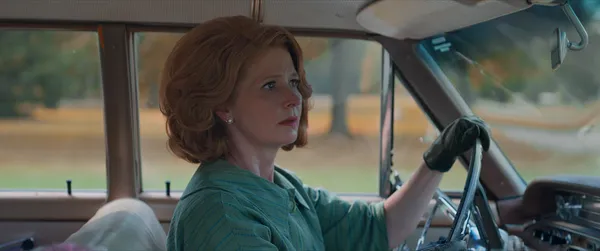
The Drive tells a small, personal story about such an event; a story about being on the sidelines, yet close enough to be swept up in the tide of history, unable to influence the course of one’s own life. We don’t see the driver at first, but her little leather driving gloves, her choice of Bach’s first concerto in D-minor on the radio, and the slightly tarnished brass fittings on the dashboard of her long brown Chevrolet El Camino tell us a lot about her, as does the journey she is making, past some of the most famous buildings in Washington DC, all the way to a school where four little girls pile into the back. She, like them, is white, and her tailored suit and carefully coiffed, sculpted hair speak to a lifetime of privilege, as well as firmly positioning us in the early Sixties.
The tragedy unfolds slowly as the girls chatter in the back. Two of them she will drop off with their mother; another is her daughter, excited because her friend is going to be there for their very first sleepover. At least, that’s the plan. Gradually, she becomes aware of the long black car that is following her own. She turns on the radio, hears the words “was shot in the head,” and quickly turns it off again with the instinct and practiced emotional regulation most parents acquire. It’s only as she notices how other motorists are behaving that she begins to realise something big has happened. Winding up her window, she attempts to control the space within the car, to shield the girls for just a little bit longer. She keeps a steady, upbeat tone in her voice when she talks to them. Even after speaking to the driver of the black car, she will prioritise the girls’ happiness and try to tell them only familiar, comforting things – until, all at once, she realises that she just doesn’t have the words.
Amber Paul is magnificent in the lead, her face speaking to the audience even as she conceals a riot of emotion from the children. Her character’s situation is unusual, perhaps unique, but the concerns driving her decisions are universal. That distinctly artificial Sixties glamour becomes a mask behind which she can conceal her own pain. At the same time, the film gently reminds us that her wealth and status will shield her, to an extent, from the consequences of what has happened. At one point she passes a Black woman who has pulled over at the side of the road and is sitting in her car sobbing.
The amount of information communicated through detail enables this film to say a great deal in just 12 minutes. It’s a beautiful example of craft, and a deserving entrant in the race for the 2027 Oscars.
Reviewed on: 12 Sep 2026


Director: David Arrow
Writer: David Arrow
Starring: Amber Paul, Allen Guy Wilcox, Blair Newman, Victoria Spitalieri
Year: 2025
Runtime: 12 minutes
Country: US
Festivals:
Search database: