





Eye For Film >> Movies >> When You Open The Door (2026) Film Review


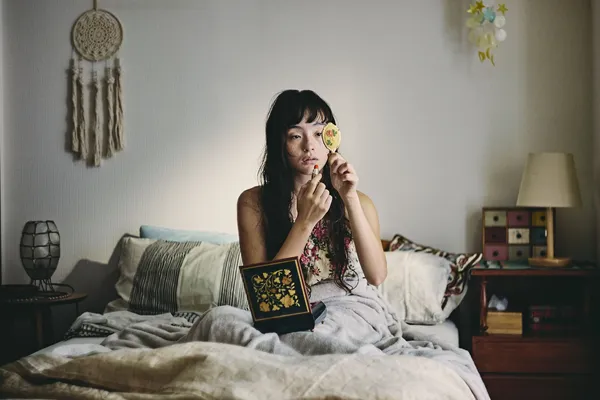

“I got bitten by a wolf,” say Miki (Serena Motola).
It’s a bizarre statement for several reasons. Firstly, there are no wild wolves left in Japan. Secondly, she was in the middle of the city, having just stepped out from her workplace to get lunch. Thirdly, there’s not a mark on her. Miki is a quiet, politely deferential individual who makes so little impact on the world around her that her colleagues barely notice her presence. She doesn’t seem like the sort of person to make up stories. So what is going on?

As viewers we have, in fact, already been privy to the attack itself, but in a strange way which, whilst intensely impactful, hints at an experience perhaps more psychological than physical. Down in an underpass, we heard a sound of growling, then slipped into a montage of images including close-up visions of a wolf’s snarling face, of splattering blood, and more. But why might Miki have experienced this? Director Eriko Katagiri sets out a trail of clues which take us back to her childhood: a little girl lying alone on a mat on a summer’s day, strained conversations with her mother, a dream in which a shadow on the other side of a door claims to be her mother but might be something else. In a doctor’s waiting room she sees a woman reading her child a story about a wolf in a similar situation.
In due course, Miki’s quest takes her to a group of older women who gather to celebrate the rising of the full moon, and make offerings to a wolf spirit. The itako or ogamisama tradition has been relegated to the margins of modern Japan, with most fully trained practitioners now elderly, but there is a suggestion that Miki may possess a natural talent for it – for connecting with spirits whilst in a trance-like state, giving her supernatural powers of perception. Regardless of how we interpret this, we see her experience an awakening, gradually letting go of her inhibitions and engaging with the world more fully, more instinctively.
A very different take on the werewolf film, Katagiri’s work utilises a dramatic form which breaks down over time, becoming increasingly surreal as Miki disconnects from the world as we know it and finds herself in a new one. Established spaces are reworked to create a very different atmosphere, whilst naturalistic performance gradually gives way to something more impressionistic, with elements of dance. Even puppetry finds a place before the end, this shifting of form encouraging us to go with Miki on her journey rather than watching from the outside an questioning her sanity, which becomes a more challenging experience as she is gradually possessed by violent desires.
Miki’s husband is a voice for rationality. He takes her to a doctor who seems unstable in his own way. She is prescribed sleeping pills. Will she be willing to be drawn back down into his world, will they be parted, or can she bring him into hers? We see her watching her pet Java sparrow in increasingly discomfiting ways, and yet there is a level on which she is also the bird, habituated to its cage but capable, should the door be opened, of taking flight.
Reviewed on: 06 Sep 2026


