





 |
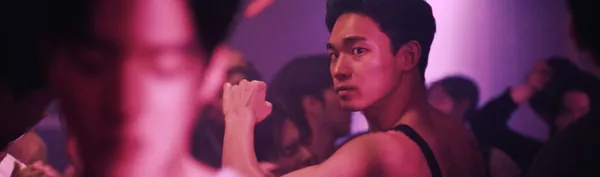
| Kim Hyun-mok and Cho You-hyun in 3670 |
Screening as part of Queer East 2026 Park Joon-ho’s complex romantic drama, 3670, explores the complex territory around friendships, relationships, and social spaces in which lots of people have dated each other. Like a more downbeat relative of another film at the festival, Open Endings, it follows North Korean defector Cheol-jun (Cho You-hyun) as he tries to move beyond the small community of people with the same background within which he has been living, and find his feet in his new home.
This is all the more important to Cheol-jun because he has grown up gay in a society with little real concept of that, and he needs to find romantic and sexual opportunities. In the process, he develops a strong bond with Yeong-jun (Kim Hyun-mok), a young man who has always felt like an outsider. The real nature of the feelings between them is never entirely clear, but as Cheol-jun gradually grows in confidence, Yeong-jun increasingly finds himself struggling.
“In Korea there have been lots of films that just two characters a have love relationship and that doesn't have any focus on their community,” Park explains when we meet. “I thought that their relationship is very similar to a heterosexual relationship – just man and woman changes to man and man relationship. But in reality, a queer relationship, and especially a gay relationship, it is very complicated. You know, it could be love, it could be friendship, or it could be companionship. It's all together, mixed feelings. Between two people, there could be a very dynamic relationship because of that, so I wanted to show that kind of complicated relationship through this film.”
“I think, for a director, making emotions and feelings is coming from the situation. So I tried to make a very complicated situation for Cheol-jun, the main character. He doesn't have biological family here. He has friends from North Korea and that's like his family, but he couldn't tell his sexual orientation to them, and so he has a kind of limitation to relate to them. He needs a care community. But in Korea is a very exclusive society. I think in community people are really sticking together very firmly, but it means it closes some people out. So in Korea, many people are not friendly to foreigners. For Cheol-jun, this situation itself is very lonely.
“So I want to show them, but I actually don't want to persuade the audience very directly. I just want them to feel [and learn from that]. And actually I want to more focus on the human person, Yeong-jun and other characters. All the characters have their [own] kind of loneliness. Maybe that is the point that I want to say. Every human being has their loneliness and they always have conflicts with society. So the movie starts with a very lonely person, but he finally realises that everyone is lonely, so maybe he’s better now. That’s the kind of emotion I wanted to express.”
Are people becoming more accepting of LGBT people in South Korea now?
“Yes. Culturally, younger generations are more generous than before. But still there is no legal [recognition] for LGBT people. So there are lots of limitations. And still most LGBT people cannot express themselves in their workplace or family. So there are long ways to go.
“I guess it's an international problem. Most queer community is based in very big cities because, you know, lots of people have to gather. So when a person lives in the countryside, he cannot meet anyone. So there's always cultural differentiation. When 3670 was screened in Korea, most people said they can very easily relate to Cheol-jun because someone who came from the countryside, they had a similar experience when they first went to the gay community. They were all alone and they had to make friends. They wanted to join a group.”
We talk about the North Korean characters in the film, who are unusually rounded, and I ask how he researched them.
“I worked as a volunteer teacher,” he explains. “[In the film] there's a teacher who teaches English and helps them to apply for the university. I was that kind of volunteer worker, and at the time, I met many students there and heard their stories. That was a very big experience for me.”
In the film, a local church community plays an important role in helping the defectors.
“In reality, in Korea, the church is the biggest enemy of the LGBT community,” he laughs. “The Protestant church, they are always coming to Pride parades. They always protest that being gay is sin, things like that. So it's very difficult. Always, in queer films, churches are antagonists. They are always the enemy. But in Cheol-jun's perspective, and most North Korean refugees, they always get help from when they go out from North Korea. Most of the brokers [who help people to cross the border] are very related to religions, especially church organisations. So most of the North Koreans are getting help from them.
“Even after the very long travel from North Korea, through China, Cambodia, Thailand, and even after they came to Korea, there's a lot of non-profit organisations who help North Korean refugees. So in reality, I want to acknowledge their role as a helper. So it's like two sides for Cheol-jun. For being a North Korean, he gets help from church. For being a gay, he kind of has a conflict. I want to show both [sides].”
I note that with the complicated social dynamics in the film and the complicated relationships, it must have been a challenge to cast it and find the right chemistry.
“Oh, yeah. Actually, in Korea, queer film is not that acceptable in the industry, so I had very hard time to find the cast. Many actors and many actors’ companies didn't want to be part of this project, so I had to explore so many actors in Korea. I had almost half a year to find the main actor. Luckily, on YouTube, I watched Cho You-hyun, the main actor's video, and I happened to meet with him and after the interview, I felt he was the one.
“Kim Hyun-mok is quite a famous actor in Korea. He did many independent films and even series or dramas, and he is actually a very good actor. But he always did very small roles in big projects, so I wanted him to be [in] a main role.
“We met many times and actually I talked with them a lot. I explained about how the gay community works and what the characters, the friends, the relationships between friends are like. As I said before, their relationship is not just friends. They are always potential lovers. They could be friends, they could be boyfriends, so it would be very complicated. So you always have always a tension because you can be flirted with or you can flirt with anyone. That kind of tension has to be present all the time. I emphasised that kind of thing.
“I think that kind of tension can be seen in the movie through the gaze, so I emphasised that your gaze is very important. You should see something and when someone passes, your gaze would follow them, things like that. So the actors are very focused on their gaze and my role is to structure that gaze.”
I tell him that something else I really liked about the acting was the karaoke scenes and the way that they have to sing with a lot of emotion, so they’re communicating a lot, but without the level of vocal skill that actors usually have.
“Yeah, we talked a lot about that,” he says. “In the final scene it’s Cheol-jun’s first time singing. So what I talked about this actor was that he just sing with his bare voice, but he might have practiced the song a lot. So the rhythm should be very accurate – almost perfect – but, you know, vibe and pronunciation could be a little clumsy. The rhythm must be very accurate. That was the rule.
“Every location belongs to real gay community place. But, you know, in Korea, gay clubs and that kind of place is very rapidly changing because of gentrification. I wanted to capture that kind of place in 2024. I want to record and I want to memorise that place because that place is full of memories of many gay people in Korea. So I wanted to shoot a real place.”
I congratulate him on this and explain that many older people in the UK community wish we had done something similar during the equivalent period, as we’ve lost a lot of our history.
“When I made the film, every owner of a location was very supportive,” he says. “And after I made the film and when the film was released last September, many gay community people came and watched the film. It was a very [emotive] issue.
“I'm really happy that my film could reach to London and actually I really wanted to go there and I want to hear their story because, you know, every gay community has very similar experiences. So I was looking forward to it.”