 |
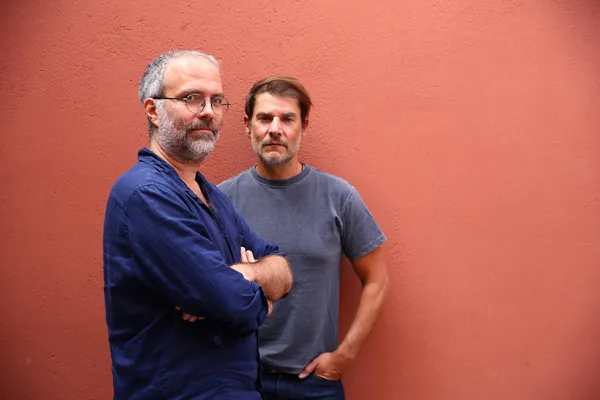
| Blaise directors Dimitri Planchon and Jean-Paul Guigue Photo: Christophe Boulze |
Blaise may only be 16 years old but he’s been on a journey. The youngster, who lies at the heart of Cannes Acid title Blaise, started out life as a comic strip, created by Dimitri Planchon, who co-directs the film with Jean-Paul Guigue. After that, he became the star of his own TV show and now he and his enjoyably dysfunctional family are at the heart of this animated feature comedy. Blaise may not even be the most hapless of the Sauvages, since his mum and dad also don’t seem to know when to stop digging when they get into a pinch. As his mother finds herself perpetually saying the wrong thing with hilarious consequences at her job, his dad is taking the opportunity to unload his problems on Blaise’s school psychologist. As for Blaise himself, he just might become an accidental revolutionary if he’s not too careful.
We caught up with Planchon and Guigue ahead of the Cannes Film Festival world premiere to talk about the evolution of Blaise, the distinctive photomontage style the pair use to make their characters come to life and expanding the universe of their young protagonist.
What inspired you to create the character of Blaise in the first place?
Dimitri Planchon: Blaise comes from a comic strip that I started drawing some 20 years ago and I was published in a monthly magazine that is called Fluide Glacial. And at first, it was just like one strip. And then it was one page and it was really about this boy and his parents – this family who were really obsessed with their own self-image.
The whole design of the animation is quite fascinating, because I know it's based on photo montage, which gives your characters a sense of realism and texture, even though you retain a caricature element. Often in animation the eyes are a bit weird but your characters’ eyes are very real. Can you tell me a bit about why you chose that technique and how you developed it to bring your characters from page to screen?
I was really into photo montage and that's something that I started developing early, alongside drawing. I was really attracted to dadaism. So I started developing this very personal style and along the way, I was drawing less and less and doing more and more montage, which down the years became more and more realistic in its form. Less dada, more realistic.
Jean-Paul Guigue: Regarding the look and the very realistic aspect of the eyes, it was, for us, the only way to catch the sensitivity of the actors because our animation is very still in a way. Even for the mouth we only had a set of 10 or 12 shapes of mouth per character – a very classical animation ‘lips library’. All the acuity was in the eyes so, for that reason, we need to have something very realistic. They’re a blend of many faces after taking pictures of many people – a composite image.
How does your partnership work together, since one of you is the creator but now you work as a pair?
DP: We're a very very small team actually so we all do everything together. We’re all like “Swiss knives” [adaptable like a Swiss Army knife]. Originally, I was more the author and Jean-Paul had more of a background in animation but along the way, I became more involved with the image and Jean-Paul with the direction and we really became a two-headed beast. We are always going back and forth, like ping pong. Our screens are very close to each other so we can look over each other's shoulders and see what the other is doing. That's also really helpful because when you're in doubt it’s nice to have the opinion of another person, someone to step back and check on what you're forgetting. The big picture. Even for interviews, it's helpful because you feel safer in everything that you're doing when you're not alone.
So this was a real opportunity to expand the universe of the characters after the books, which were much more simplified and even after the TV series. Did you find anything tricky about creating this full world?
DP: This came in several steps. Alexandre Gavras approached me to make the series. That was shown on Arte and that’s how I took up with Jean-Paul. We really enjoyed this process.Then I felt I really wanted to continue in animation because I was enjoying it so much, and then Alexandre came back with the idea of doing the feature. I found that really exciting because somehow I felt a little bit confined within those very short stories and I thought there was something that I could do with this family that could never really assert themselves. I really wanted to push this whole thing to the extreme, nearly to the philosophical. Having the time and space to do it in a feature, I felt that my writing really blossomed in the feature form.
I love this idea of a sort of accidental revolutionary but I wonder if you aren’t arguing that people need to grow a spine and say what they want out of life, do you think we’re too eager to please as a society?
DP: Well, I like to push some character traits to the extreme and everything just to bring out the fun of what happens when you push things that far. But no, I wouldn't say I'm trying to give a lesson or anything. It's just you know it's just showing things for where they are. Of course, it's part of society but just pushing things to something more extreme.
I imagine it was quite a lot of fun to sort of create this kind of, almost triptych of characters – Blaise and his mum and dad – who were stumbling over their own words all the time?
DP: I think it's probably more fun to watch than to write because sometimes it's painful to come up with creativity. It needs to make me laugh myself when I write but it’s not an easy process.
Blaise the film is still very young, it’s not even been born into cinemas yet but Blaise the character is someone you’ve been living with for a long time. So, I’m wondering, do you see yourself going on more adventures with Blaise in the future or do you think that this is kind of the final step of this evolution now he’s been brought to the screen?
DP: Well it's more like the end. We feel that we're probably ready for something else.
So what sort of thing do you think you would like to do in future? It must be a wrench after all this time, like giving up a family member?
DP: So we’ve actually planned for some sort of postpartum depression this summer because we haven't slept much in the last weeks and we've only finished the film last week. So for us it's still very, very fresh and we probably just need to breathe a little first and have time to think about the future but we’re thinking in terms of a graphical universe and things like that. Of course, for me, probably the stories that I'm thinking about are always about the difficulty of communicating because that's really part of who I am.
J-PG: I think what we know is that we'd like to continue in the same line of animation style because we tried a few things along the way, like full 3D, motion capture and things like that. When we were trying these, we realised that sometimes when you are too precise you lose the soul of the characters and it becomes less funny, less original. So that’s why we decided that we wanted to come back to the technique that we used for the series and to better that technique itself. Sometimes when you’re very static, it becomes nearly abstract and very synthetic and there's no pollution from the rest so you get a pure result.