





Eye For Film >> Movies >> Feels Like Home (2025) Film Review



Feels Like Home Star rating: 4 Quote: Director: Gábor Holtai Writer: Attila Veres Starring: Rozi Lovas, Áron Molnár, Tibor Szérvet, Bettina Józsa, István Znamenák, Kornél Simon, Dorka Gryllus, Soma Simon Year: 2025 Runtime: 124 minutes Country: Hungary Festivals: Sitges 2025, Thessaloniki 2025, Golden Horse 2026, Crossing Europe 2026
Real horrors are not caused by mythic beings like vampires, werewolves or zombies that are usually used as metaphors of human behaviour. Neither are they caused by fantastic creatures like giant sharks or mutated spiders that simply expand the borders of human imagination. They can be caused, but rarely, by madmen running around summer camps with knives and axes. Real horrors happen behind the closed apartment doors or in the wide open streets of deeply messed up societies.

One prime example comes from Hungary and faithfully mirrors the life in the later years of the rule of Viktor Orbán, marked by poverty, job insecurity and power concentrated in narrow, arbitrarily chosen circles. When scriptwriter Attila Veres presented Feels Like Home on its most recent festival stop, at Crossing Europe Film Festival in Linz, he stated that the head of the national institution swore that “Hell would freeze over before the film would be made” after reading the script. Indeed, it was financed independently and gained attention on the international film festival circuit, especially at genre-specialised festivals. And, with the change of government, it would be safe to assume that it will be regarded as a document of a certain time on home turf in the foreseeable future.
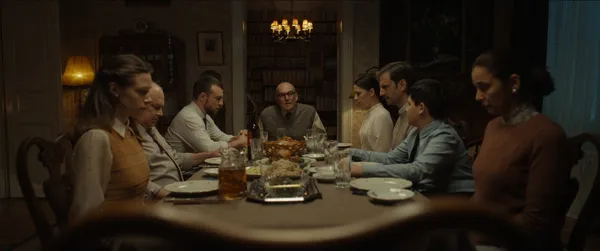
It seems that Rita (Rozi Lovas) is at the rock-bottom when she gets let go from her job as a clerk at a shoe store due to the shop closing down. Things go from bad to worse the same night: while observing a car burning on a parking lot in front of the nondescript socialist building she rents a flat in, she gets abducted. Rita wakes up tied and gagged on the floor of an unfurnished, darkened room. A man, unknown to her, presents himself as her brother Marci (Áron Molnár) and informs her that she is actually his estranged sister Szilvi Árpád and a member of an influential, secluded and somewhat controversial clan controlled by the old and enigmatic Papa (Tibor Szervét).
The whole story seems obviously fake and borderline unbelievable to her, but she has to learn the relationships and how to play her part in order to be allowed more freedom and comfort. The “characters” are vaguely written: uncle Rudi (István Znamenák) is a simple drunk, older brother Miklós (Kórnel Simon) serves as the accountant and has his own family – wife Juli (Dorka Gryllus) who is jealous of her sister-in-law and son Istvánka (Soma Simon), who visibly struggles with the delivery of his lines – while the younger sister Anna (Bettina Józsa) is quiet and submissive. Marci serves as the primary enforcer of Papa’s will and the man who handles the business. And they are all also prisoners in the same plot.
Obviously, all Rita wants is to escape somehow, but, even when she is allowed to exit the apartment in a centrally located building in Budapest, she finds out that no one, from the neighbours to store clerks, is willing to intervene on her behalf. Once she realises that Szilvi is actually the father’s favourite, Rita changes the strategy and starts playing her role differently in order to protect her fellow “siblings” who, like her, have nowhere to go and no one to turn to, and even to “rewrite the script” so she can get even more freedom and agency, and therefore change the power structure within the “household”.
One can argue that Veres’ script and Holtai’s directing, in which they insist on character build-up and rounded “topography” of a spacious, but still confined apartment, drag a bit until a crucial plot twist some time after the half-way point. But the fact is that both the scriptwriter and the director take their sweet time and aim for the maximal effect of realisation and for the crescendo at the film’s end. In that, they can rely on the help of the meticulous camerawork by Dániel Szöke and the pace-dictating editing handled by Holtai and Vica Éva Kovács.
Simply put, if they would simply run through the mandatory exposition, some of the gloominess of the atmosphere would be lost. Also, Rita’s path to realisation of her position and the change of her “tactics” would seem less believable, making the ending come as shocking and schlocky instead of logical and poignant. That way, Feels Like Home avoids the usual traps of a thriller-chamber drama genre combination such as unnecessary repetitions that are the product of laying out the cards too soon.
Style-wise, it is not hard to sense some traces of the work of Michael Haneke and Yorgos Lanthimos, not too dissimilar to those that the up-and-coming Croatian filmmakers Andrija Mardešić and David Kapac employed in their thriller The Uncle (2022), which was also politically charged. However, the charging in Feels Like Home is more widely social than strictly political, and more openly laid out than hidden behind metaphors, which also makes it more effective in exposing the recent failures of Hungarian society. In the end, it serves as an example of how genre filmmaking can be an adept tool for social commentary, but also as a test of human psychology, as we ask ourselves how our lack of will to interfere enables abuse of power, corruption and violence.
Reviewed on: 04 May 2026