





Eye For Film >> Movies >> Castration Movie Anthology I: Traps (2024) Film Review


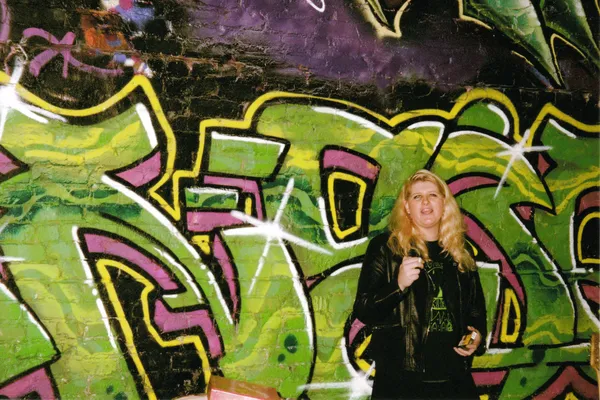

A sprawling saga which is 15 hours long at the time of writing, with four more currently in post-production, Louise Weard’s Castration Movie is a kind of queer Heimat. It is being released in parts, each of which consists of two chapters and runs to nearly four hours in length. Chapter One presents the chapters Incel Superman and Traps Swan Princess. Eventually, Weard has promised, it will become clear thar all of these form part of the same story.
Whilst this might sound quite gruelling, you could be surprised. Once you get into the rhythm of Weard’s work and relax, it’s easy to be drawn into events, and the time quickly slips away. The principal characters may be difficult, sometimes unlikeable people, but they’re also very watchable. Weard has a remarkable ability to make viewers feel as if they’re present on the fringes of the action, hanging out in a corner of the room. Her lengthy, unhurried scenes enable one to set aside what has happened so far and stop wondering what’s coming next, to be completely caught to in the meandering present.

As a thesis on gender, the project begins by following the radicalisation of an unremarkable young man into a deeply toxic form of masculinity. Turner (Noah Baker) begins by mocking the laments he reads from incels on 4chan, failing to grasp that the smug superiority he feels in doing so is not far removed from the attitudes that make incels problematic. There’s another layer of similarity in that his reading them aloud annoys his girlfriend, Brooklyn (Jasmine Provins), who is trying to work on her furry erotic drawing commissions. His feeling of entitlement to women’s attention is also demonstrated by a passionate speech on the origins of Superman which he delivers when trying to impress a stranger. Naturally, disappointents follow.
There’s a lot of knowing humour here. At work, Turner enthuses about Harry Potter books and the films of Zack Snyder. He writes self-indulgent poetry which references castration, and takes outhis frustrations by harassing a human statue. Perhaps most significant is what we don’t see. Brooklyn isn’t denying him sex. In fact, she’s more keen on it than he is; he just doesn’t have much time or energy for her. His problems doesn’t emerge from sexual frustration, but rather with a growing conviction that everything that goes wrong in his life is somebody else’s fault, and that most ills can be blamed on women. His treatment of Brooklyn goes from bad to worse. His behaviour becomes increasingly inappropriate, invariably making his own circumstances worse. By the end of the chapter he seems to be on the brink of doing something dangerous.
In the second chapter, we find ourselves with a different set of characters. Weard herself plays Michaela, a sex worker known to her friends as ‘Traps’ (‘trap’ being a term commonly used as a slur against trans women, implying that they try to fool straight men into sleeping with them by pretending they’re cis). She doesn’t need to fool anybody; it’s not hard for a trans woman who has not had genital surgery to attract sexual attention. She still needs to let people know she’s out there, however, so she enlists various friends to help her make promotional videos, creating tension and a good deal of laughter because it feels so weird for people with close platonic relationships to engage in even fake erotic activity together.
There is surgery talk here within a group of people. It flows very naturally and will prove enlightening to viewers whose only knowledge of such matters comes from newspapers. Another common community concern is addressed as Michaela waits for blood results which will tell her whether or not she’s still fertile. Feeling unable to open up to friends about this – she’s the tough one who pushes them around and gives life advice – she finds it hard to balance her emotions. When the man she thought of as her boyfriend reveals that he sees their involvement differently, she suffers a crisis of confidence which threatens to lead her into a very dark place. Although there’s a lot of trans-specific stuff here, it’s something that anyone who has ever been in an unbalanced relationship will find it painfully easy to relate to.
Despite the downbeat tone of the film, there is humour throughout. Anyone familiar with trans screen clichés will be amused by the shot of Michaela putting on lipstick in the bathroom, and the poster for a film called Sissy Hypno Porn (referring to a largely imaginary phenomenon which one psychiatrist believes to be the cause of most trans women’s existence) is a treat. In the midst of various people’s relationship problems, we also encounter a couple on the verge of splitting up due to an argument about Frank Herbert’s Dune.
Despite the rough quality of the images, this is an accomplished piece of work, with naturalistic performances and a way of getting under the viewer’s skin. Despite its position as part of a larger work, it stands well on its own. Don’t worry about waiting until you can catch the rest of the instalments. There’s plenty to engage with right here.
Reviewed on: 03 May 2026


