




 |
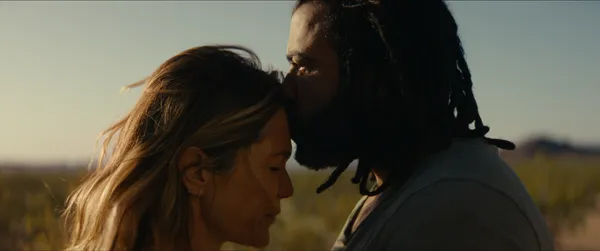
| Katie Aselton and Daveed Diggs in Magic Hour Photo: Sarah Wheldon |
Katie Aselton is an actress, writer, producer and director who made her directorial feature dèbut, which she starred in, with the comedy drama, The Freebie, about a couple that decide to take a one-night only break in their relationship. Aselton has also directed the fantastical comedy Mack & Rita starring Diane Keaton, the horror thriller Black Rock, and the short film Oh, Christmas Tree, both of which were written by husband Mark Duplass. The couple have been collaborating since around 2024, when Aselton and Duplass starred opposite one another in the short film Scrapple and then the feature road trip comedy, The Puffy Chair, which Duplass co-directed and co-wrote with his brother Jay.
Magic Hour, directed by Aselton and co-written with Duplass, revolves around Charlie (Daveed Diggs) and Erin (Aselton), who escape to the desert to reckon with the unexpected difficulties that have arisen in their relationship.
In conversation with Eye For Film, Aselton and Duplass discussed the nebulous nature of cinema amd the way we grow with a film, reshaping what it means to us. They also spoke about exploring vulnerability and relationships through stories, ghosts, purgatory, a classic rom-com, and more.
The following has been edited for clarity.
Paul Risker: What does cinema mean to you as storytellers as well as on a more personal level?
Katie Aselton: In more recent years, it has been representative of community and a shared experience. And seeing movies with audiences in theatres is particularly special. To share those moments, and to hear a sniffle or a laugh or any reaction, gives you permission to react in your own way that you don't have when you are by yourself.
So, for me, it starts with the theatrical experience, but then this idea of community goes so much further because it's what we do through the collaborative experience of making movies and telling stories together. That effort to come together is the most enriching experience for me because it is about community. And so, from the very impetus of an idea to sharing it with an audience, there's nothing else quite like that — it's really meaningful.
Mark Duplass: I've been thinking a lot about the chaos of making a film work and how it's just not one of those forms where the more educated and the more experienced you get, the better your movies are. It just doesn't work like that. There are so many disparate elements that have to come together. The sheer monstrosity of the form means that it’s more complicated than most three-minute pop songs or even what a painting requires. I’m thankful that it is so difficult and elusive because that has kept me alive and vital and interested in it. And also, because I used to be a musician, I'm thankful that in cinema, as a filmmaker, you get to make your movie and put it away. It was who you were back then. You move on, and you don't have to perform that movie on stage and have people shouting, “Sing The Puffy Chair!” So, I guess I've just been thinking selfishly about how suited I am to this form and how grateful for it and what it's giving me.
KA: But to that point, there is something so beautiful about getting to revisit moments. We've gotten to travel with The Puppy Chair, which is having its 20-year anniversary this year. And it has been shockingly enjoyable to share that movie again with audiences and get to talk about it as the people we are now versus the people we were then. So, yes and no, we don't have to perform The Puffy Chair anymore, thank God, but getting to still have markers of where you were in those spaces is really fun.
PR: A film’s contradiction is that it is in a permanent and impermanent form. The film never changes, and yet, what we bring to a film emotionally reshapes it in terms of how we connect with the story and its characters in that moment.
KA: A great example of that for me is When Harry Met Sally, which is a perfect movie — it is a perfect romcom. I've thought that since I first saw it, and it's probably one of my most re-watched movies. That movie has been such a comfort to me in so many ways. You can grow with a movie and feel the characters in a different way depending on where you're at in your life. Do you have kids now? Have you had your heart broken? Have you experienced a loss? You’ll feel things so differently. And the beautiful thing about movies is having all of these ways to connect with a character and then shifting to connect with a completely different character because of where you're at in your life. Films are nebulous.
MD: The size of the room and the number of people you watch a movie with is also such a defining factor. With a movie like Magic Hour, we've had screenings where we were playing to 500 people. You'll hear a couple of people giggle, and then you'll hear some other people giggle through some of that discomfort, because they’ve been given permission to laugh. Whereas when it plays in a much smaller room, it can play a little more solemnly, as people are examining how this couple is really mining what it means to be codependent, the breakdown of their codependency and how they are going to move forward. And then it becomes a little more intellectual or philosophical even, in how they [the audience] approach it. The subjectivity of the viewing experience is always fascinating to me.
PR: It's important to consider vulnerability when making and talking about films, because to make or be a part of a film is to be vulnerable. The audience too must allow themselves to be vulnerable, and yet the subject of vulnerability is something we don't discuss enough.
KA: I think we got really lucky with The Puffy Chair being our first success, and I use that term very loosely. It was the first thing that we were recognised for, and that movie was unbearably vulnerable for me. I felt like my insides spilled out, and I was sharing a side of myself that, as an actor, I had never done before.
I remember there's a scene in the hotel room where I'm sobbing. I'm in a real emotional state and the audience laughed because it is so uncomfortable, and you can relate to where the character is at this point in her life. And it was such a revelation to me in that moment how if something is real and truly comes from your depths, then it is wonderful for an audience to be able to see and connect with. So, we wanted to try and do this more often, because why have these feelings if we’re not going to share them?
We see a lot of movies where people are very cool, they’re very slick, and they say and do the right things all the time. And you think, ‘God, I wish I could be that person.’ But very rarely do you have a cringe moment on screen where you think, ‘Oh, my God, I feel that so deeply, because I'm pretty sure I've said that at some point.’ So, yes, it was a gift to have had The Puffy Chair work in that way because I feel like I've been chasing it ever since.
PR: One of the ideas explored in Magic Hour is about whether we want to move on, or does our pain or trauma exert a pull that makes the uncertainty of moving on frightening. It’s something that is not discussed enough.
KA: There’s something interesting about looking at how relationships imprint on you. Regardless of how they fall apart, whether it's a breakup or a friendship that falls apart or a betrayal or a deeper loss, all of those relationships leave their own ghost behind. And it's an interesting thing to dig into. How present do you want that ghost to be in your life? How long do you hold it close to you? And then, if you put it to one side, how long does it stay there? It's a beautiful concept because I do believe that every relationship that you have leaves its mark on you in a way. It changes who you are and how you move through the world.
MD: And Magic Hour just happens to be about the biggest one.
PR: It’s difficult to discuss Magic Hour without discussing the use of space. In what ways are the desert and the characters connected?
KA: It is very reflective of her state of mind. For me, it was maybe less about the desert itself and more about being in this otherworldly place. It doesn't feel like the city where they lived before. There’s this very strange horizon line that cuts everything half-and-half. And the light, it’s either light or dark. So, it is just an otherworldly, surreal story space, but that's the surreal time she is living in: Where am I? What is this?
MD: That’s reflective of their relationship, which is essentially in purgatory at the moment. And what’s a nice space to put that, but a space where you look around, and you ask yourself, “Okay, where am I?”
KA: And there's a desolation to the whole thing. There’s not a lot of life, except that you'll sometimes see a lizard or a flower that gives you hope. There are these little signs that everything's gonna be okay or not — no spoilers.
MD: There are also skulls out there.
KA: Will she survive or will we lose her to the desert? Will he make it through? Where will he end up?
PR: Is filmmaking a transformative experience, where the person you were before the film is different to the person you are afterwards?
KA: This one in particular really shifted me on the inside. Our schedule was really short. We shot for an intense 12 days, and it was intense to dip into that emotional place in the desert. Also, people go and do mushrooms there. Joshua Tree is a deeply spiritual place, and there are theories that there are three rivers that run underneath it, so energetically, there is science that backs it up.
It does alter your emotional state. It's incredibly windy, in a way that it’s not like a wind blowing from one direction, but this swirling kind of wind that surrounds you. It's a little destabilising being out there, and telling the story was wildly destabilising, to a point where I have had trouble going out to Joshua Tree after that.
I went out once for a friend's birthday, and I was like, “No, I'm not ready yet.” It shifted something in me, but it was so much fun getting to dip into this story, because look, I think films are always some sort of therapy. And getting to really roll around in the mud of this, emotionally, was interesting. It makes you confront yourself, your ideas, your insecurities and maybe things that you thought were once true. It just makes you go deep into it all, and so, this one did create a shift for me. And the day I finished, I remember thinking, if this is it, then this was enough. It was a really cool movie to make.
Mark had to stay home and take care of the kids.
MD: I had a great relaxing time at home with the children and our rescue dogs.
I wouldn't say it was like a tectonic shift for me as a human being, but the change for me really came about when we started screening the film. I've been thinking a lot about what this is all about. Everybody has so many movies in their Netflix queue, so should we continue to make these things? Given that the industry is struggling right now, what's the meaning of it? And when the lights came up after our first screening at SXSW and nobody had left, and they wanted to talk about their fear of losing the one they're with, or their fear that they won't ever find the one, or their fear that the one that they've recently lost would disappear from the spectre of meaning in their life, that was edifying for me. I realised that what this is about right now, is sharing these movies in a community with audiences. And this is worth it.
KA: Yes, that's why we do it. It goes back to your initial question. It’s the communal experience of sharing emotions together because it helps it all make sense.
Happy Hour is released theatrically in the US on 15 May.