





Eye For Film >> Movies >> Kokuho (2025) Film Review


Lee Sang-il’s Kokuho (meaning “national treasure”) spans half a century, beginning in Nagasaki in 1964 with a rupture. Kikuo (Soya Kurokawa), 14 years old and born into a yakuza household, is left orphaned when his father is killed, and he is absorbed into a different dynasty altogether, the world of kabuki, after the famed actor Hanjiro Hanai (Ken Watanabe) takes him under his wing. The feature treats that world neither as a quaint relic nor as a cultural showcase, but as a fiercely contemporary institution, hereditary, competitive, and unforgiving. The adult Kikuo (Ryo Yoshizawa) carries that initiation like a scar and a credential.
Kabuki, the centuries-old Japanese theatre tradition, is historically performed by all-male casts, with women’s roles played by onnagata, male actors trained to embody femininity through movement, voice and controlled illusion. Kikuo is drawn to this discipline with a kind of hunger that the drama never reduces to mere ambition. Under Hanjiro’s tutelage, he trains alongside his son, Shunsuke Ogaki (Keitatsu Koshiyama as a child, Ryusei Yokohama as an adult), and what begins as apprenticeship gradually hardens into something more complicated, friendship intertwined with rivalry, affection laced with threat.
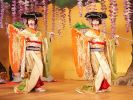
The central tension is simple and inexhaustible: birthright versus earned right. Kabuki is, in many ways, a blood art, a world where heirs are raised into roles, where names and pedigrees function like passports. Shunsuke holds the obvious advantage. He is the son, the inheritor, the one who belongs. Kikuo has only the work, the discipline and the frightening velocity of his talent. The narrative is most alive in the discomfort this creates. Shunsuke’s mother Sachiko (Shinobu Terajima), watching Kikuo’s progress, can barely hide her alarm. “He absorbs everything like a sponge,” she observes, “so bottomless, it’s scary.” Hanjiro’s response is both praise and omen: an “empty vessel, a natural-born onnagata”. Greatness is admired, but it is also feared, especially when it comes from the “wrong” bloodline.
What makes this dynamic work is that it refuses to paint either boy as a villain. Shunsuke is not merely entitled, and Kikuo is not merely pure. Their bond is real, and so is the pressure that corrodes it. The rivalry does not arrive as a plot twist but a consequence of the world they have entered. When your identity is tied to a craft that doubles as a family legacy, another person’s talent can feel like an invasion.
Running beneath this is a harsher idea about the curse of the artist, and the narrowing of a life in service of a single excellence. Kokuho suggests that to be exceptional at something like kabuki, you may have to become incompetent at most other forms of living. The performers move with the precision of ritual, yet their private lives often look improvised, fractured, or underdeveloped, as if the discipline required for stage mastery drains the capacity for ordinary stability. Art is not simply what these characters do. It is what they have allowed to replace everything else.
Kabuki sequences are staged with reverence that stops short of worship. The performances are thrilling, emotionally direct and physically exacting, but they function as narrative instruments too. Each dance carries a faint echo of what comes next, foreshadowing the next turn in Kikuo and Shunsuke’s story without spelling it out. The stage becomes both mirror and prophecy, expressing what the characters cannot say plainly in life.
The screenplay’s layered authenticity is inseparable from its literary origin. Kokuho adapts Shuichi Yoshida’s novel of the same name, and that background registers as texture rather than trivia. The work feels written from inside the machinery of theatre, from the hierarchy and etiquette to the politics of patronage, and the quiet humiliations that accumulate behind the curtain. It never treats kabuki as a museum piece. It treats it as labour, and as social order.
One of the most resonant lines arrives as a blunt articulation of the system. Hanjiro tells Kikuo, in essence, that in the kabuki world you are nobody if your father is not a kabuki actor, and if you do not have bloodline protection, all you have to fight the detractors is kabuki itself. Master the art and it becomes a kind of revenge, stronger than swords and guns. It is a startling formulation, art as weapon, art as proof of worth, art as the only legitimate form of self-defense allowed within a gated culture.
That idea opens into a broader sting, the way modern society licenses, segregates, and aristocratises art, making it simultaneously sacred and restricted. Kokuho is alive to the paradox. We romanticise artistic excellence while building structures that ensure it is inherited, gatekept, and policed. This is not preached. It is dramatised through the boys’ lives, through who gets welcomed, who gets tolerated, and who must become undeniable in order to be allowed to stay.
Formally, the passage through time is handled with rare grace. The story leaps forward in carefully judged steps, and the editing makes these jumps feel almost seamless, less like chapters than like breath. Decades pass, faces age, relationships warp, yet the transitions arrive with such quiet confidence that the viewer rarely feels the gears shifting. It is one of the feature’s great achievements. A life devoted to performance becomes its own clock, repeating roles while the body steadily betrays the illusion.
Kokuho is not simply a backstage drama or a rivalry narrative. It is a film about what a tradition demands from those who want to embody it, and what it refuses to give back. It asks whether mastery can ever be separable from sacrifice, and whether the “national treasure” is the art itself or the human beings consumed to keep it alive.
Reviewed on: 05 Jan 2026


Director: Sang-il Lee
Writer: Satoko Okudera, Shûichi Yoshida
Starring: Ai Mikami, Takahiro Miura, Emma Miyazawa, Nana Mori, Masatoshi Nagase, Kyûsaku Shimada, Mitsuki Takahata, Min Tanaka, Shinobu Terajima, Ken Watanabe, Ryûsei Yokohama, Ryô Yoshizawa
Year: 2025
Runtime: 174 minutes
BBFC: 
Country: Japan
Search database:
