 |
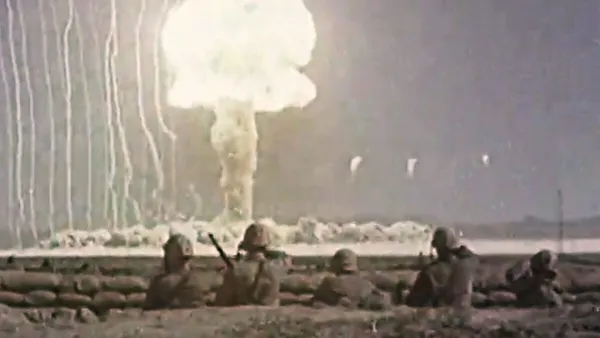
| Soldiers in a trench witness an atomic test in Our Planet, The People, My Blood |
Speaking with director Daniel Everitt-Lock about his new documentary, Our Planet, The People, My Blood, I explain that it’s the latest of several films I’ve seen on this subject. Every time I see one, what it has to say is more horrific and more enormous in scope than the one before.
The film looks at the subject of atomic weapons testing, collecting the testimony of survivors from around the world. Not victims of war (although it does at one point address the bombing of Hiroshima) but, primarily, people who happened to live near where weapons were tested, or inadvertently spent time in contaminated areas, or were deliberately exposed to early weapons to see what they would do. Those people and their children, their grandchildren, their great-grandchildren – because the genetic damage continues to injure and kill people to this day.
I ask Daniel if previously classified material about tests is only now emerging.
“Yes and no,” he says. “Absolutely there is pre-existing knowledge there and I think that would be available to the public somewhat. A lot of it is, and a lot of it is just not really publicised. The Atomic Veterans have been campaigning for decades. They were subject to the test almost 70 years ago, back in the Fifties and Sixties. There's been cases like the Rosenblatt case that we cover in the documentary, back 10, or 15 years ago, but we look at new evidence and new things that have come out. And then obviously, with our global perspective, there are different communities around the world that have been affected by the nuclear weapons tests.
“There are, obviously, the initial problems that were caused when testing was happening between the Forties and the Nineties. But it's the legacy of what is left over from that, and how those effects are still very much ongoing today – really getting worse because it passes down from generation to generation, so you look at the Marshallese and really there is nothing that's got any better for them. The health issues that they've had are now just being passed down from generation to generation. And the impact of the testing on those islands, for instance, is very different to the impacts that the Hibakusha had, who survived Hiroshima and Nagasaki, and the Atomic Veterans and stuff. Each of these communities has had these effects and they pass down through the generations in different ways.”
I mention the 2010 documentary After The Apocalypse, about Russia’s tests in Kazakhstan, people there were saying that they thought that it was getting worse, into the fourth generation.
“Yeah, exactly,” he says. “That is part of the problem. Kazakhstan, unfortunately, we didn't get to. We've got a more global perspective. We tried to cover as much as we could. Obviously budget was a limiting factor. We made this thing on a. On a shoestring budget. We did as much as we could. Kazakhstan is one of the very much worst affected places.
“The documentary started out as just about atomic veterans, because that is all I learned about initially. And then when we met our main subject, Alan Owen. He runs this organisation called Labrats that he started. He's the son of an Atomic Veteran, so he's one of the descendants. His family have been hugely affected by the tests as a result of his father's service, and through his discovery of what his dad had gone through, Alan started campaigning for these guys. He eventually realised that there's all these different global communities that were not talking to each other.
“He started Labrats to not only represent the atomic veterans in the UK but to also get all of these global communities to talk to each other and actually help each other in their campaigns, in what they're trying to achieve for recognition and compensation. And so he introduced us to all of these other global communities and that was what made us pivot into this thing, taking a really unique perspective and taking a global look at all of these things, and showing the evidence.
“For a lot of these communities, the burden of proof is put onto them for any kind of compensation. But if you look at it in a global perspective, you can see so clearly how all these communities have been affected by the same thing, and how it affects each of them in very similar ways. It creates a very obvious pattern. So we thought ‘Okay, how can we maximize as much of these communities as possible, and tell as much of a global story as possible, with a really small amount of money?’
“I was living in Toronto at the time, so that gave me more immediate access to the US. I'm originally from the UK and I've moved back to the UK now, so I had access to the UK – so doing those two was quite an obvious thing. And what we kind of discovered is that within the US we could interview subjects from the downwinder communities and uranium mining communities. We could meet with Hibakusha that had moved from Japan over to the US. So that covers three different communities. And then there's the Marshallese. There's communities of the Marshallese that live all over the US, particularly in Hawaii. And then obviously there's the US and UK atomic veterans, so that became a thing that we covered as well.
“Eventually when we started diving deeper into the UK story. We thought it was kind of necessary to talk about the Australian communities, so we ended up going out to Maralinga and meeting with the indigenous communities out there to see how the British test had affected that community as well. So then we had these six different communities that gave us enough of a global perspective.
“If we had more money, I would have loved to have met with one of the French Polynesian communities, the people from Kazakhstan in the Polygon, and stuff, but we had to make decisions.”
There hasn’t been much, in cinema, about the British tests, I observe. It will be interesting for UK audiences to see this as not something limited to remote superpowers, but something our governments had a hand in too.
He nods. “Yeah, yeah, that's the thing. I mean, if you look at people within the US, like I said, there's all these different communities. If you look in the UK, really, it is only the atomic veterans and their descendants. Now that community still accounts for literally hundreds of thousands of people, which is crazy, but what there isn't, for instance, is an indigenous community in the UK. There was no testing that the UK did that took place in the UK, you know? The UK moved it all as far away as possible because they knew about how incredibly bad the impacts of these tests were going to be.
“The UK originally planned to test nuclear weapons somewhere off the coast in the north in the UK, and then the scientists realised that this would be the absolute worst idea ever because all this fallout is going to impact all across the UK, so they moved as far away as possible. They went out to Australia, literally the other side of the planet, just to keep it as far away from the UK as possible.
“All of these countries that did the testing, in a lot of cases, they never tested on their own lands because they were well aware of the impacts of what they were doing. You know, the UK tested out in Australia. Australia and the US tested out in the Marshall Islands. They did do in tests in Nevada and New Mexico as well, but they were the smaller weapons. The thermonuclear weapons that were a thousand times larger than a lot of the ones they tested in Nevada and the ones that were dropped on Hiroshima and Nagasaki, they moved out to the Marshall Islands in the middle of Pacific, nowhere near the US. Even Russia tested them out in Kazakhstan. All these countries didn't really test in their own lands, other than China.”
I ask how much he knew beforehand and how much he discovered during the process of making the film.
“Honestly, I didn't anything about this before starting this,” he admits. “How this all began was a short documentary that Vice had put out about 10 years ago about these atomic veterans and experiencing the bomb. They talked about how they were told to stand, in some instances, about 20 miles away from the explosion. They were told to stand with their hands in front of their eyes and close their eyes, facing away from the explosion. And even then the flash from the bomb was so bright that they could see all the X ray of their hands and the people in front of them, through their closed eyes.
“There’s thousands of soldiers that attested to seeing this crazy thing. It was just this insane story that I'd heard nothing about. And then it kind of became this little bit of a thing of talking with friends and family, and discovering that a lot of people didn't know about this. It's just such a mad concept. It's like, how do people not know about this part of history? And it became this thing for me. I realised that it's not really part of anybody's education. It's left out a lot of coverage within the news and all this kind of stuff. And it was a thing that I believed would make a really good documentary.
“That’s how it started. And then, you know, several years later, once I got into a position where I had the opportunity and the experience in the documentary world to make my own documentary as a director, that's when I really started learning more about the subject. Major things that pushed that learning curve were obviously Alan Owen and the Labrats, and discovering more in the global communities. And then another one which was really interesting was Professor Robert Jacobs, Bo Jacobs. He was a professor at the University of Hiroshima. He's originally from Chicago, I think, and he wrote this book called The Global Hibakusha, which is basically a look at how the over 2,000 nuclear weapons tests taking place across the world have impacted everybody to some extent. That book really became a staple of really everything we were trying to say. And so our interview with Bo actually lasted about eight hours or something. It was crazy shooting him in this boiling hot studio. The poor guy, I think we really put him through his paces.”
We discuss the structure of the film.
“The absolute priority was to bring it down to the individual story, and to the really intimate nature of interviewing a singular subject within the community, and to use that as a representation of this global thing,” he says. “Something one of our subjects, Mary Dixon, actually said, which completely mirrored what we were doing with the documentary, was ‘You can tell the facts and you can talk about how a million people were impacted, and for an audience member or somebody, anybody, it's so difficult. You can't really imagine a million people.’
“You know, you think of when you go to a full stadium for a really big sporting event, you maybe have 70,000 people or something. I think a million people is just too hard to really comprehend. When you bring it down to the individual and you put a face to that story that represents those million people, and they give their real opinion, in that subjective moment with that person – if you can capture them in a way that is really intimate and really close – then that is so much more impactful, emotionally and thoughtfully, than the fact that a million people are impacted by this thing. So the focus was to bring it down in the most analogue and organic way possible for the money, to bring this really intimate and close perspective to the subject.
“It was the most amazing journey. Obviously it was incredibly eye-opening, but emotionally it is quite a difficult thing to do. You do have to put some kind of perspective on it. When I started this film, it very much was a film to me. The idea was that this would make a great documentary and get seen by lots of people. And then very soon afterwards, meeting with these people, it completely flipped and it became this thing of, like, these people's stories need to be heard.
“The level of injustice is absolutely outrageous. It became like a mission, really, to get this seen by as many people as possible, because it needs to be seen. It's so incredibly unfair that these people have been treated like this for so long, never had any real recognition or compensation that actually kind of justifies what was done to them. So, yeah, it changed.”
At a professional level, he will now be moving on to other things, he says. But at a personal level, it’s different. “I’m very closely connected with the people within these communities now, and I want to help in any way that I can. So that's really beyond the documentary.”
Our Planet, The People, My Blood is in UK cinemas from 12 May. Find out more here.