 |
| The Mortuary Assistant |
American director Jeremiah Kipp’s supernatural horror The Mortuary Assistant is an adaptation of the video game of the same name, co-written by Tracee Beebe and the game’s creator Brian Clarke. The story revolves around Rebecca Owens (Willa Holland), a recovering drug addict with a traumatic past, who is the newly certified mortician at the River Field Mortuary. As she settles into her role, she begins to discover the secrets kept by her mentor, funeral director Raymond Delver (Paul Sparks), and is thrust into a nightmarish ordeal when the corpses are possessed by demons.
Kipp has previously directed Slapface, which centres on a young, lonely boy who encounters a monster in the woods, and the Sixties-set thriller Sins. He has also directed the bookshop set short film Don’t Pick Up, starring Keith David and Kathryn Erbe, and the horror short Dark Roads, about a stranded couple who realise there may be something lurking in the shadows.
Speaking with Eye For Film, Kipp discussed opening up a cinematic world for his audience, prioritising story and themes over technical wizardry, and not wanting to feel nauseous from eating too many M&Ms. He also spoke about grounding the film in the audience’s reality, his love for Don Coscarelli’s Phantasm, and its influence on his female protagonist.
The following has been edited for clarity.
Paul Risker: There's the adage about first and lasting impressions. The Mortuary Assistant's opening image is a powerful one that immediately commands the audience’s attention. What was your thought process behind this visually striking opening?
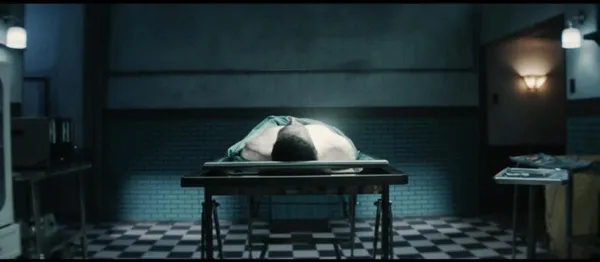
Jeremiah Kipp: The opening image of a movie is always key. We wanted something that was impactful, visceral, and shocking — the title of the movie is The Mortuary Assistant. We wanted to let the audience know right away, this is what you can expect from our story.
From that first image of the body with the wires coming out of the mouth and seeing Rebecca Owens at work, snipping the wires, pumping the blood out of the body and putting the embalming fluid in after an incision, we wanted to pull the audience into Rebecca's world.
It was the same principle as Dawn Of The Dead, where it’s of course shocking the first time you see a zombie shot in the head. So, after a while, you're going to get used to what Rebecca does for a living and, to me, that's not the scary part of the movie. We're all going to die. Death is universal; it awaits us all. We are even afraid of what happens to us after we die — who is taking care of and touching us. But when I was preparing the film, most of the mortuary assistants that I spoke to were some of the most empathetic and kind people. They were very shy, but also very tender towards the dead. And so, we not only wanted to pull the audience into Rebecca’s world, but we also wanted the audience to get used to who Rebecca, the person is.
She is more comfortable at work than she is in her personal life. Her apartment is like a hotel room, and the mortuary feels more like a home for her. Taking care of the dead, she knows where everything is and how everything fits. Her life outside is filled with struggle — she has a one-year chip for Narcotics Anonymous. The dead are less complicated than the living. Human beings are strange and unpredictable animals, but the dead are not going to talk back to you, or at least you don't think they will until demonic forces are at work.
I found the mortuary science of it all rather captivating, and because we knew we were going to be filming these special effects in tight close-ups, we even had a medical lens that we fitted on the camera called the probe lens, that allows you to get very close to the wounds. Our special effects artist, Norman Cabrera, is a very experienced FX artist. He was a protégé of Rick Baker's, and he has been around forever. He was very studious about the whole thing and once he knew that we were shooting the special effects up close, he said, “Send me the photographs of every actor that you cast as a dead body, so that I can match their skin tones and their body types.” There can be no margin for error if you're getting that close, and you want it to look hyperrealistic.
I was very pleased with the opening scene, especially when I saw that the audience were affected by the grossness of it. And then, over time, how they gave way to accepting this is the world our story is set in.
PR: A thought that occurred to me while watching the opening scene is how, for the deceased, life’s journey is now over. For Rebecca, who is completing her final assessment, it’s the end of the beginning of her professional journey. This juxtaposition of the end versus the beginning struck a nerve. Of course, death is a part of life, but accepting this doesn’t necessarily make it more comforting.
JK: I make these films because I want the audience to be pulled into an emotional or a thoughtful response. The journey is harder than the end of the journey. At the end of the journey, you're at a point of departure. But if you're on the journey, like Rebecca is, the demons are binding themselves to her. They’re speaking in the voices of depression, addiction, suicidal ideation, and guilt. And those are the things that can kill you with a living death.
Once those things latch on to you, then you have to wake up the next morning and deal with them all over again. And the next morning and the next, unless you choose not to, and that's scarier to me than taking care of somebody who is gone. But once you're a vessel for the dead, it's easier than dealing with the mundane cruelties of ordinary life.
PR: A film is constructed from multiple layers, and as a filmmaker, you are trying to create a cohesion between the aesthetic and these other layers that emphasise character, emotion, themes and ideas.
JK: The technical requirements of the medium need to follow the story and themes, which have to come first. You need to ask what the scene is actually about, and then you use the camera and the edit to illustrate it. You can't lead with flashy technique, and if I see that, I feel like I'm eating too many M&Ms, and I feel sick afterwards. But if a film is using the medium to convey a thought, a feeling or a question, then that's always pretty exciting to me.
Whenever we were breaking down a scene into its components or shots that we were going to use, we’d ask, "What is the scene actually about? How are we supporting that with the visual medium?” And I think horror movies are wonderful for that because there's a thing on the surface, which is the thing that unnerves or scares you, but then there's the thing underneath, something in our humanity that makes us afraid. But what is that, because monsters are just distorted versions of our own humanity.
I think what attracted Brian Clarke to me doing this movie with him was in Slapface, you’re seeing human behaviour that is awful. You're essentially seeing child abuse, and watching outside the window is a monster. What’s worse? Is it human behaviour or the creature that is lurking? And I thought The Mortuary Assistant as a game had a very interesting proposition. Its minimalism allowed you the space to really think about what was bothering you in those scenes, and by giving you that space, it personalises the experience for you, the player. And our ambition for the film was to create a space for the viewer to meet the movie halfway.
PR: And by creating space for the audience to enter the film, they come to feel that Rebecca’s demons are an extension of themselves.
JK: That's exactly right, and I love horror because the audience projects so much. It underpins the entire trope of the 'Final Girl'. We put ourselves in Jamie Lee Curtis’s position in Halloween, Amy Steel in Friday The 13th Part 2, and Marilyn Burns in The Texas Chain Saw Massacre. What is most specific is most general, and so, you want to make the characterisation more specific.
Willa Holland is not a mortician, and she doesn't believe in demons, but she pulled in a lot of things from her personal life to fill out the character. What are the things that are relatable to Willa and Rebecca? Willa grew up in Hollywood. Her next-door neighbour was Steven Spielberg, who was like, “Kid, you should be a star.” And her stepdad was Brian De Palma. So, she was thrust into this world.
She was six years old, and she had 300 people with caps on, pointing lenses and lights at her. She spent more time on the make-believe of film sets than she did making friends in school — her human connections with other kids were practically non-existent. And when she was around kids, she didn't really know what to do because she was used to working on movies which exist in a non-reality, essentially on a construction site.
That was her whole life, and when she was a teenager, she worked on stuff like the OC and then Arrow. It was one thing after another and looking at it as an audience member, you're seeing strength upon strength, work upon work. But Willa desperately wanted to connect with parts of reality, and I think what attracted her to Rebecca Owens was having experienced that situation of being blocked from reality.
I thought that Willa was able to personalise the role in a way that made it very specific, particularly in the Narcotics Anonymous scene where she wanted to honour people that she knew from the programme. She was calling up people and asking them about the monologue, working to personalise it for herself.
It was an incredible scene to shoot because she'd gone so deep into the lives of these people who had been in the programme in order to represent them on screen. She was really honouring them, and when an audience projects onto a character, the more that the actor has done to live inside the shoes of that character, the more the audience will see an honest depiction of somebody, and they will relate and respond to that in some way. And Willa was particularly sincere and honest in her portrayal.
PR: The horror in The Mortuary Assistant is offset by a compassion and sensitivity that is commanded by the protagonist’s shy and introverted nature. There’s the thought that it's important to have a character be sympathetic to engage the audience, but I’d argue sympathy is secondary to a character being interesting.
JK: It's an essential element in horror to care about the character, but they don’t need to be a good person. Travis Bickle in Taxi Driver does some pretty bad things, but when he's on the phone trying to talk to Betsy, and the camera can't look at him anymore, and it moves away, you feel a lot of sympathy for him. And it's because Scorsese and De Niro have created enormous sensitivity for this character. And you know, we've all been in that given circumstance.
Another reason why I like the Narcotics Anonymous scene is we haven't all been chased by demons, but in that moment it’s public speaking, which a lot of people who are shy, don't want to deal with at all. And in that first scene, doing her final exam, she's being watched by Raymond Delver, the funeral director, who comments on her work. Anybody who has been through a high-stress job interview knows what that feels like.
In a sense, we are trying to pull the audience into Rebecca as a character and engender sympathy for her. We are doing that by creating situations for the audience where it'll be like, I've been there; I've been in that given circumstance, I know what that feels like. So, when the rest of the events unfold, the audience accepts it when those supernatural elements come crashing in.
Spielberg did a great job of this in his science fiction fantasy ET, because before the alien even shows up, there are so many specific elements of childhood, like playing Dungeons & Dragons, Coca-Cola cans, scraped up wooden floors the kids play on. Also, Stephen King will make references to things that you experience in real life, so that when the horror comes in, you've already accepted that you're in a reality that is yours. Relatable circumstances in movies are always a good way to plug an audience in, and in The Mortuary Assistant, get them on Rebecca's side before the hellfire ensues.
PR: There is, as you’d expect, the intent to use darkness to create an oppressive claustrophobia. While you assert story and theme come first, horror is a genre whose visuals play a role in defining it. With that in mind, how did you approach the film’s cinematography?
JK: The director of photography, Kevin Duggin and I talked a lot about darkness — what you can't see in the dark and then what we want the audience to see. That’s always a tricky proposition in movies. You want the audience to see the sinister thing, but you also don't, because what the audience doesn't see is so much more powerful than what they do.
I thought it was very daring of Tracee Beebe, without giving away any spoilers, to place the final scene during the day. It was challenging for us to film because we were taking certain horrific elements and putting them in daylight. But I said, “We have to go for it because it's thematically relevant.” Up until then, the whole movie has been about these things you see out of the corner of your eye, that exist in the dark, and you don't really want to look at. But you have to deal with them and the moment she wants to confront them is in broad daylight.
It was challenging for special effects, and it was challenging for creating mood and atmosphere. But I thought it was very bold and daring of Tracee to write that scene because there was something exciting, in the sense that it was one of those make-or-break moments that might not work. So, I was proud of her for walking that razor's edge and moving the story out of the dark and into the light.
PR: The subject of women's representation in horror has been a controversial and divisive subject, given the gratuitous and violent nature of the genre. What does Rebecca Owens bring to this conversation, in terms of where the genre has been and what its future might look like?
JK: She has autonomy in her professional role and she’s skilled. When she's learning about the monster, she's applying that same pragmatism and sincerity. And she's the mortuary assistant; she’s not the funeral director. So, she's essentially Mickey Mouse in The Sorcerer's Apprentice. She's learning about the depths of the world around her, but she walks into that world with a sense of professional skill that she uses to her advantage against the things that are beyond her control.
Now, a movie that I really love is Don Coscarelli's Phantasm. Women do not exist in that universe, but they are objects, and they are confusing to the boys. It's about the little kid, Michael, his older brother Jody, and Reggie the ice cream man. And whenever they run into a woman or a girl, it's always like, 'Oh, how can I have sex with her?’ Or ‘I want to have sex with her, but she wants to kill me.’ So, women are objects of confusion to these boys who are far more comfortable with guns, trucks, and the barracuda car.
Phantasm is the most extraordinary fugue-state movie. It’s a wonderful film; it’s from a child's perspective, but it doesn't have Rebecca Owens in it. If it were from a woman's perspective, that would be a completely unique and interesting experience. And in many ways, I was excited about the prospect of taking Rebecca Owens and pulling her into a phantasmagoric world to see how she dealt with it.
Personally, I just identified with Rebecca. She reminded me of me when I was in my mid-20s, and I just decided that I wanted to represent that character on screen, and Willa also wanted to plug herself into the spooky ghost category. But within that, you're dealing with it on a different level because Rebecca’s trying to figure out ways of dealing with her trauma, which she doesn’t want to deal with, but is forced to. And that's the unique thing about Rebecca Owens. She's doing some of this stuff under duress, but once she's called upon to face it, then she summons it within herself and does. I thought that made her a compelling person to follow, and she’s the protagonist for me.
The Mortuary Assistant is streaming now on Shudder.